This article is published in Aviation Week & Space Technology and is free to read until Feb 08, 2026. If you want to read more articles from this publication, please click the link to subscribe.
U.S. Operation In Venezuela Shifts Defense Narrative
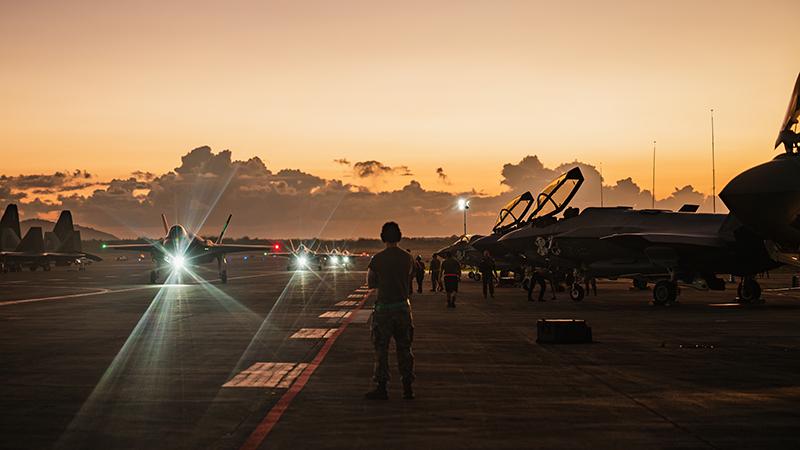
U.S. Lockheed Martin F-35 fighters and other assets operated from Puerto Rico and elsewhere to support the insertion of special operations troops into Venezuela.
The U.S. military action to snatch Venezuela’s President Nicolás Maduro and his wife from inside a heavily guarded compound marked the culmination of decades of honing airborne special operations, with implications beyond the immediate mission.
Days after the nighttime raid, the U.S. boarded ships in the Caribbean Sea and North Atlantic, underscoring the Trump administration’s plan to exert more control over the region.
- Secretive RQ-170 supported U.S. planning for Venezuela mission
- Russian air defenses fell short
The initial operation unfolded over less than 5 hr., after U.S. President Donald Trump gave the go-ahead at 10:46 p.m. EST Jan. 2. U.S. Army special operations helicopters, including Sikorsky MH-60 Black Hawks and Boeing MH-47 Chinooks, were backed by more than 150 combat and support aircraft including Lockheed Martin F-22s and F-35s, Boeing F/A-18s, EA-18s, B-1 bombers and a host of uncrewed aircraft. The secretive Lockheed Martin RQ-170 Sentinel appeared to be operating from Puerto Rico, along with many of the fighters and other assets.
All this, Chairman of the Joint Chiefs of Staff Gen. Dan Caine said, came together “in time and place to layer effects for a single purpose: to get an interdiction force into downtown Caracas while maintaining the element of tactical surprise.”
Caine said the mission, called Operation Absolute Resolve, was approved weeks before but was waiting for a confluence of events to be executed. It built on decades of counterterrorism operations, he added. The U.S. had begun deploying ships and aircraft to the region in the late summer.
After Trump’s go-ahead, assets launched from 20 locations, Caine said. U.S. Army special operations and attack helicopters flew across the Caribbean Sea as low as 100 ft. above the water. Caine said the aircraft “maintained totally” an element of surprise until the helicopters arrived at the compound to capture Maduro at 1:01 a.m. EST.
The helicopters took fire; one was hit and sustained damage but was still able to fly and complete the mission, Caine said. The helicopters responded with “overwhelming force,” he noted. By 3:29 a.m. EST, the raiding party was back over the water to take Maduro and his wife, Cilia Flores, to the USS Iwo Jima amphibious assault vessel.
Central to the operation was the U.S. Army’s 160th Special Operations Aviation Regiment (Airborne) unit, set up in the wake of the disastrous Iran hostage rescue mission in 1980 known as Operation Eagle Claw. The secretive unit has since taken part in various operations, including the effort to depose Panamanian dictator Manuel Noriega that ended in his surrender in January 1990, as well as the ill-fated 1993 mission to catch Somali warlord Mohamed Farrah Aidid in which several unit members died. The unit was heavily involved in Afghanistan starting in 2001, culminating in the 2011 raid in Pakistan that killed Osama bin Laden.
The implications of the raid on Caracas go far beyond Venezuela. Russia’s war in Ukraine had put into doubt the viability of helicopter operations on the modern battlefield because of the proliferation of man-portable surface-to-air missiles, other air defenses and explosive-laden loitering drones.
However, the U.S. action in Venezuela demonstrates that an effective helicopter raid into contested environments remains possible when combined with effective airpower and air defense suppression.
The U.S. mission also raises questions about Russian and Chinese military equipment critical to Venezuela’s defenses. Only weeks earlier, standing before state TV cameras on Oct. 2 in Caracas, Venezuelan Defense Minister Vladimir Padrino exuded confidence even as U.S. naval, air and special forces massed in the Caribbean region, aimed squarely at his country.
On that autumn day, Venezuelan air defense radars—including some of China’s and Russia’s most advanced systems—had detected stealthy F-35Bs about 46 mi. north of the country’s coastline, he said, noting that they were flying at 35,000 ft. and 400 kt.
“We are watching you,” Padrino added. “And I want you to know that this does not intimidate us.”
The U.S. raid also came less than two months after the Venezuelan Air Force flexed its capabilities. Outsiders had speculated that the service’s aging fleet of U.S.-supplied Lockheed F-16A/Bs and more recently acquired Sukhoi Su-30MK2 fighters could no longer pass an airworthiness evaluation. But Venezuela deployed detachments of both fighters to La Orchila Island, 160 mi. north of Caracas, on Nov. 14. The Su-30MK2s were observed carrying Kh-31A anti-ship missiles over the Caribbean, even as the USS Gerald R. Ford carrier strike group operated there.
But Venezuela’s Air Force, still considered among the most capable in Latin America despite its age, proved no match for the U.S. aerial strike package. Outmatched in almost all respects against F-22s and F-35s, the Venezuelan fighters could have challenged the U.S. intruders in the sky with their Russian air-to-air missiles or threatened the raid’s enabling support ships at sea with Russian or Iranian anti-ship missiles. There is no evidence that Venezuelan fighters scrambled during the event.
On the ground, Venezuela’s largely Chinese- and Russian-supplied equipment also failed to react. In video clips posted on social media, a single, arcing streak of flame from the ground to the air signaled the launch of a man-portable air defense missile—perhaps one of the 5,000 Igla missiles and launchers that Maduro’s predecessor, Hugo Chávez, ordered from Russia two decades ago. But there was no sign of Venezuela’s surface-to-air missile systems, which include Russian mobile S-300s and Buk-M2s. Caine said that U.S. cyber and space systems helped neutralize Venezuela’s air defense threat. The strike package also included radar-jamming and destroying EA-18Gs.
“Seems those Russian air defenses didn’t quite work so well, did they?” U.S. Defense Secretary Pete Hegseth quipped Jan. 5.
The raid marked another setback for Moscow’s reputation as an arms supplier. Last year, Israel meticulously took down Iran’s air defenses, which were built around Russian equipment.
It is possible to make too much out of the results of the raid based on public data. Venezuela acquired China’s vaunted JY-27A counter-stealth radar in 2019 exactly to deter this sort of attack. China’s export rules could degrade the capability released to export customers. In any event, Beijing rolled out the latest domestic version, dubbed the JY-27V, in May 2025. Venezuela’s air defense operators may not be proficient with it—or perhaps they merely decided that discretion is the better part of valor in the face of overwhelming U.S. airpower.
During a press conference at Mar-A-Lago on Jan. 3, Trump said the U.S. military was poised for another, larger round of strikes if needed.
The U.S. followed the operation on Jan. 7 with the seizure of the M/V Bella 1 oil tanker—renamed and re-flagged as a Russian vessel while at sea—in the North Atlantic. That seizure involved at least one Army special operations Boeing MH-6 Little Bird helicopter, according to images provided to Russian news outlet RT. It appears the MH-6 operated from a U.S. Coast Guard cutter that had been shadowing the ship.
Around the same time, the U.S. also boarded a smaller oil tanker in the Caribbean Sea, the M/T Sophia.