This article is published in Aviation Week & Space Technology and is free to read until Mar 14, 2026. If you want to read more articles from this publication, please click the link to subscribe.

U.S. Army Drone Dominance Vision Meets Reality In Training Exercises
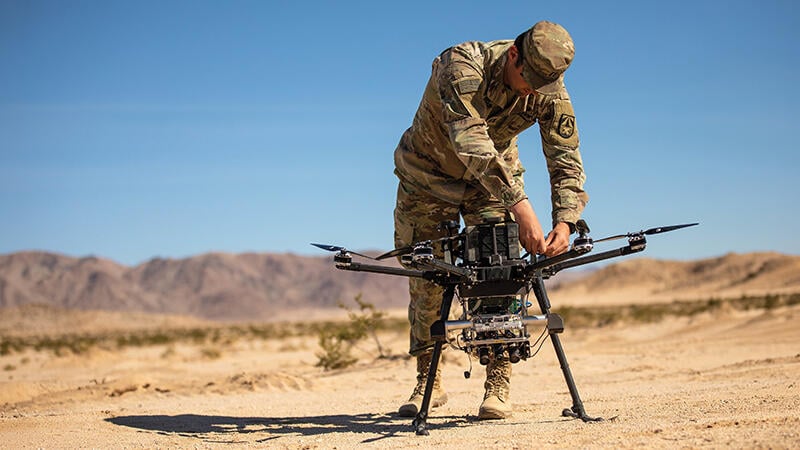
U.S. Army soldier handling drone

Soldiers learned how to integrate swarms of drones during large-scale exercises at Fort Irwin.

Credit: Sgt. Woodlyne Escarne/U.S. Army

Sprawling across the northeast rim of California’s Mojave Desert, the scrubby landscape of the Fort Irwin National Training Center is far from the fertile, rolling steppe of eastern Ukraine. But observers of recent exercises could be forgiven for noticing a similar obsession with militarized drones.

The Pentagon’s six-month-old Drone Dominance Program is intended to field more than 340,000 small uncrewed aircraft systems (UAS) by the end of next year, and U.S. Army units are scrambling.

  • September exercise exposed gaps in drone readiness
  • Power generation, battery supply and interference presented hurdles

Regiment-size units, which seldom possess more than a handful of small UAS at any time, are racing to prepare for the logistical and operational realities of fighting with hundreds—if not thousands—of drones, as they train during the large-scale exercises staged annually at Fort Irwin.

Since the Drone Dominance goal was announced in July, the returns from the latest brigade-size training events at Fort Irwin—involving dozens of hastily procured drones—show the transformational potential of operating alongside large numbers of UAS as well as the obstacles that need to be overcome to improve training.

A first attempt by elements of the 82nd Airborne Division in September illustrated the challenges of rapidly integrating so many drones into a peacetime training event. In Ukraine, millions of new UAS will be produced and fielded on the front lines this year alone, yet training with only a few dozen at Fort Irwin proved difficult.

“I wanted to swarm, but we only got four [UAS] up at any point in time, which is a far cry from the 42 that I wanted up at once,” Lt. Col. Mat Scott, commander of the division’s 504th Parachute Infantry Regiment, said at the Expanded Maneuver-Air Summit at Fort Rucker, Alabama, on Feb. 10.

Despite the disappointing shortfall, those small numbers paid immediate dividends in the regiment’s mock maneuvers. A unit of only 18 paratroopers—11 UAS operators and seven electronic warfare specialists—was credited for identifying targets for 44% of the 2,692 mortar rounds fired by the regiment in eight days of simulated combat, accounting for 241 confirmed enemy casualties, three disabled T-90 tanks and 13 BMP-2 troop carriers, Scott said.

Since this was a training event, however, the unit’s leaders are focused on what did not work. Scott, for example, analyzed why the regiment failed to strike 399 more targets detected by the regiment’s drones, including key threats, such as enemy tanks, troop carriers, radars and command-and-control centers.

In many cases, the sheer volume of targets identified by the reduced number of airborne drones exceeded the unit’s ability to summon mortars, artillery or air attacks within the eight-day event.

“We just couldn’t shoot because the fires apparatus or our own personal human bandwidth—cognitive bandwidth—wasn’t there to process it and get it done,” Scott said. “So we left a lot on the table.”

The missing swarms of target-seeking drones likely would have added to the regiment commander’s cognitive burden, but mental overload did not appear on his list of reasons for their absence.

The biggest obstacle stemmed from batteries. The regiment thought they were well supplied with 20 double-charging batteries on-site, but that was not nearly enough. The drones exhausted their batteries within 28-29 min. of flight time and then took 2.5 hr. to recharge, Scott said.

Power generation for those battery chargers also proved insufficient for a light infantry regiment. Paratroopers arrive with only the gear they can carry, so they had to wait for the logistics vehicles to roll in later. When they did arrive, reliability issues arose for the power generators in those vehicles, which struggled to continue generating electrical power when repositioned to different locations, Scott said.

The ground control stations also created radio frequency (RF) interference, making it necessary to space the stations apart by more than 35 ft. so their overlapping signals would not jam one another, Scott said.

“When you couple that with the battery limitations and the RF interference, it made for a great cocktail of ‘Hey, we’re only getting four up instead of 42,’” Scott said.

Steve Trimble

Steve covers military aviation, missiles and space for the Aviation Week Network, based in Washington, DC.