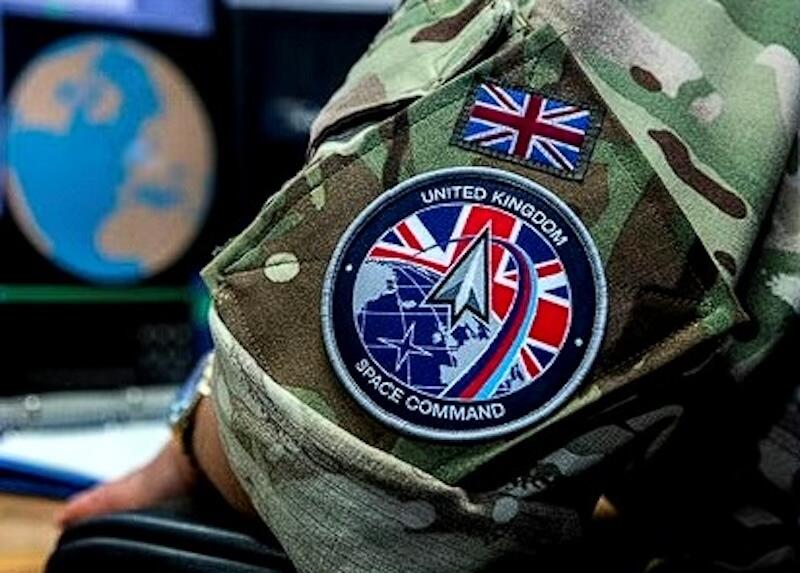
LONDON—The UK Royal Air Force (RAF) is creating a space effects squadron to protect its satellites and counter hostile activity in orbit.
No. III Space Effects Squadron will disrupt, degrade and deny adversary activity against UK interests in space, service boss Air Chief Marshal Harvey Smyth said at the UK Space Power Conference here Sept. 23.
Smyth said the UK is developing “capabilities for orbital warfare,” and that the new unit would use “actions and effects” such as electronic warfare and capabilities to counter anti-satellite weapons. He did not divulge more detail on those capabilities and whether they were shared with allies.
The squadron will expand over time as new capabilities enter service, the UK Defense Ministry said.
It would help to deter threats, defend critical space infrastructure and reduce adversaries' freedom to operate against the UK and its allies, Smyth said.
The creation of the unit comes a week after U.S. Air Force Secretary Troy Meink declared that the U.S. had placed weapons in orbit.
The new squadron forms part of the RAF’s pivot from space domain awareness to space control, a recognition of the growing importance of space as a warfighting domain.
Smyth said the service’s ambition to become a sixth-generation air force and increased reliance on uncrewed aircraft meant that space had become the “connective tissue” for the UK's three armed services as well as the fabric of society. Space is no longer a “supporting function, but a warfighting domain in its own right, with equal importance to the other domains,” Smyth said.
The UK has been troubled by Russian activity in orbit in recent months, with Smyth describing the activity as little different from flying an aircraft to within 50 ft. of another aircraft without coordination. “We are now seeing more irresponsible and provocative actions from our adversaries, and a disregard of the norms for responsible behavior by spacefaring nations,” he said. He pointed to recent maneuvers carried out by a constellation of five Russian military satellites that had moved “within rapid reach” of a pair of Finnish commercial satellites, maneuvers that had raised “serious questions” about Russia’s intent in space.
He also said that another Russian constellation had caused disruption to GPS signals across Europe, Greenland and Canada for 75 days between 2019 and 2026.
Several UK media outlets reported that the new squadron is making use of a ground-based electronic warfare system.
Bleddyn Bowen, astropolitics associate professor at Durham University, England, who has written on the military use of space, said the UK capability was likely to be analogous to the U.S. Counter Communications System (CCS) developed by L3Harris. CCS is a deployable satellite signal jammer, with a cone of effect that does not halt the operation of or damage the adversary’s satellite. The effects of the system are “non-kinetic and reversible,” Bowen said. He added that he welcomed the “transparency” by the UK government, noting that adversaries such as Russia have made no secret of their counter-satellite capabilities, such as its Luch (Olymp-K) spacecraft that often maneuver close to communications satellites.
The announcement of the new unit follows the RAF’s decision to redesignate its High Wycombe, England-based Air Command headquarters to Air & Space Command at the beginning of September. The new unit is one of six dedicated space squadrons that will be formed under the UK’s Space Command and outlined in the Defense Investment Plan published in June.
No. I Squadron runs the UK’s National Space Operations Center, while No. II Space Warning Squadron operates the phased-array surveillance radar at Fylingdales in Yorkshire, England.
Of the next three RAF space squadrons, one will be dedicated to space tactics and training, another will support the new Deep Space Advanced Radar Capability that the U.S. will construct in west Wales, and the last will be part of a newly established air, space and missile defense operations center.
Smyth said the new squadron was being delivered to deter conflict in space. “We will never escalate military activity in space, but we must respond responsibly to a rapidly changing environment in which threats to our critical space systems are growing every single day,” he said.

Related Content