This article is published in Aerospace Daily & Defense Report part of Aviation Week Intelligence Network (AWIN), and is complimentary through Aug 14, 2026. For information on becoming an AWIN Member to access more content like this, click here.

Spanish Air Force Vision Outlines Procurement Plans

Credit: Tony Osborne/AWST

The Spanish Air Force plans to acquire a new batch of combat aircraft through a third iteration of its Halcon program, the service’s new vision lays out.

Two earlier iterations of Halcon are acquiring a total of 45 new-build Eurofighters, but the service wants its Halcon III program to acquire what the service’s vision calls a “state-of the-art system” with advanced sensors and effectors that also can leverage emerging collaborative combat aircraft (CCA) and other emerging technologies.

But it does not say whether Halcon III will be a new alternative fighter platform.

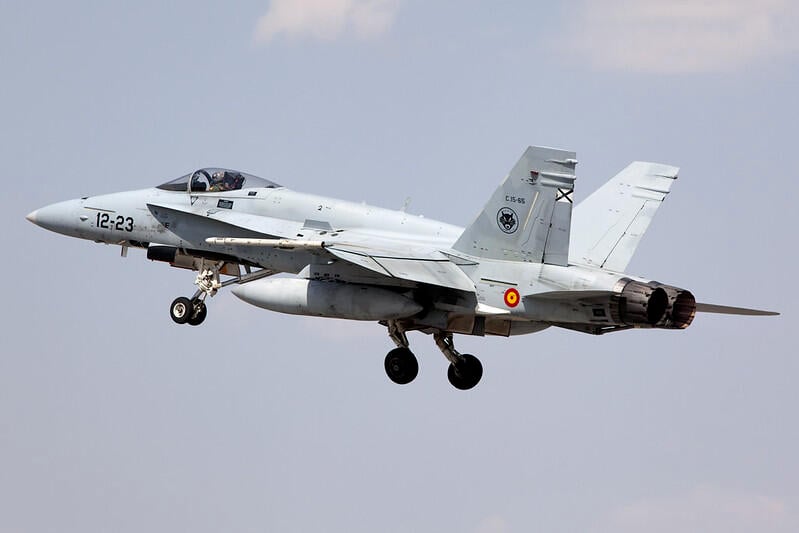
For decades Madrid has preferred to operate a mixed fleet of two or three different types. The service currently operates Eurofighters alongside U.S.-made McDonnell Douglas F/A-18 Hornets, but the latter are being phased out and the capabilities are being steadily transitioned to the Eurofighter.

Launching the vision on July 30, General Francisco Braco Carbó also revealed the service’s Astra concept for a national future combat air system (FCAS). While the service eventually wants to introduce a sixth-generation combat aircraft as a “cornerstone," the Astra concept will define the “guidelines and principles” for FCAS, which also will include a combat cloud network for distributed computing and information exchange.

The emergence of Astra comes after the collapse of the Franco-German and Spanish development of a next-generation fighter aircraft after industrial tensions between Airbus and Dassault led France and Germany to go their separate ways. Spanish industry has now teamed up in a similar fashion with Germany’s Team Gen 6 to find new pathways to the development of a new combat aircraft.

The vision also calls on the service to acquire an organic airborne early warning (AEW) platform to “complement the current surveillance, command, and control infrastructure.” AEW aircraft would provide “greater agility and reach to national deterrence capabilities,” the vision says, but no details about the number of aircraft or the timeline for their introduction are revealed. Spain has never operated a fixed-wing AEW aircraft, although air force personnel are involved in the NATO E-3 Component in Germany, and the Spanish Navy did operate an AEW version of the Sea King helicopter in support of its aircraft carrier.

The vision also commits to the restoration of the Spanish air force's electronic intelligence-gathering capability following the retirement of a Boeing 707-based platform in 2014. Last December Airbus and Indra were contracted to perform studies for a Spanish domestic development of an airborne signals intelligence (Sigint) platform potentially based on the Airbus A321 airliner.

The vision also calls for improvements to ground-based air defenses, with priority given to the “active defense” against ballistic and hypersonic missiles, drones, and electronic warfare capabilities. Spain will also enhance its deep-strike capabilities which are seen as a “primary element of strategic deterrence.”

The nation’s air bases are seen as part of its “combat system” and therefore increasing their survivability is seen as “critical,” the document says. It says the bases must now be “hyperconnected" and feature more protected infrastructure, more agile logistics, and resilient command and control networks. The service’s Connected, Sustainable, and Intelligent Air Base (BACSI) project is a strategic initiative to modernize Spanish airbase infrastructure. The air force will also embrace NATO’s agile combat employment doctrine to generate sustained combat air power through dispersal, the vision says.

Carbo said the changes are not a “goal” but a “path” that reflects changes in the geopolitical environment, including Russia’s invasion of Ukraine. 

He said the vision is to be a “stable and functional reference” with “flexibility to anticipate emerging changes.”

Click here for a Spanish language pdf document on the Astra FCAS concept.

Tony Osborne

Based in London, Tony covers European defense programs. Prior to joining Aviation Week in November 2012, Tony was at Shephard Media Group where he was deputy editor for Rotorhub and Defence Helicopter magazines.