This article is published in Aviation Week & Space Technology and is free to read until Feb 20, 2026. If you want to read more articles from this publication, please click the link to subscribe.

Singapore Rethinks Strike Concepts

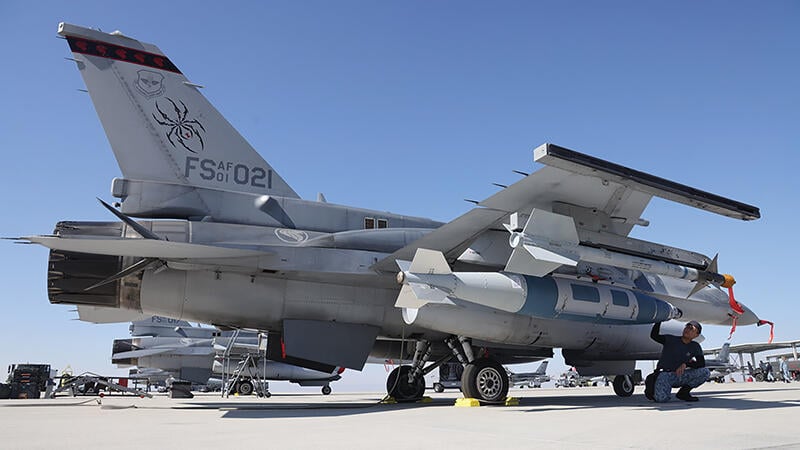
 F-16D Block 52 aircraft

This F-16D Block 52 aircraft, armed with laser joint direct attack munitions, took part in the Forging Saber exercise last year.

Credit: Chen Chuanren/AW&ST

Singapore built its reputation as having one of the world’s premier militaries by fielding advanced equipment, such as souped-up Boeing F-15s, Lockheed Martin F-16s and soon F-35s. But recent conflicts have caused the city-state’s armed forces to look beyond relying on those flagship platforms to retain its edge.

For 20 years, the Singapore Armed Forces has used the continental U.S. as a testing ground to hone strike capabilities at the proof-of-concept exercise Forging Saber in Mountain Home, Idaho. Traditionally, the drill validated the military’s ability to conduct conventional strike operations using fighters, helicopters and rocket launchers. In its latest iteration, Singapore embraced a new approach.

  • Singapore pursues conventional strike concept along with emerging drone trends
  • Software-as-a-capability is driving adaptions to modern threats

Like many militaries, Singapore has been grappling with somewhat conflicting inputs. Since Russia’s full-scale invasion of Ukraine in February 2022, the narrative around warfare emphasized the utility of small uncrewed aircraft systems, with combat aircraft pushed into a standoff role in the dense air defense environment. However, Israel’s attack on Iran last year demonstrated that combat aircraft could still prevail on the modern battlefield.

“It’s good that after the Ukraine-Russia War there was the Israel-Iran conflict—both showed us the two spectrums of today’s warfare,” said Brig. Gen. Teo Soo Yeow, commander of air combat for the Republic of Singapore Air Force (RSAF).

“The Israel-Iran conflict shows that manned platforms still have to do a lot of heavy lifting,” said Teo, who led September’s Forging Saber exercise, where the service explored new operation concepts.

The key, he added, was to take the lessons from both scenarios and make sure small uncrewed air vehicles (UAV) are properly integrated with high-end combat airpower.

Singapore used last year’s Forging Saber to experiment with that shift. The RSAF deployed F-15SGs, F-16D Block 52 Mid-Life Update fighters, Boeing AH-64D Apache Longbow attack helicopters and Israel Aerospace Industries Heron 1 UAVs as part of the exercise. It augmented them with new mini drones—the Ascent Spirit, Skydio X10 and Neros Archer. The drones were used for close-in intelligence, surveillance and reconnaissance (ISR) roles, each offering distinct capabilities, such as terrain avoidance on the X10 and jam resistance on the Archer. The RSAF suggested the Archer could be adapted for attack roles.

The service also leased three Textron Aerosonde Mk. 4.7s to validate specific concepts of operations.

Lt. Col. Lim Swee Ann, head of concepts and tactics at Singapore’s UAV Command, said the construct envisages mixing human judgment and firepower of crewed platforms with the persistence and survivability provided by drones.

Singapore also used the Forging Saber exercise to hone its operational concepts to some of the battlefield challenges seen in recent conflicts, such as GPS and communications jamming. The goal was to ensure that the air force could still conduct sense-and-strike operations amid disturbances. The RSAF was tight-lipped about tactics used in GPS-denied battlespaces but signaled some of its approach by deploying with the Raytheon Enhanced Paveway dual-mode bomb that marries a laser-seeker with GPS guidance.

Lim said mini UAVs enable persistent ISR on targets from different angles and in low cloud cover. For the more challenging tasks, such as laser designation, the service will still rely on systems such as the Heron 1, he noted.

In a nod to how quickly the battlefield is evolving, Singapore also used Forging Saber to test its ability to learn on the fly. The RSAF brought its Agile Innovation Digital software to the exercise for the first time to test how its artificial intelligence-powered command and control information system could rapidly evolve with new data sources and integrate with new platforms.

A new feature of the command and control system is “Grab-a-Bomb,” inspired by ride-hailing technology. Just as consumer apps connect a passenger with the nearest available ride, Grab-a-Bomb tries to connect ground operators rapidly with the optimally available strike platform.

“The ability to adapt and refine processes in real time is actually our winning edge beyond pure capability,” Defense Minister Chan Chun Sing said while visiting the exercise.

The military already is looking at the next evolution, driven in part by the scheduled arrival of its first short-takeoff-and-vertical-landing F-35B and the resulting surge of information that the sensor-heavy fighter will deliver. The RSAF also has not yet tested the Boeing GBU-39 Small-Diameter Bomb in service, and the country’s defense ministry has said it will likely upgrade its Lockheed Martin Himars rocket system with the purchase of precision strike missiles.

The evolving training brings its own challenges. Singapore was unable to use Himars’ roughly 50-mi.-range rockets in 2023 due to range limitations in Idaho. Chan said Singapore is in talks with the U.S. about what other ranges the country could utilize.

Chen Chuanren

Chen Chuanren is the Southeast Asia and China Editor for the Aviation Week Network’s (AWN) Air Transport World (ATW) and the Asia-Pacific Defense Correspondent for AWN, joining the team in 2017.