This article is published in Aviation Week & Space Technology and is free to read until Mar 25, 2026. If you want to read more articles from this publication, please click the link to subscribe.
Back from impending retirement, Gen. Kenneth Wilsbach is tasked with reversing the U.S. Air Force’s declining readiness.
Early last fall, Gen. Kenneth Wilsbach was heading for retirement from the U.S. Air Force, having stepped aside as leader of Air Combat Command, when his phone started ringing. The question was simple but consequential: Would you like to be chief of staff?
The service was moving on from Chief Gen. David Allvin just two years into a typical four-year term. That abrupt change came amid a refocus on top priorities. The second Trump administration wanted a leader to guide the service toward its idea of “peace through strength,” which led to a scramble for a nominee.
- The service prepares for a budget plus-up
- Funding is to prioritize immediate capability
- Commanders are ordered back to cockpits
“My response was, ‘When you’re a general in the U.S. Air Force and you’re asked to serve, you do,’” Wilsbach told Aviation Week during a wide-ranging interview in his Pentagon conference room—his first since taking the role. “So that’s why I’m here. I came back for the airmen, because I felt like I had something that I could offer to make their lives better and to make the Air Force better.”
Wilsbach’s brief time as chief of staff so far has been guided by a basic overarching need. “The most important thing we do in the United States Air Force is fly and fix aircraft,” he said. “And of those two, ‘fix’ is more important than ‘fly.’”
Wilsbach and Air Force Secretary Troy Meink are refocusing a service that under prior leaders had been looking long-term. The Air Force had been operating under the idea of “divest to invest”—cutting current fleets down to free up spending for big-ticket modernization efforts. The goal was to have a more modern and capable service in the mid-2030s. This led to concern that the cuts were too deep and were making the Air Force less capable now, to the point that it would not matter so much what could happen in 2035 if the service were to lose a conflict before then.
“There is a discussion or debate about whether to take risk now and modernize later to build future deterrence,” Wilsbach said. “The risk there is that by the time you’re ready for the future, you might face a conflict you’re not prepared for. So the strategy here is to constantly improve your strength. . . . Our adversaries should never doubt that they’re going to lose.”
The administration and Defense Secretary Pete Hegseth call that goal “peace through strength.” Although the idea can seem nebulous within the Air Force, it is a relatively simple order: Be ready now. This is the “why” for focusing on fixing before flying—obtaining additional spare parts to improve fleet health and in turn allowing aircrews to fly more and become more proficient. The Air Force needs to bolster sortie rates, training missions and deployment pace so adversaries can see plainly what the service is doing, Wilsbach explained.
Good news appears to be coming for the Air Force’s coffers as the Pentagon wraps up its forthcoming budget request and President Donald Trump calls publicly for $1.5 trillion in spending. For now, Wilsbach said, the service’s budget officials are working with higher-ups at the Pentagon to determine how a potential increase could be spent—but details are not being shared yet. The service is continuing its major modernization efforts—the Boeing F-47, Northrop Grumman B-21 and Collaborative Combat Aircraft, among others—but spares and flying hours are expected to become more of a priority.
“We don’t know what the budget’s going to be, but we are prepared to respond, and we’ve prioritized all our spending,” Wilsbach said. “We will create an Air Force that the nation needs by properly applying those funds to mission capability in a number of different ways.”
This push harkens back to the first Trump administration, when then-Defense Secretary Jim Mattis called for all combat aircraft to have at least an 80% mission-capable rate by 2019. In the end, the Air Force dropped the goal, and the Navy’s Boeing F/A-18 was the only front-line fighter to meet the target. Now the Pentagon is less public about its target and no longer disclosing its mission-capable rates. But outside of the public eye, there will be a North Star—there needs to be a standard, Wilsbach said.
In his roles as leader of Air Combat Command and Pacific Air Forces, Wilsbach said he was known as the “standards general”—stressing the importance of individual appearance and fitness as well as operational standards.
As the Air Force’s chief of staff, he is pressing leaders—from commanders of major commands and numbered air forces down to wing commanders—to take a similar approach and start with one major step: Fly. Commanders cannot stay behind a desk or work from a “standoff distance” to truly understand what is going on, Wilsbach said, emphasizing that leaders need to get their fingers dirty with details and learn things that can only come from being in the cockpit.
“If you’re out there flying the mission, you will discover things you didn’t know, that nobody told you, that you have the capability to fix, sometimes on the spot,” he said.
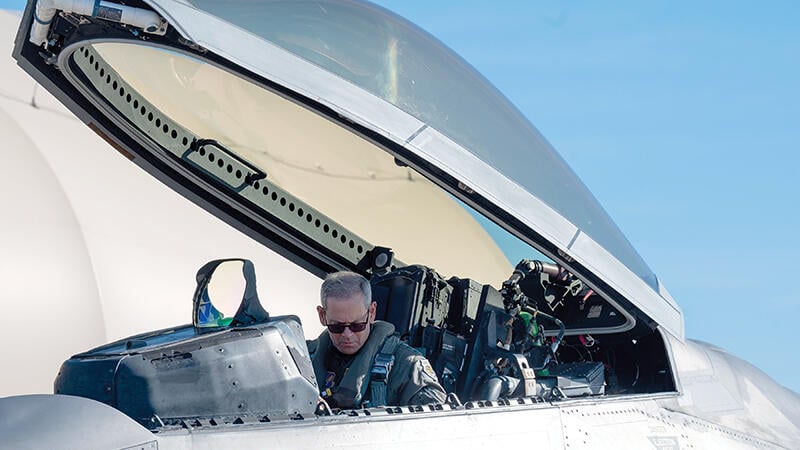
In November, Wilsbach went to Joint Base Langley-Eustis in Virginia, where he strapped into a Lockheed Martin F-22—the jet in which he finished his flying career with 6,200 total flying hours. He said that flight showed him a specific, “fairly critical” issue facing the Raptor fleet that had not been briefed up the chain of command. After landing, Wilsbach went back to headquarters to figure out how that had happened, and he said the issue is being fixed. This showed that leaders, especially at the wing level, need to know the maintenance status of their aircraft, he stated.
“Commanders should have a working understanding of what’s going on in their organizations,” Wilsbach said. “The needs that they have, the gaps that they have—they should be communicating those up so the system will respond in a positive way to get their jets fixed and in the air.”
When the second Trump administration took office in early 2025, the Air Force was well into an initiative known as the Reoptimization for Great Power Competition. Led by Allvin and then-Air Force Secretary Frank Kendall, the changes included creating a new modernization command, realigning the service’s training command and overhauling its deployment structure, among other things. However, almost all of these have since been halted.
Wilsbach said that foundationally, there were not enough resources to follow through. For example, the proposed modernization-focused Integrated Capabilities Command would take acquisition and requirements leaders from individual major commands and create a new office consisting of hundreds of personnel. The Air Force is reverting back to the original structure and keeping the requirements design within its Air Force Futures office and major commands.
Another major proposal was overhauling the deployment structure under a plan called Deployable Combat Wings. First rolled out in 2023, this would source aircraft and personnel from a sole location to deploy and run an overseas base while keeping an “air base wing” at home to run the installation. Yet the Air Force lacked the resources, money or people to make that function properly.
The service in January announced a modified version of the preceding model, wherein wings would be tapped for a deployment and send the core forward, with resources supplemented from other locations. The Air Force has the funding to do that “in perpetuity,” Wilsbach said.
Guiding many of the previous changes was the largely classified One Force Design, which set a plan for how the service would equip itself to fight primarily in a standoff role in the Asia-Pacific region. The plan’s rollout raised questions and concerns on Capitol Hill that the service is working to address. Wilsbach said the overall goal of the design was good, but the messaging has been jumbled.
“The challenge is, if you’re not an airman, you might not understand it,” he explained. “And if you don’t understand it, can you get behind it? Can you support it? Will you resource it? I’m focused on talking about our force design in a way that, if you’re not an airman, you can relate to. We’re working to refine the narrative and the way we talk about it to get it right.”
Wilsbach expressed concern that some adjustments in recent years have led to “change fatigue,” affecting how the service operates.
“What I want to do is limit the amount of change,” he said. “Every time you make an organizational change, you take away the overall capacity of the unit while they figure it out, and that reduces readiness.”