This article is published in Aviation Week & Space Technology and is free to read until Apr 02, 2026. If you want to read more articles from this publication, please click the link to subscribe.
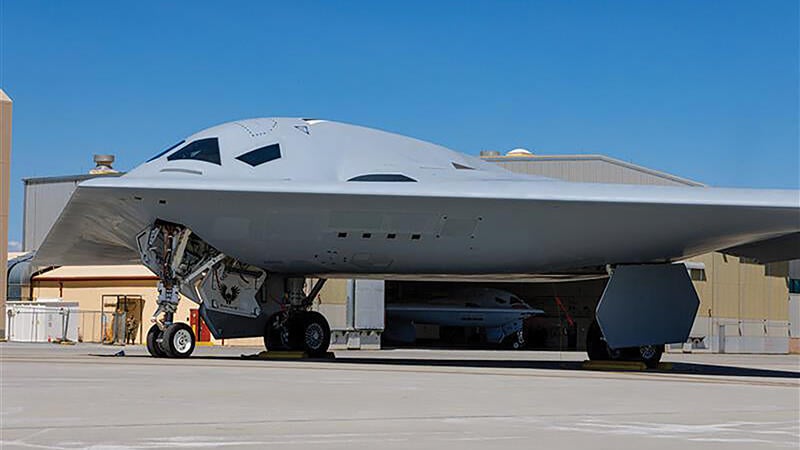
While B-21 capacity will increase, the Air Force has not outlined a new rate for production.
The U.S. Air Force is revamping its two biggest nuclear modernization efforts, increasing its capacity to build B-21 Raiders while changing its approach to fielding a massive ICBM program that has seen costs and delays spike.
Northrop Grumman runs both programs and has invested its own resources to meet the service’s demand.
- The B-21 is planned to enter service in 2027
- The service and Northrop are setting new Sentinel cost
Air Force Secretary Troy Meink on Feb. 24 announced a new agreement with the company to expand production of the bomber by 25%, using $4.5 billion provided by last summer’s One Big Beautiful Bill Act. Service officials have been quick to point out that the spending is intended to boost capacity—focused on things like infrastructure, parts and hiring—but a specific rate increase has not been set yet.
“That keeps us with open options going forward, and at the same time, it keeps them in a production posture, which is what we need, especially if you consider what we might do in the future with that program,” says Gen. Dale White, who was recently appointed as director of critical major weapon systems to oversee the two nuclear programs, among other top priorities.
The Air Force has a program of record of 100 B-21s, but key leaders in the service and at U.S. Strategic Command have voiced support for expanding that. Northrop Grumman has 21 on order over five low-rate initial production lots ahead of full-rate production, expected in 2027. The company has said it is taking $1.5 billion in cost overruns under that low-rate initial production order and expects more favorable terms in follow-on orders. The specific production rate is classified, but analysts think it is eight per year, meaning a 25% increase would bring it to 10. Two flight-test aircraft have been delivered.
In addition to the $4.5 billion in new funding, Northrop Grumman has said it will invest $2-3 billion in capital expenditures for the capacity increase. The Air Force has kept a target of $692 million in 2022 dollars per unit.
“People say, ‘Well, if you’re spending all this money, how do you call it successful?’” White says. “Because in this particular program, we manage the program against the government estimate of what we were willing to spend to get this capability, and we’re still operating underneath that number. . . . That has been our North Star, our guiding light, and technically it’s kind of our contract with Congress because it’s the acquisition program baseline.”
The Air Force expects the first operational B-21 to be delivered to Ellsworth AFB, South Dakota, in 2027.
Shortly after the B-21 announcement, Air Force leaders also updated progress on the Northrop Grumman LGM-35A Sentinel intercontinental ballistic missile program to replace the Boeing LGM-30 Minuteman III. The program was paused and is undergoing restructuring after a significant cost increase from the original projection, which resulted in a Nunn-McCurdy Act breach and revocation of its Milestone B acquisition status.
White says the plan will be set by the year-end with a new Milestone B, more accurate cost estimate and a planned launch next year. Within the past few months, the Air Force has taken a Minuteman III silo out of service to help plan the transition, and Northrop Grumman has broken ground on a prototype silo in Utah.
Silos have become the program’s biggest hurdle. Originally, the Air Force planned to reuse Minuteman III silos. However, the Sentinel is significantly larger and unable to fit in the aging silos, which are in such disrepair that the service decided it would be better to build new ones—450 across the Mountain West.
In addition to the ICBM and silos, the program is building alert facilities, wing command centers, other support infrastructure and thousands of miles of fiber-optic cabling to run through both government and private property to connect them. The infrastructure bill was the driving factor of cost growth, which was up to 81% higher than initially expected. A new cost estimate is not ready yet, officials say.
“There was just a set of assumptions that we tried to employ, and all of them didn’t work out,” White says.
As part of the review, the Air Force has “matured our understanding of silos” through testing and new cost estimates, a service official says.
The Sentinel program was originally designed in a different strategic time, ahead of China’s rapid nuclear expansion and before the expiration of the New START agreement between the U.S. and Russia. That treaty’s end leaves open the possibility for Sentinel to have multiple independently targetable reentry vehicles, although that would be a national political decision to make, explains Adm. Richard Correll, commander of U.S. Strategic Command.
The service expects initial fielding of Sentinel in the early 2030s; Minuteman IIIs will remain in service into the 2050s. Francis E. Warren AFB, Wyoming, will be the first to host the new missile.

Related Content