This article is published in Aerospace Daily & Defense Report part of Aviation Week Intelligence Network (AWIN), and is complimentary through Mar 15, 2026. For information on becoming an AWIN Member to access more content like this, click here.
Israel Strikes Tehran As 'Operation Epic Fury' With U.S. Enters Day 2
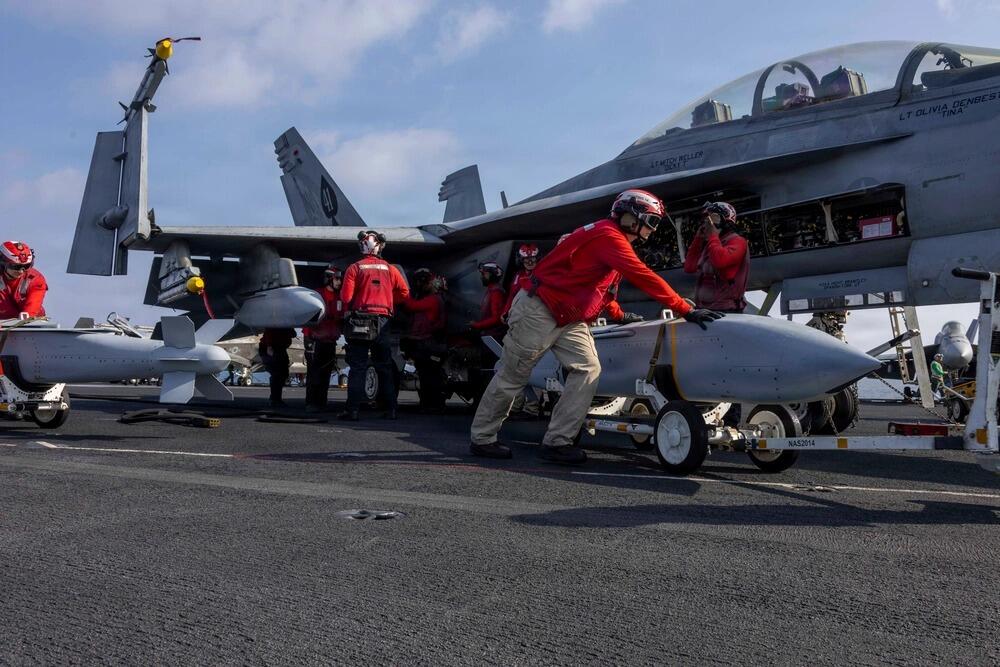
F/A-18F attached to VFA41 fighter squadron on the flight deck of the USS Abraham Lincoln.
The U.S. and Israel appeared to have secured air superiority over Iran as their military operation entered a second day during which more regime targets were engaged but the Pentagon confirmed its first fatalities.
Israel said March 1 that the Israeli Air Force had expanded its operations all the way to Tehran. Israel commenced what it calls Operation Roaring Lion by focusing on air defenses and missile launchers in western Iran, before using its air supremacy there to pave the way to the capital, the Israel Defense Forces (IDF) said. The third stage of the operation then established air superiority over the capital, achieving that goal by conducting more than 700 sorties.
"In recent hours, Israeli Air Force aircraft have been operating with air superiority in the skies over Tehran, striking and eliminating numerous targets," the IDF said.
Operation Epic Fury, as Washington is calling the campaign, began at 9:45 a.m. Tehran time on Feb. 28 and involved a sustained array of strikes from land, air and sea, including what Israel called its largest ever mission, with roughly 200 fighters in the air. Israel said more than 1,200 munitions were fired by its fighters in the opening day.
"Three U.S. service members have been killed in action and five are seriously wounded as part of Operation Epic Fury," the U.S. Central Command (Centcom) said March 1. Others sustained smaller injuries and are returning to duty, the command said.
The U.S. over weeks massed an array of forces in the region, including two aircraft carrier battle groups. Combat operations included Boeing F-15 and F/A-18E/F fighters, along with Lockheed Martin F-35s fighters and EA-18 Growler jamming aircraft.
The U.S. also fired scores of Raytheon Tomahawk land-attack cruise missiles, Lockheed Martin Precision Strike Missiles and, for the first time, employed its Low-cost Unmanned Combat Attack System drones that resemble the Iranian Shahed-136. “These low-cost drones, modeled after Iran's Shahed drones, are now delivering American-made retribution,” Centcom said.
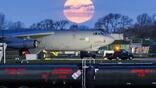
Similar to the U.S. strikes on Iran in June 2025, the Pentagon flew Northrop Grumman B-2 stealth bombers from Whiteman AFB, Mo. that struck Iran overnight from Feb. 28 to March 1. The bombers employed 2,000 lb. bombs to go after hardened ballistic missile facilities, Centcom said.
Among the other assets Centcom said it employed were Lockheed Martin F-22 and F-16s fighters, A-10 attack aircraft. Maritime patrol Boeing P-8s, intelligence gathering RC-135s, MQ-9 Reaper uncrewed air systems, Northrop Grumman Battlefield Airborne Communications Node communication relay aircraft, and Boeing E-3 Awacs airborne early warning aircraft, and refueling aircaft were among the supporting equipment. Centcom also cryptically referred to "special capabilities" it could not name.
The attacks that aimed to take down the Iranian regime killed leader Ayatollah Ali Khamenei, the country’s defense minister, head of the armed forces and boss of the regime-loyalist Islamic Revolutionary Guard Corps, among others.
"The majority of the highest-ranking senior military officials of the Iranian security leadership have been eliminated," the IDF said. The Israeli Air Force took out 40 senior commanders in what the IDF called "a historic strike that was made possible due to the guidance of IDF intelligence."
The IDF said that among the targets it struck were the headquarters of the General Staff for Internal Security and the headquarters that coordinated Tehran's defenses.
Centcom also said it struck an Iranian Jamaran-class corvette, noting the vessel was sinking to the bottom of the Gulf of Oman at a Chah Bahar pier. President Trump later said that nine Iranian navy ships had been sunk.
Iran appeared to show little direct ability to confront U.S. and Israeli forces. The IDF said, though, the Israeli Air Force struck Iranian F-4 and F-5 fighters looking to take off at the Tabriz airport in western Iran.
The bulk of Tehran's counter has focused on firing ballistic missiles and drones at Israel and neighboring Gulf states, including targeting U.S. military-used infrastructure in Bahrain and Prince Sultan Air Base in Saudi Arabia.
Tehran also struck civil airports in Kuwait, Dubai and Bahrain. In Abu Dhabi, debris from an intercepted drone targeting Zayed International Airport killed one person and injured others.
Commercial aviation was disrupted throughout the region, with Emirates Airline, Qatar Airways, El Al and others grounding flights. European and Asian airlines rerouted flights between the regions to avoid the combat zone that the European Union Aviation Safety Agency warned carriers not to use.
Oman said an oil tanker was hit after Iran threatened to target shipping in the area.
Israel, the U.S. and Gulf states employed a large number of Patriot and other air and missile defense interceptors to deal with the threat. Israel also used combat aircraft to down Iranian drones. The IDF said it it had successfully intercepted more than 50 drones, including through the use of fighters and attack helicopters.
The U.S. Air Force had F-15s armed with air-to-air missiles and Apkws rockets on drone patrol. The United Kingdom said a Royal Air Force Eurofighter Typhoon operating from Qatar downed a drone using an air-to-air missile heading toward Qatari territory.
The United Arab Emirates Defense Ministry spelled out the scale of the effort. The country's air defenses dealt with 165 ballistic missiles, two cruise missiles and 541 Iranian drones over just over the first day of fighting. It destroyed 152 ballistic missiles, with 13 falling into the sea. The two cruise missiles were destroyed. Most of the drones were downed, though 35 struck the country ,causing three fatalities and many more injuries.
The number of ballistic missiles fired at the UAE was almost as high as the roughly 180 estimated to have been launched at Israel. Qatar said 66 missiles were fired in its direction, while Bahrain said it downed 45 missiles and nine drones. Kuwait said it downed 97 ballistic missiles and 283 drones.
Centcom said it employed both RTX Patriot and Lockheed Martin Theater High-Altitude Area Defense air and missile defense systems to down threats.
The IDF said Iran, before last June's Operation Rising Lion, was on pace to build a stockpile of 8,000 missiles. It had an inventory of about 3,000 at the time of the 12 days of conflict, which set back those efforts.
Before the latest campaign, Iran produced 12 ballistic missiles per month "with a clear acceleration in its recovery pace," the IDF said. Iran also had efforts underway to safeguard the manufacturing sites by moving them underground. "The IDF will not allow the Iranian terrorist regime to restore its military capabilities and will continue to act to neutralize any emerging threat," it said.