This article is published in Aerospace Daily & Defense Report part of Aviation Week Intelligence Network (AWIN), and is complimentary through Mar 17, 2026. For information on becoming an AWIN Member to access more content like this, click here.

Israel Strikes Iranian Air Force, Space Headquarters
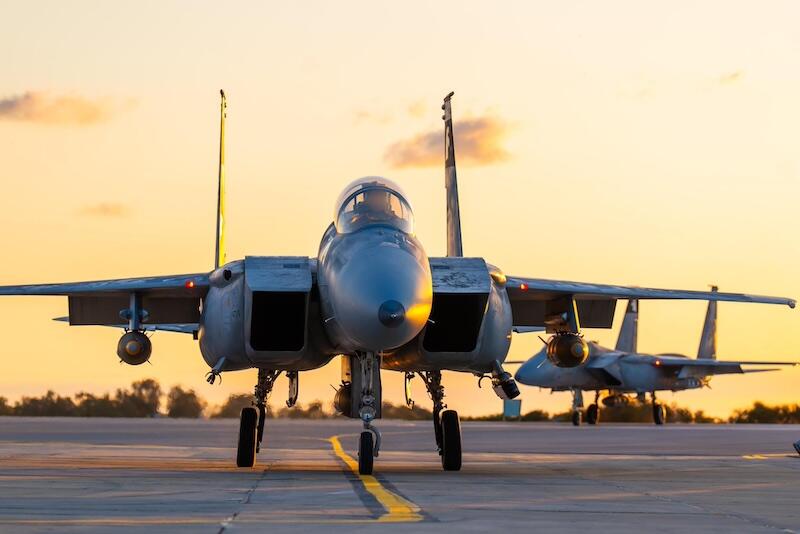
israeli fighter jets
Credit: Israeli Air Force

The Israel Defense Forces (IDF) stepped up attacks on Iranian military infrastructure after it and the U.S. said they were shifting their focus of operations to degrading the regime’s long-term military capabilities.

The Israeli Air Force struck an Iranian rocket engine production site, the IDF said March 9 as the fighting entered its 10th day. It also went after Iranian internal security forces. An IDF official said the country’s air force has been operating nonstop in Iranian airspace since the outbreak of fighting.

Over the weekend, the Israeli Air Force struck Iran’s Isfahan Airport and F-14s located there as part of Operation Roaring Lion, the IDF said. It also targeted the Islamic Revolutionary Guard Corps (IRGC) Air Force headquarters and its Space Force headquarters from which Iran controlled its reconnaissance satellites, the IDF noted. The site also functioned as a research center for the Iranian Space Agency. The IDF on March 9 added that it also went after an IRGC drone command center and storage site.

Days earlier, the Israeli Air Force destroyed 16 aircraft at Mehrabad Airport in Tehran, which Israel said Iran used to transport weapons to its Lebanon-based proxy Hezbollah. The IDF said it had now struck more than 600 targets in Lebanon in going after the group, employing around 820 air, naval and ground-launched weapons.

Israel spent months ramping up production of munitions and stocking up its inventory. “We are now working to replenish all munitions expended in order to be prepared for any scenario,” Maj. Gen. Amir Baram, director general of Israel’s Defense Ministry, said in a March 9 statement. “The decisions we made to expand and accelerate production lines in Israel before the operation will now allow us to take production rates to the next level,” he added.

Iran continued to fire ballistic missiles and drones in response. Israel, the United Arab Emirates (UAE), Bahrain and Saudi Arabia alerted citizens about incoming threats on March 9. Iran for a second time fired a ballistic missile at Turkey that NATO forces intercepted. Debris fell on parts of southern Turkey, the country’s defense ministry said March 9.

The IDF continued its effort to not just counter those attacks, but to stop them from the get-go, saying March 9 it again targeted Iranian ballistic missile launch sites. As of late last week, Israel said it had degraded about 60% of Iran’s ballistic missile launchers.

The IDF official, speaking March 9, said Iran has significantly curtailed its missile firing, to around 10 to 20 per day. In some cases, they no longer fire large numbers of missiles at once to overwhelm defenses. “Most of their barrages are small barrages,” the official said, putting the figure at two to four missiles. Israel has accused Iran of trying to use their missiles to terrorize neighboring countries, arguing Tehran is targeting civilian locations and using cluster-bomb submunitions.

Data released by the UAE, which has provided some of the most detailed accounting of threats fired by Iran against the country, illustrated that Iran still had plenty of missiles to fire. The UAE said on March 9 that the total number of ballistic missiles fired in its direction had risen to 253, 15 more than the day prior. Of the total, two made it through the air defenses and the others were either destroyed or fell into the sea. Iran also fired 1,440 drones at the country, the UAE Defense Ministry said. Qatar also said Iran fired 17 ballistic missiles in its direction and six drones.

U.S. Central Command in a March 9 statement said it had struck more than 5,000 targets as part of the operation, including damaging or destroying 50 Iranian ships. The command also for the first time disclosed the use of Northrop Grumman E-2D Advanced Hawkeyes, Lockheed Martin U-2 Dragon Lady spy planes and Lockheed Martin EC-130H Compass Call electronic warfare aircraft.

The command also said a seventh service member died from airstrikes early in the conflict, with the latest casualty occurring at Prince Sultan Air Base, Saudi Arabia. This is in addition to the six service members killed in an airstrike in Kuwait. Israel also said more than 3,000 targets were struck.

The UAE Defense Ministry said two service members died because of a technical malfunction of their helicopter in what may have been linked to counter-drone operations.

The UK said it dispatched a Crowsnest Merlin-helicopter-based airborne early warning helicopter to the region to aid in drone and missile detection. London had previously bolstered its presence in Cyprus after its base in the country was struck by a drone. The UK also said its forces had taken down a drone in defense of Bahraini and Jordanian airspace.

Turkey said it deployed six Lockheed Martin F-16s to northern Cyprus, the Turkish-occupied part of the island country. The action came after Greece and the UK dispatched military equipment to Cyprus to help safeguard its skies after a drone struck the British military installation on the island.

With airspace in the region severely constrained for more than a week now, countries also boosted efforts to help stranded citizens return home. Singapore said it was sending one of its Airbus A330 multi-role tanker transports to Riyadh on March 10, with another due later. The Netherlands sent a military A330 to the region for its first recovery flight.

The European Commission also chartered two repatriation flights to take people from Oman to Romania.

Robert Wall

Robert Wall is Executive Editor for Defense and Space. Based in London, he directs a team of military and space journalists across the U.S., Europe and Asia-Pacific.

Brian Everstine

Brian Everstine is the Pentagon Editor for Aviation Week, based in Washington, D.C.

Tony Osborne

Based in London, Tony covers European defense programs. Prior to joining Aviation Week in November 2012, Tony was at Shephard Media Group where he was deputy editor for Rotorhub and Defence Helicopter magazines.

Steve Trimble

Steve covers military aviation, missiles and space for the Aviation Week Network, based in Washington, DC.