This article is published in Aviation Week & Space Technology and is free to read until Aug 23, 2026. If you want to read more articles from this publication, please click the link to subscribe.
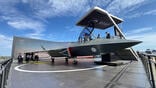
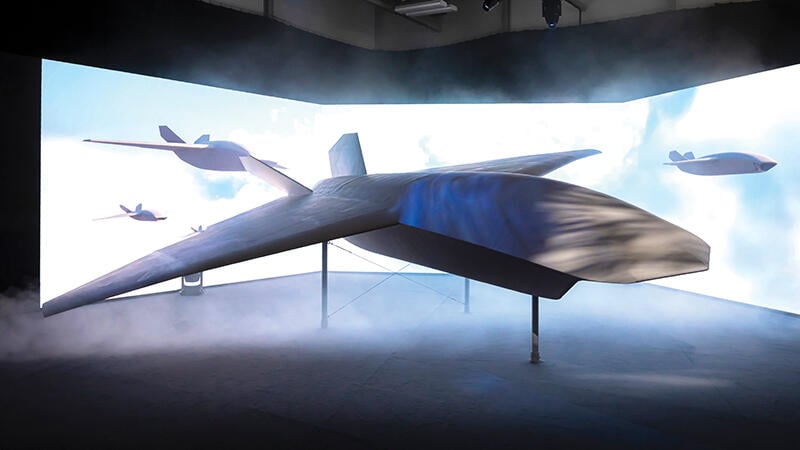
BAE Systems displayed this model of the Brontanax at Farnborough. A prototype is being readied for flight in northwest England.
Half a dozen collaborative combat aircraft concepts were displayed at this year’s Farnborough Airshow, but only one had the attention of the UK Royal Air Force.
BAE Systems’ Brontanax is set to become the service’s first collaborative combat aircraft (CCA) proof of concept—and potentially its first operational autonomous combat aircraft.
- The Diamond-wing uncrewed aircraft is planned to make its first flight in mid-2027
- BAE Systems’ FalconWorks is leading the CCA’s development
- Future versions will use the Rolls-Royce Orpheus family of engines
Named after the ancient Greek word for “thunder king,” the Brontanax has been chosen by the Royal Air Force (RAF) to demonstrate the potential of CCAs and to begin moving the service toward RAF commander Air Chief Marshal Harv Smyth’s goal of becoming Europe’s first sixth-generation air force. BAE Systems is hoping its self-funded development may eventually also find its way into the service’s inventory as the platform of choice for the RAF’s new Storm Fighter CCA program—as well as pique the interest of export customers.
The program also received the backing of UK Defense Secretary Wes Streeting, who unveiled the aircraft on July 22 during one of his first public appearances in the role. Streeting said the new UK government would be “unapologetic about backing Britain and British ingenuity.”
BAE says the 5-metric-ton-class, diamond-wing, low-observable platform—similar in size to a Hawk jet trainer—is produced almost entirely domestically, drawing on a supply chain of nearly 100 UK companies including many from nontraditional, aerospace-adjacent suppliers. The only major non-UK component is its Williams International powerplant, but BAE Systems and the RAF plan to use an emerging family of Rolls-Royce engines based on Rolls’ rapidly developed Orpheus turbofan demonstrator.
The Brontanax’s internal weapon bays can accommodate every weapon in the RAF inventory except the MBDA Storm Shadow cruise missile.
At the heart of the aircraft is a BAE-developed vehicle management system with software that leans on the Pyramid reusable and open avionics system reference architecture that is owned by the UK Defense Ministry.
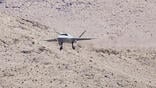
Although BAE displayed a model of the Brontanax at Farnborough, the company has assembled a pre-production prototype at its Warton facility in northwest England. BAE expects to power the aircraft on by the end of this year and begin ground tests in the first quarter of 2027 before beginning flight trials in the UK in the second quarter.
If all goes to plan, the RAF hopes to debut the aircraft during NATO’s Steadfast Defender exercise in 2027, flying alongside a Eurofighter Typhoon.
“This is not a demonstrator, but we will be demonstrating with it,” Dave Holmes, the director of BAE’s FalconWorks aerospace research and development arm, told reporters following the unveiling. “Our ambition is that we see this meeting requirements not only in the UK, but also featuring with allies as well around the globe.”
RAF officials said emerging threats have spurred CCA development. The service’s analysis has long recognized that fleets of autonomous uncrewed adjuncts can provide additional combat mass while improving situational awareness, persistence and survivability of crewed fighters. But the RAF did not expect to have the resources until the late 2030s to develop a CCA to accompany the sixth-generation Global Combat Air Program platform currently under development (page 16). The government’s Defense Investment Plan, however, is now accelerating the CCA effort with an initial £300 million ($400 million) of funding.
“This is not just launching something to be in the market,” BAE Senior Military Advisor Gerry Mayhew said. “The need to have this combat mass is clear, and that’s why we’re driving so hard and fast.”
Although BAE began conceptual CCA development in 2022 under the code name Pegasus, company engineers were able to lean on nearly two decades of uncrewed aircraft systems experience, with the likes of Corax, Herti, Mantis and Taranis. Holmes said the Brontanax’s range and endurance will be key differentiators in an increasingly crowded CCA market. The airframer is also targeting what Holmes calls a “sweet spot” that balances capability and cost by producing a platform able to perform 70-80% of the Eurofighter’s missions, but at 20-25% of the cost.
Holmes’ view is that deviating from that sweet spot raises costs and could inadvertently invoke Norm Augustine’s 16th law, which prophesies prices of military aircraft growing exponentially.
Lessons from the RAF’s previous attempt to develop a CCA demonstrator—Mosquito—have also shaped the Brontanax. The Mosquito’s development was halted in 2022 before assembly was completed. Among the lessons learned from that effort is not to overengineer such platforms, as doing so generates what Holmes called “parasitic cost.”
Instead, the Brontanax has been engineered to have a service life of just a few hundred hours, compared with a crewed fighter’s several thousand hours of service life.
Beyond developing the air vehicle, Holmes said the company has also been considering how to deliver the platform and make sure it can be enhanced in “calendar weeks” rather than the “calendar years” associated with the upgrade of current-generation crewed fighters. The company is exploring the potential of a production system that could be not only “fractionated and distributed to partner nations” but always on—and “doesn’t care what it is making,” Holmes said.
That would avoid what he described as the “astronomical cost of the engineering, the tooling, all of the infrastructure that goes with it to launch a big program.”
BAE says the Brontanax could also be adapted to support the Royal Navy’s CCA needs, as that service attempts to establish a hybrid air wing for its Queen Elizabeth-class carriers. Holmes said an iteration of the aircraft—modified with a toughened airframe, landing gear and arrestor hook—could meet the requirement for launch and recovery from the carrier without a need for catapults. Furthermore, because of the modularity of the airframe, these modifications could be performed on the production line.
If realized, that would allow a common autonomous aircraft family to support both RAF and Royal Navy operations without requiring a separate platform development.