This article is published in Aviation Week & Space Technology and is free to read until Jul 12, 2026. If you want to read more articles from this publication, please click the link to subscribe.
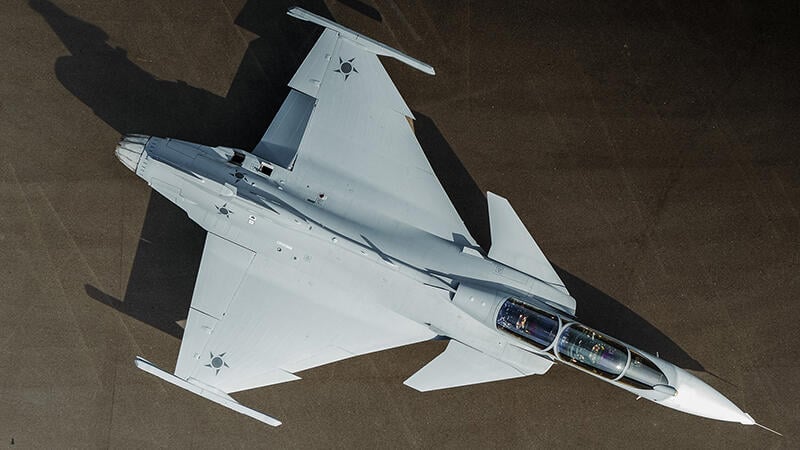
Saab rolled out the first of eight two-seat Gripen Fs for Brazil on June 2.
Saab faces a bow wave of potential orders for more than 50 additional JAS-39E/F Gripen fighters as sales negotiations advance with Ukraine and Brazil.
Ukraine is in final negotiations to acquire a first batch of 20 E/Fs with funding from European loans, while Brazil has raised the prospect of acquiring 20 more to top off the 36 it has on order.
- Sweden plans to donate Gripen C/Ds to Ukraine
- Meteor missiles would threaten Russian combat aircraft
- Two-seat Gripen F for Brazil rolled out on June 2
- Sweden is considering a role for two-seat model
A Ukrainian Gripen E purchase could then unlock a Swedish buy of 12 aircraft, adding to the 60 on order, after Stockholm declared that it would donate 16 earlier-model Gripen C/Ds to bolster Kyiv’s air defense capabilities.
Ukraine is eager to expedite the order and deploy the ex-Swedish Air Force aircraft to the front lines of its war with Russia.
Ukrainian President Volodymyr Zelenskyy said his country’s lawmakers have approved the allocation of €2.5 billion ($2.9 billion) for the Gripen procurement from the EU’s €90 billion Ukraine Support Loan, after dispersement from the fund later this month to finalize the contract. Speaking to journalists in Sweden as the two governments advanced negotiations on the acquisition, Zelenskyy suggested that Gripen C/Ds armed with long-range weapons would serve as an effective countermeasure to Moscow’s long-range air-to-air missiles and enable the Ukrainian Air Force to target Russian strike aircraft carrying standoff weapons.
“These jets, with very specific weapons, especially [MBDA] Meteors . . . can destroy [air] targets [at ranges of] 200 km-plus [124 mi.-plus],” he said. “We think we will push back these Russian jets, and they will not be able to use their aerial glide bombs.”
Negotiations for a Ukrainian Gripen E order began last year, when Zelenskyy suggested Kyiv could acquire 150 of the fighters. His ambition remains, but the aircraft will be acquired in batches. Ukraine has made similar pledges to France for the Dassault Rafale, but negotiations have not matured at the same pace. Analysts have long argued that the Gripen is particularly well suited to Ukraine’s operational environment because of its ability to operate from austere locations and employ such weapons as the Meteor.
Analysts also point out that the Gripen is more forgiving to fly and maintain than the F-16s already delivered.
“Gripen was built for a country that may have to fight outnumbered, under pressure and from dispersed bases, [and] that makes it highly relevant for Ukraine,” Swedish Defense Minister Pål Jonson said.
The $2.3 billion support package would include the donated Gripens, weapons, ammunition, training and maintenance support. Pilot training is underway and slated to accelerate in the fall. Delivery of the Gripen C/Ds would then facilitate the service entry of Ukrainian Gripen Es that Sweden intends to begin delivering before 2030.
Swedish Prime Minister Ulf Kristersson said there had initially been skepticism about Ukraine’s plans to acquire Gripen E/Fs last year because Kyiv lacked the funding. At the time, pro-Putin governments in Hungary and Slovakia were blocking the Ukraine Support Loan. The European Council finally approved the loan in April after the two nations lifted their objections.
A Swedish order beckons if the 16 Gripen C/Ds are donated because its air force wants to maintain six fighter wings for a total of about 100 fighters. Discussions with Stockholm on the potential order are expected to begin shortly, Saab said.
The airframer has been making moves to ramp up Gripen production rates and expects to produce 20 a year in 2027, although Saab could lift production to 30 aircraft a year, CEO Micael Johansson told investors in April.
In the past 10 months, Saab secured Gripen E orders from Colombia and Thailand; Brazil is considering a follow-on purchase, Jonson said on June 4, as Brasilia and Stockholm moved to deepen their defense partnership.
The two formally began discussions on expanding the Brazilian Gripen fleet last September. Brazil has long sought a force of about 66 aircraft but has lacked the funding to do so. An order for 20 additional fighters would move it significantly closer to its target.
At the same time, Saab rolled out the first two-seat Gripen F for the Brazilian Air Force on June 2. The two-seat model mates the wings and mid- and rear-fuselage section of the single-seat aircraft with a new forward fuselage and cockpit section.
The two-seater is designed to be fully operational; the rear cockpit can operate in several different modes, including independently or in tandem with the front cockpit to support training. Brazil has ordered eight twin-seaters; Colombia, two; and Thailand, one. Sweden has yet to order the Gripen F, but Jonson suggested that Kyiv’s acquisition could reshape Stockholm’s own future fighter requirements.
—With Steve Trimble in Ottawa