This article is published in Aviation Week & Space Technology and is free to read until Sep 26, 2026. If you want to read more articles from this publication, please click the link to subscribe.

South Korea Gears Up For Future Fighter

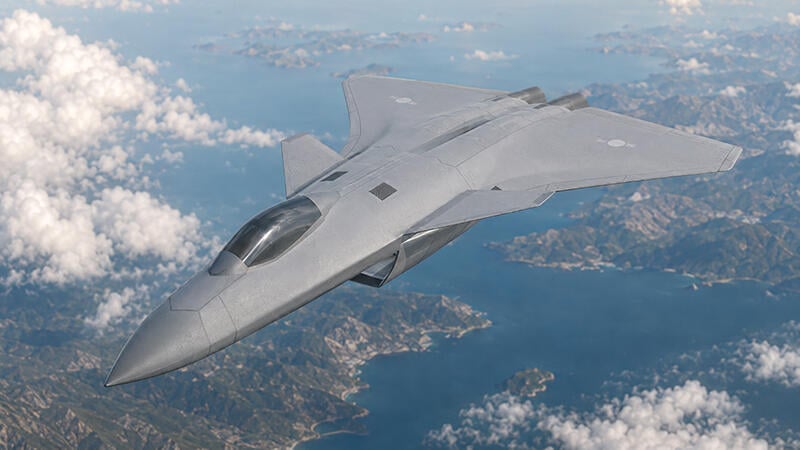
South Korean future combat aircraft concept

South Korea’s Agency for Defense Development has devised a notional design concept, recreated above, for a future combat aircraft.

Credit: 3DCG_mylife/Choi Dong-hyun

South Korea’s efforts to develop a homegrown next-generation fighter are stepping up as the country looks to keep pace with Western programs and maintain its combat aircraft design and development capabilities.

The country’s Defense Acquisition Program Administration (DAPA) and Agency for Defense Development (ADD) are pursuing parallel efforts around sixth-generation fighter designs. Although Seoul has not set a timeline on the eventual outcome of these activities, they suggest the country aims to field an aircraft no earlier than 2040.

  • Seoul explores options for a domestically designed new-generation fighter
  • The Republic of Korea Air Force is eyeing adaptive engines

DAPA, in a request for proposals released on Aug. 21, asked industry to deliver a study defining the operational concept, configuration design and technology road map for the next-generation fighter. During the Republic of Korea Air Force-hosted Aerospace Weapon Systems Technology Conference held July 7 in Daejeon, the ADD disclosed its design effort. The sixth-generation fighter concept emerged from research into ways to devise airframe shapes more rapidly during the conceptual design phase and quickly assess flight performance and radar cross-sections.

DAPA is starting the effort with a relatively modest investment. The study phase, due to run about 14 months, is funded with about 900 million won ($650,000). The agency wants to explore two competing configuration designs and gather data about potential operational capabilities and mission effectiveness.

Much is still uncertain about Seoul’s path. A decision is expected before the end of the decade on when to begin a program formally; questions remain open about whether to pursue indigenous development or import a fighter. Also unclear is whether the new program would supplant plans for a stealthy version of the Korea Aerospace Industries (KAI) KF-21 fighter, sometimes referred to as the KF-21EX or the Block 3, featuring an internal weapon bay. The concept has not received government development budget approval and would be distinct from the new ADD research and DAPA activities.

Moreover, a South Korean military official said that while the air force has a sixth-generation fighter on its long-term requirements list, along with the evolution of the KF-21, putting the nearer-term aircraft into service in large numbers has greater priority.

Embarking on a clean-sheet design would mark South Korea’s first effort to do so largely on its own; Lockheed Martin assisted with the T/FA-50 and KF-21. The latest project likely would not attract such support.

To help inform the pathway to developing a single-seat fighter, DAPA is asking program participants to assess other fighter projects to develop operational concepts and mission profiles. Among the systems to assess are the Boeing F-47 in development for the U.S. Air Force, emerging Chinese fighter concepts like the J-36 and J-50, and the Global Combat Air Program being pursued by Italy, Japan and the UK, the agency says. Those assessments are intended to drive plans for the South Korean fighter’s combat radius, top speed, stealth performance and electronic warfare capabilities.

The designs are required to be tailless, feature internal weapon bays and take diamond- or lambda-wing approaches. DAPA’s solicitation further specifies that the completed design must achieve stealth performance against L-, S- and X-band radars.

To improve stealth performance, the agency is requiring features such as embedded, serpentine inlet ducts. The fighter should be powered by dual adaptive-cycle turbofans, enabling flight faster than Mach 1 without afterburner.

DAPA wants participants to build a roughly 1.5-m-scale (5-ft.) model, more for display purposes than for technical assessments.

The ADD activity has centered on a twin-engine, tailless, cranked-delta main wing aircraft design sporting upward-canted canards. The design features a fully blended fuselage and wing to form a low-side-area lifting body with an extremely low thickness-to-chord ratio.

The concept that is likely to evolve, possibly significantly, has three internal weapon bays—one under the fuselage and one on each side—with the ventral bay housing four MBDA Meteor beyond-visual-range air-to-air missiles and the side bays each carrying a single Diehl IRIS-T short-range air-to air missile. The missiles suggest the aircraft would be roughly 16 m in length with an 11-m wingspan. The engines appear to be comparable in length and width to, or slightly larger than, the General Electric F414 turbofan used on the KF-21. The engines feature thrust-vectoring nozzles and S-shape inlet ducts.

ADD, KAI and Korean Air are the most likely entities to participate in DAPA’s concept study. Korean Air and KAI would not disclose the status of their sixth-generation fighter designs, although both companies are attempting to join ADD’s Full-Scale Stealth Fighter Demonstrator program, which began last November. The program aims to produce a flying testbed within four years. DAPA has indicated that companies or research institutes may form teams to submit joint bids for the concept study.

South Korea has been gradually trying to advance its low-radar-cross-section designs, including through demonstrators and collaborative combat aircraft concepts. LIG Defense and Aerospace has been working on internal weapon bay fabrication, among other activities.

The greatest challenge for South Korea’s sixth-generation fighter ambitions is propulsion. Seoul plans to develop the KTF-16000, a state-led jet engine intended for the KF-21, targeting initial clearance for flight trials in 2041. The KTF-16000’s dry thrust of 16,000 lb. and afterburning thrust of 24,000 lb. would present challenges to delivering the supercruise capability DAPA wants on the roughly 16-m tailless stealth fighter ADD has designed.

South Korea also has not shown expertise in adaptive-cycle engine and thrust-vectoring nozzle technology for fighter aircraft, adding to the mismatch between propulsion ambition and technical know-how. An adaptive engine would not be critical to delivering a new fighter, however. The U.S. opted to forgo the technology for at least the initial iteration of the F-47 and U.S. Navy’s F/A-XX.

Kim Minseok

Kim Minseok covers South Korean defense. He has worked as a journalist for South Korean military magazines Military Review and Defense Times. Mr Kim is also a research fellow at the Korea Defense and Security Forum, a think tank.