This article is published in Aerospace Daily & Defense Report part of Aviation Week Intelligence Network (AWIN), and is complimentary through Aug 24, 2026. For information on becoming an AWIN Member to access more content like this, click here.
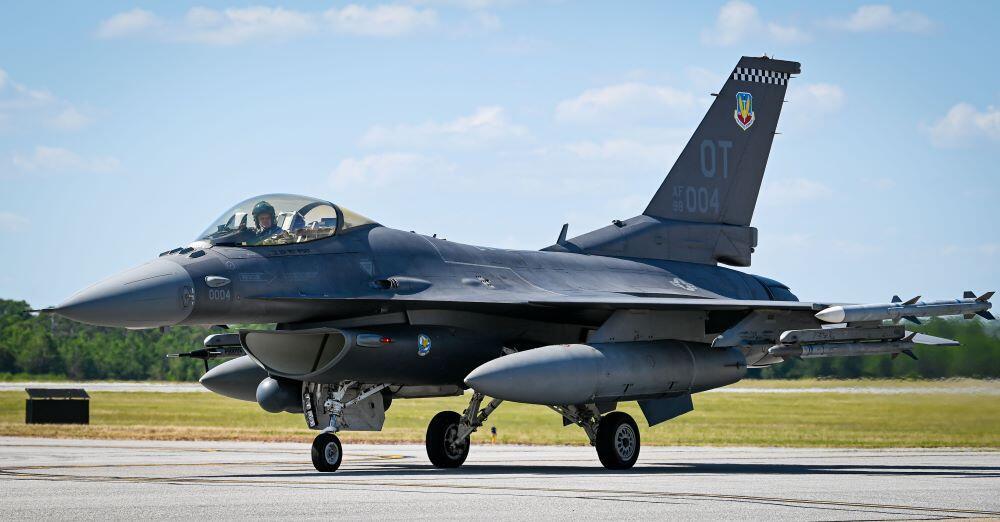
An F-16 with the Northrop Grumman ALQ-257 pod.
Bolstered by the new U.S. Air Force program of record and integration on a new U.S. Army platform, Northrop Grumman is increasing its pitch for airborne electronic warfare self-protection systems on international F-16s, business jets and even bigger aircraft.
Northrop Grumman’s ALQ-257 Integrated Viper Electronic Warfare Suite (IVEWS) has become a formal program for the Air Force after years of prototyping and testing, with a major show of support in the form of a proposed $2.5 billion in spending over the next five years. The company has received a $30 million award following the U.S. Congress directing about $187 million in spending last year for IVEWS.
While IVEWS was first developed for F-16s, the company has said it was also designed for business jet-based aircraft as evidenced by the Army’s decision to integrate it on the ME-11B High-Accuracy Detection and Exploitation System (HADES)—a heavily modified Bombardier Global 6500 used for deep sensing.
Mike Minahan, Northrop Grumman’s vice president for mission systems, says IVEWS is a major pitch for the company abroad, including at the Farnborough Airshow, because of the prevalence of F-16 operators. Business jets are also being used more for intelligence, surveillance and reconnaissance and other missions similar to HADES abroad, so the system is relevant.
“Any platform that’s going to operate in today’s congested airspace, it’s got to have an [electronic warfare] capability, otherwise its going to be forced to operate toward the rear to stay safe and that tends to create mission impacts,” he says. “It prevents other sensors from operating effectively, and so for aircraft to operate effectively and given today’s threats, they’ve got to be able to [operate] forward.”
Northrop Grumman also is eyeing other applications for IVEWS and similar systems. The U.S. Air Force, for example, is looking for increased self protection for its mobility aircraft, starting with refueling tankers like the Boeing KC-46 and KC-135.
“For mobility, there’s a lot of applications there, and so when you think about different scenarios around the globe where mobility aircraft need to operate farther and farther toward the front, that IVEWS capability would certainly be extremely helpful there for pilots that are operating in that contested airspace,” Minahan says.
Northrop Grumman has already been selected to provide its similar ALQ-251 radio frequency countermeasures system for U.S. Special Operations Command and Royal Australian Air Force C-130s.
For IVEWS on F-16s, the U.S. Air Force has moved it through Milestones B and C for production. The service has wrapped operational assessments with 550 hr. of flight tests over 300 sorties, Minahan says.
“Our sense is the Air Force is moving very quickly and of course we are primed and ready to meet that challenge, and so we are producing IVEWS systems today and we are well prepared to meet that growing demand signal,” he says.

Related Content