This article is published in Aerospace Daily & Defense Report part of Aviation Week Intelligence Network (AWIN), and is complimentary through Nov 14, 2025. For information on becoming an AWIN Member to access more content like this, click here.

Boeing Enters Large VTOL UAS Race With CxR Concept

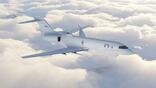
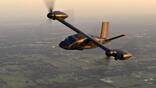
Artist's rendering of Boeing's CxR concept

Boeing’s Collaborative Combat Rotorcraft (CCR) is one adaptation of Boeing’s Collaborative Transformational Rotorcraft (CxR) – a modular, unmanned, multi-mission autonomous tiltrotor concept.

Boeing has unveiled a large, high-speed and vertical take-off-and-landing (VTOL), uncrewed aircraft system (UAS) for the U.S. Army, with a modular design focused initially on strike and reconnaissance roles but also capable of producing variants for cargo missions.

Boeing’s Collaborative Transformation Rotorcraft (CxR) concept design proposes to introduce the largest UAS in the Army inventory since the 2011 arrival of the fixed-wing, 3,600-4,200-lb. General Atomics Aeronautical Systems Inc. MQ-1C Gray Eagle and breaks from the Army’s recent focus on a class of smaller, expendable air vehicles known as “launched effects.”

The 5,000-7,000-lb. CxR design features a 200-250-kt.-capable tiltrotor configuration, with a single gas-fueled, turboshaft engine powering two tilting propellers, Chris Speights, chief engineer for Boeing’s Vertical Lift division, told reporters.

In a combat role configuration, the CxR could carry weapon and sensor payloads weighing up to 1,000-2,000-lbs., including acting as a mother ship for smaller launched effects.

“It would create a larger sensor volume than what smaller launched effects would see, and it will have the speed and range and endurance that help meet the needs of the mission, both today and in the future,” Speights said.

To adapt the CxR for logistics missions, the concept features a modular fuselage with several common features, such as the propulsion system and vehicle management systems. The cargo version would feature a new fuselage capable of medium- and heavy-lift cargo missions, Speights added.

Boeing revealed the CxR concept on the first day of the Association of the U.S. Army’s (AUSA) Annual Meeting, even as engineers internally continue working to finalize the design.

“We're working through operation analysis in order to fine-tune the exact requirements and what we believe the right solution is for the customer,” Speights said.

The concept comes as Boeing’s competitors also have shown interest in offering large, VTOL-capable UAS to the military. Sikorsky, a Lockheed Martin company, revealed the Nomad concept for a family of VTOL UAS based on rotor-blown lift propulsion technology. Shield AI also plans to unveil a VTOL-capable, collaborative UAS later this month.

The Army’s original plan for the Future Vertical Lift family of systems included an Advanced UAS, but the project was shelved by 2020 to help focus the acquisition community on completing development of what has become the Bell MV-75, a large tiltrotor aircraft expected to partially replace the Army’s fleet of Sikorsky UH-60 Black Hawks.

Steve Trimble

Steve covers military aviation, missiles and space for the Aviation Week Network, based in Washington, DC.