A high-speed rejected takeoff by a HondaJet at Falcon Field Airport in Mesa, Arizona, ended tragically when the jet overran the departure end of the runway.
Unfortunately, a high-speed runway excursion after the takeoff attempt of an HA-420 HondaJet at Falcon Field Airport (KFFZ) in Mesa, Arizona, on Nov. 5, 2024, has brought attention to whether the city-owned airport complied with the FAA’s safety zone criteria.
The flight was a birthday present for a teenage member of the close-knit family and friends who planned to watch a basketball game in Provo, Utah.
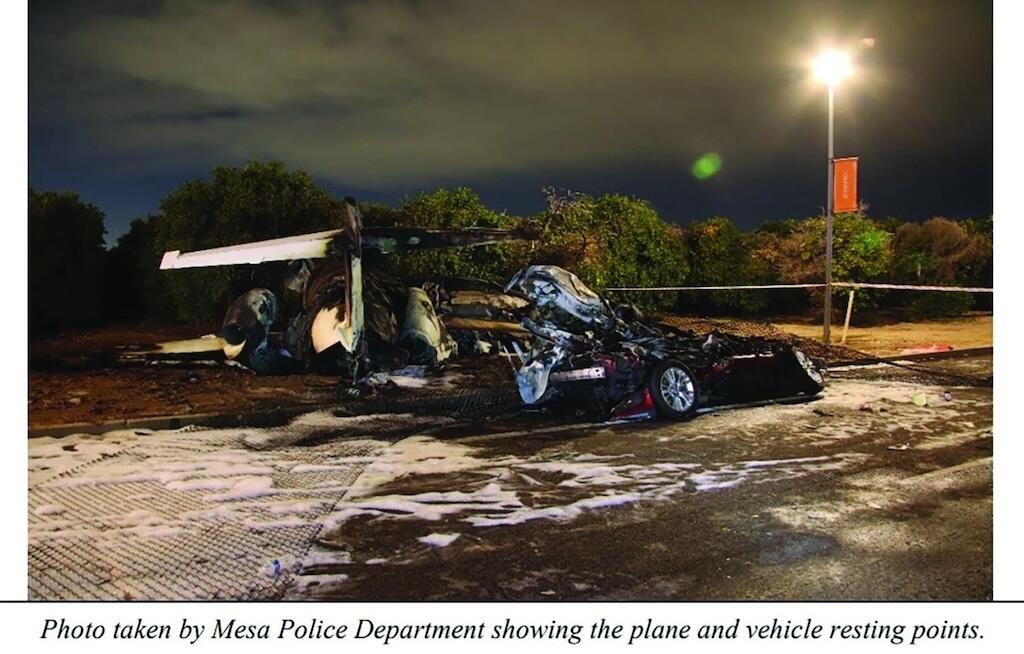
The NTSB’s preliminary investigation used security video to capture images of the jet accelerating on Runway 22L for about 3,000 ft. With 2,100 ft. of runway remaining, the jet began to decelerate. Publicly available ADS-B data suggests that the HondaJet lost an insufficient amount of velocity before leaving the end of the runway. It overran the departure end of the runway, struck the airport perimeter fence and continued across a roadway where it struck a single automobile.
The pilot and three passengers were killed, along with the single occupant of the car that was struck by the jet.
The NTSB has published a preliminary report on the accident; its final report will likely take at least a year before it is completed. According to the preliminary report, a removable Secure Data card recorded that the jet had accelerated to about 130 kts before it began to decelerate.
Why was the takeoff rejected at an abnormally high speed? The preliminary report gave no indication. Flight-control continuity was verified by the investigation team on site. The control column gust lock was located uninstalled. The jet’s brake and anti-skid system were examined with no anomalies noted. No engine anomalies were noted in the data.
Attorneys representing the pilot’s family and three other families affected by the accident have filed multiple lawsuits seeking hundreds of millions of dollars in claims from the city of Mesa. They accuse the city of failing, neglecting and refusing to design, establish, construct and maintain a safe Runway Safety Area (RSA) and Runway Protection Zone (RPZ) for Runway 4R/22L. This contributed to the five deaths and one injury, the lawsuits contend.
The law firms also allege that Mesa failed to prevent, eliminate or mitigate the airport hazard involving land use inside the RPZ. Specifically, they refer to N. Greenfield Road, where the jet impacted the car. The lawsuit argue that historical maps indicate the presence of N. Greenfield Road since the 1950s, and this should have been considered during the evolution and growth of the airport. The road, which experiences 20,000 vehicle trips per day, should not have been considered a compatible land use by Mesa, according to the plaintiffs.
It is timely at this point to revisit the FAA Airports Division guidance: “Airports that do not own the entire RPZ should consider the need to acquire such land if there is any possibility that incompatible land uses could occur within the RPZ.”
The legal filings contend that leaving N. Greenfield Road inside the RPZ and the lack of safety remediation measures to arrest the velocity of aircraft on the ground departing Runway 4R/22L decreased the amount of time and area to slow down. They further argue that the impact with the fence on the airport’s perimeter and the automobile directly resulted in the tragic loss of life.
The plaintiffs’ attorneys cite a federal report that recommended the creation of “cleared runway extension area zones extending at least half a mile beyond runway ends, free from obstructions and incompatible land uses. These areas were intended to be integral parts of airport design, ensuring safety during takeoff and landing phases.”
At this writing, it was not possible to present the countering arguments. A spokesperson said the city of Mesa is not issuing a statement due to the pending litigation. As these cases will be adjudicated in a court of law, I ask that readers keep a sense of balance without pre-judgement.
In Part 3 of this article, we discuss the value of Engineered Material Arresting System surfaces in mitigating the impact of runway excursions.

Related Content