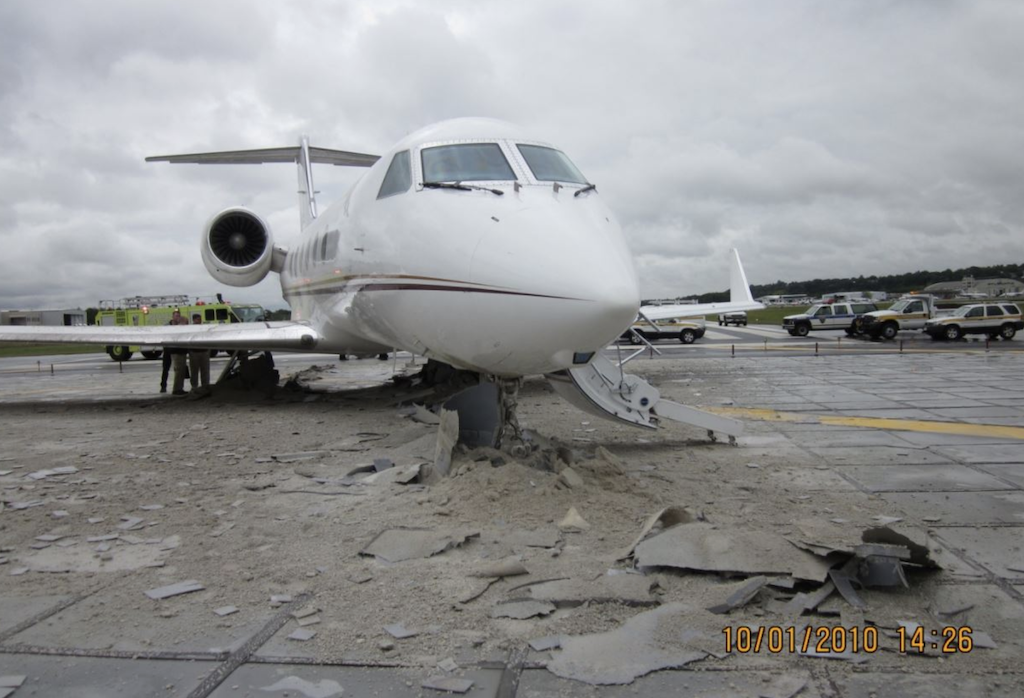
A landing overrun by a Gulfstream G-IV at Teterboro Airport in 2010 resulted in the jet traveling 100 ft. into the EMAS at the end of Runway 6.
Many airports commonly used by business aviation were built in the 1940s and 50s. At the time, these airports were surrounded by vacant fields. With the rapid growth of cities these airports are now encircled by roads, businesses and high-density neighborhoods, leaving no extra room to expand. The airports weren’t originally designed for the operating weights and speeds of modern business jets.
Why should the business aviation industry be concerned about this conundrum? An airport that doesn’t comply with the FAA’s safety guidelines may create a hazard for an aircraft experiencing a runway excursion. Furthermore, airport operators who haven’t expanded the size of their safety zones necessary for jet aircraft are becoming defendants in civil claims involving runway excursions.
FAA RSA Guidance
A high-speed tire failure on a Dassault Falcon 20 on Aug. 28, 1998, as it departed from El Paso International Airport (ELP) in Texas is indicative of the compromised braking and steering that challenges pilots during an aborted takeoff.
The flight crew reported that at approximately 120 kts, they heard a loud “bang” followed by a vibration, and the pilot-in-command called for the first officer to abort. The crew stated that they thought they had enough runway to stop but reported that application of both pilot and co-pilot brake pedals was not effective in slowing the aircraft.
Despite the flight crew’s actions, the jet overran the departure end of the runway, traveled over the 800-ft. paved stop-way, across approximately 1,000 ft. of sandy terrain, through a steel perimeter fence, over embedded railroad tracks, through a concrete curb, across a four-lane highway impacting three moving vehicles, through a second concrete curb, and through another steel fence, before finally coming to a stop. The distance from the departure end of the runway to where the aircraft stopped measured about 2,010 ft.
In accordance with FAA Advisory Circular (AC) 150/5300-13 Airport Design, runway safety areas (RSA) serve as the primary safety mitigation for runway excursions. The RSA is a defined surface surrounding the runway, typically 500 ft. wide and extending 1,000 ft. beyond each runway end. It provides a graded area in the event an aircraft overruns, undershoots or veers off the side of the runway. Airports must maintain smooth and clear grading, good drainage, load-bearing capability and the absence of non-essential and non-frangible objects throughout their RSAs to prevent damage to the aircraft or injury to its occupants during a runway excursion.
The airspeed and size of “runway critical aircraft,” along with the runway’s visibility minimums, provide the primary factors to determine a runway’s standard RSA dimensions. Guidance is contained in AC 150/5000-17, Critical Aircraft and Regular Use Determination and AC 150/5300-13, which provide information to determine standard safety area dimensions as well as maintaining safety area characteristics.
AC 150/5300-13 states in part: “All existing and planned airport elements including the following should be on airport property: Object Free areas; Runway Protection Zones [and] Areas, other than those which can be adequately controlled by zoning, easements or other means to mitigate potential incompatible uses.” In other words, the airport owner must be able to protect against both obstructions and incompatible land use.
“Compatible land use within the Runway Protection Zone (RPZ) is generally restricted to such land uses as agricultural, golf course or similar uses that do not involve congregations of people or construction of buildings or other improvements that may be obstructions.”
The FAA’s Airports Division recommends that airport owners and managers review the Airport Layout Plan for conformity with the above statement. “Airports that do not own the entire RPZ should consider the need to acquire such land if there is any possibility that incompatible land uses could occur within the RPZ.”
The FAA’s Runway Safety web page states: “Because many runways were built before the 1000-ft. RSA standard was adopted, the FAA implemented the Runway Safety Area Program to make practicable improvements to the RSA for priority runways. Improvements were made to over 1000 runways at 500 airports. Although the original RSA improvement projects are complete, the program continues to evolve to address safety risk and plan for future improvements.”
There are many reasons why this is especially important for business aviation. Scores of airports used by business jets have runways that are shorter and narrower than those served by commercial air carriers. Additionally, runways used by business jets often lack the surface features (grooves, crowning, porous friction course) that lessen the effects of runway contamination. Business aircraft frequently operate into airports and runways with limited snow removal capabilities and unreliable runway condition reporting. This operating environment creates a higher risk for runway excursions.
Secondly, the relatively small size of tires on business jets along with stresses from operational and maintenance practices increase the chances of high-speed tire failures. It is a challenge for flight crews to keep an aircraft on the runway with compromised braking and steering, especially when this occurs at high speeds.
The previously mentioned high-speed tire failure involving a Dassault Falcon 20 at ELP is one example of this concern. Another example was the fatal runway overrun of a Bombardier Learjet 60 on Sept. 19, 2008, during a rejected takeoff at Columbia Metropolitan Airport in South Carolina, resulting in the deaths of four of the six occupants of the aircraft.
Third, many destinations often utilized by business jets have foreboding terrain at the ends. For example, imagine attempting a high-speed rejected takeoff caused by a tire failure from Runway 27 at Telluride Regional Airport in Colorado. The terrain at the departure end of the runway is a cliff.
Other business jet destinations have steep hills and dense trees. Others are simply surrounded by high-density buildings and busy roads.
The city of Mesa, Arizona, faces a lawsuit after the fatal runway overrun of an HA-420 HondaJet, in Part 2 of this article.

Related Content