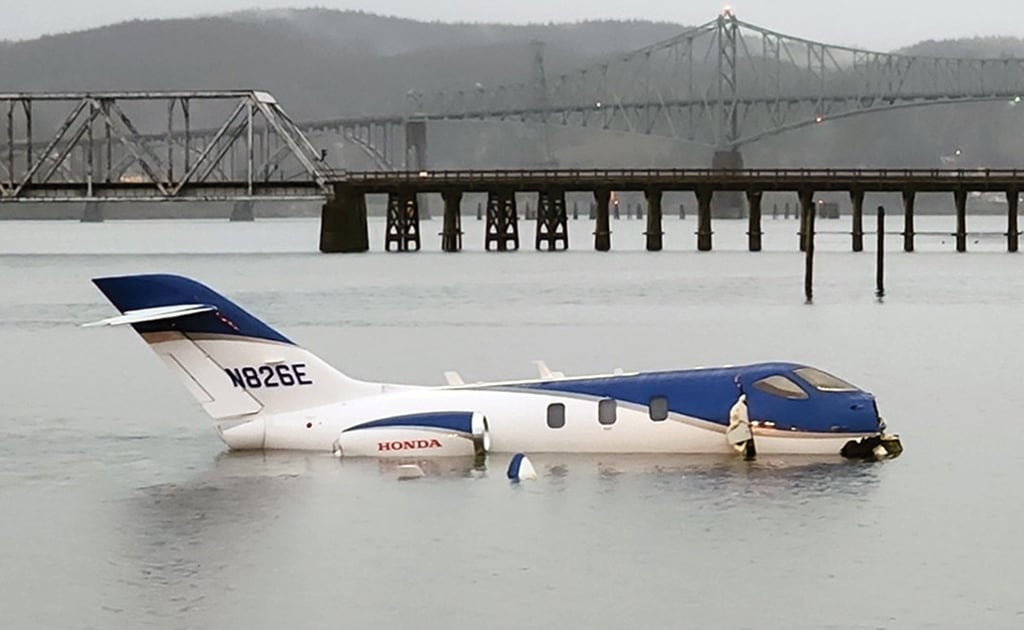
HondaJet that overran North Bend Southwest Oregon Regional Airport’s Runway 05 on March 7.
The image of the HondaJet being lifted out of the waters of Coos Bay, Oregon, filled the screens of the national news on March 7, 2025. This was just one of four additional runway excursions involving HondaJets that have occurred within a seven-week period. These runway excursions unfortunately reinforce the many questions asked by this author in the last issue of BCA (“HondaJet’s Runway Excursions,” BCA Q1 2025). The runway excursions trend is a blemish on a jet with notable cruising performance and whose inflight safety record is laudable. But for these runway excursions, the HondaJet’s list of incidents and accidents in the Aviation Safety Network’s database would be remarkably small.
Let us review the four most recent runway excursions. On March 4, 2025, a HondaJet landed on Runway 31L at San Antonio International Airport after originating at the Austin Executive Airport, Texas. Winds were from the west at 19 kt. gusting to 36 kt., resulting in a crosswind component of 12-23 kt. The ADS-B data reveals the aircraft began to veer to the left at a ground speed of 99 kt. and was traveling at 81 kt. when it departed the left side of the runway. The right landing gear was damaged. The sole occupant was not injured. The aircraft was substantially damaged.
On March 7, 2025, a HondaJet overran the end of Runway 05 at the North Bend Southwest Oregon Regional Airport in early morning darkness. The aircraft ended up about 100 ft. off the end of the runway in the water of Coos Bay. All five occupants were rescued. The aircraft was substantially damaged.
The runway has a four-light PAPI with a 3-deg. glide path and is served by an ILS/DME. The runway surface is asphalt with grooves with a published landing distance of 5,320 ft. Video from that morning shows wet covered surfaces. A closer look at the AWOS reveals threats from a runway that was at least damp if not wet due to the light rain as well as a quartering tailwind which would have lengthened the aircraft’s landing distance. The NTSB’s preliminary report had not been published at the time of this writing, thus the aircraft’s speed at touchdown has not been officially stated.
The aircraft flight manual (AFM) recommends increasing the landing distance by 30% on a wet runway. The Flight Safety Foundation’s Approach and Landing Accident Reduction (ALAR) Briefing Note 8.3 Landing Distances reminds pilots that landing distances increase when decrabbing an aircraft during a crosswind landing. AC 91-79A, Mitigating the Risks of a Runway Overrun Upon Landing (9/17/14), reminds pilots that the majority of runway excursions usually involved a combination of factors to include excess speed on final, insufficient consideration of the runway surface conditions, excess height over the threshold, landing long and adverse winds. These are important points that all pilots should keep in mind during a landing performance assessment.
On April 9, 2025, a HondaJet veered off the left side of Runway 05 while landing at Naples Airport, Florida. No aircraft damage resulted, and the sole occupant was not injured. The latest METAR reported winds were 320 deg. at 10 kt., gusting to 19 kt. This was a direct crosswind.
On April 13, 2025, a HondaJet landing on Runway 36 at Japan’s Nagoya/Chubu Centrair International Airport veered to the right. The amount of damage is listed as “unknown” at the time of this writing. The latest reported METAR recorded winds 300 deg. at 21 kt. with light rain showers and mist. This wind combination would produce a crosswind component of 18 kt. The occurrence has been rated as a serious incident by the Japan Transport Safety Board (JTSB).
This same airframe was involved in a serious incident on March 13, 2021, when the aircraft deviated from the runway into the grass. The JTSB’s probable cause statement said that the tires skidded during the landing roll, making it impossible to control the direction of travel. Excessive corrective maneuvers caused the aircraft to tilt, which in turn caused the tires to skid, adversely affecting the steering controllability.
HondaJet Video
David DeCurtis, safety chair of the HondaJet Owners and Pilots Association (HJOPA), produced a 37-min. video highlighting the important differences between landing a HondaJet by the AFM’s recommended procedures versus techniques that pilots may have learned from their previous experiences. DeCurtis advises viewers: “Whether you are coming from a single-engine prop working your way up to the HondaJet like I did, or you are coming from a Boeing 787 coming down to the HondaJet, it is important to understand that the HondaJet has a particular landing technique, and we get this technique from the AFM.”
The HondaJet’s AFM contains the proper procedures for landing. This starts with utilizing Vref in ALL landing conditions. DeCurtis emphasizes in the video: “This is critical, and this is contrary to many of the sort of rules of thumb you hear out there like add half the gust factor ... We target Vref at all times.”
A warning in the HondaJet’s AFM regarding crosswind landings states: “The approach and landing must be made using the crab technique. Using the wing-low method could result in a wingtip strike. The bank angle must be limited to 10 deg. in order to ensure wingtip clearance from the runway surface.”
DeCurtis emphasizes this is a crab all the way to the runway. Perform the decrab maneuver by applying the rudder to align the aircraft fuselage with the runway. Ideally this is done just prior to the wheels touching down. Simultaneously apply aileron into the wind to minimize drift. If the crosswind is 15 kt. or more, it is important to input full aileron. Attempt to align the aircraft with the centerline prior to touchdown.
A firm touchdown ensures full landing gear compression, which is important not only for positive contact of the tires with the runway, it also produces a timely spin-up of the tires to trigger the anti-skid operation. A firm touchdown also ensures activation of the air-to-ground sensors (often called “squat switches”) into the ground mode.
DeCurtis’ video contains a good demonstration of the proper positioning of the feet prior to touchdown. It is important to position feet up on the brake pedals, so they can be applied after touchdown without having to make the transition while making pedal inputs to track centerline.
It is also important to perform a prompt de-rotation without delay. DeCurtis emphasizes, “We’re not holding the nose off, not even for 1 sec. in the HondaJet.” Three tires are placed in solid contact with the runway by de-rotating promptly. Forward pressure on the yoke puts more weight onto the nosewheel’s contact with the runway, which will provide additional steering and resistance to sideways rotation. The nosewheel is free castering for the first 1.5 sec. after touchdown, thus still needs large rudder inputs. As the nosewheel logic comes in, progressively smaller rudder movements are required.
Symmetric moderate to heavy braking should be applied after nosewheel touchdown as specified in the AFM. Rapidly applying both brakes symmetrically will reduce the likelihood of a directional disturbance caused by one brake being applied before the other. If the anti-lock system releases the brakes, unless you need to regain control of the airframe, it is critical to hold steady pressure on the brakes. If the brakes are pumped, the landing distance will increase.
Not only does this video emphasize the key important steps in the specific procedure for landing a HondaJet, but DeCurtis also created a number of insightful visual aids to show the effects of immediately de-rotating the aircraft as well as landing at excessive airspeeds. These examples show simulated and actual landings in crosswind conditions at Ocean Reef, Orlando Executive and Teterboro, all of which highlight the importance of targeting Vref without adding any additional speed.
This informative video is available on YouTube: “HJOPA Proficient Pilot Program-HondaJet Landing Technique.”
Applicable to Other Jets
Much of the information in the HondaJet Landing Technique video applies to other business jets, and indeed also to larger transport jets. Scores of swept-wing jets generally require using the “crab then kick out” method due to the risk of striking the runway with the engine pod (for underwing-mounted engines), the flaps or the wing tip. These aircraft have a maximum pitch/bank angle limitation for the touchdown published in their AFM.
The Flight Safety Foundation’s ALAR Briefing Note 8.7 Crosswind Landings reminds pilots that wheel-braking forces and tire-cornering forces (i.e. steering effectiveness) are based on tire conditions, runway conditions and also on each other. The higher the braking force, the lower the cornering force. The briefing note also points out that distortion of the tire tread caused by the yawing movement of the wheel will negatively affect the tire’s cornering force, or in simpler words, lessen its steering effectiveness. A 10-deg. steering angle will reduce a tire’s cornering and wheel braking force by 55%, and gets markedly worse with higher steering angles.
The briefing note informs pilots of a lesser-known ground handling dynamic in a crosswind. Be advised that placing into-the-wind aileron to keep the upwind wing down puts a higher load on the upwind wing’s landing gear. Higher loads placed on the upwind tires increases its braking force, and this creates an additional force rotating the aircraft into the wind.
Remember the goal of a landing is to put the two main landing gear equidistant from the runway’s centerline. The main landing gear sits behind the cockpit, and if the pilot is aiming to put the nose of the aircraft on the centerline during a crosswind landing, this actually results in the main gear touching down to the side of the centerline. On a 150-ft.-wide runway, there is still plenty of margin from the runway edge, but on the narrower runways at many general aviation airports that margin is much smaller.
Therefore, to set the main gear down on the centerline at touchdown the sight picture from the cockpit actually needs to place the nose slightly to the upwind side of the runway centerline. If you fly a jet with a longer distance between the cockpit and the main landing gear then your sight picture will require placing the cockpit even further displaced from the centerline. As you can imagine, the sight picture from the flight deck of a long-bodied transport during a crosswind landing requires putting the cockpit at a seemingly unnatural close proximity to the upwind edge of the runway. If this description does not convey this concept well or if you tend to be a visual learner (which most pilots are), search on YouTube for crosswind airliner landings, which will clearly demonstrate this concept.
Many Questions Remain
Many of the past HondaJet investigations have not revealed if the pilots involved in the accidents had closely followed the AFM landing procedures. Without flight data monitoring, we do not know how many pilots are accurately replicating the AFM’s landing procedure. Nor do we definitively know if pilots using the specific landing procedure are—or are not—experiencing landing abnormalities. If the data shows that pilots adhering strictly to the recommended landing procedure are still having problems with controllability and stop ability, then the search for answers needs to look at deeper causes. These are vital questions that need to be answered to develop data-based solutions to this recurring problem.
The NTSB classified the March 4 accident in San Antonio as a Class 4 investigation. Class 4 investigations only examine the actions and conditions directly relating to the accident. After more than 30 runway excursions documented in the Aviation Safety Network, plus many more close calls contained in the NASA ASRS database, practical strategies to avoid future recurrences are needed.
There are many important issues raised by this recurring trend of runway excursions that apply to all of business aviation. Is the training process sufficient to transition a pilot from a propeller-driven aircraft to a jet? What training and proficiency are needed to un-do the habits of flying previous aircraft with different ground handling characteristics to properly and consistently, even while fatigued or stressed, apply the specific landing procedures for this jet?
Are the pilots, especially those coming from a general aviation background in propeller aircraft, given enough in-depth training and mentoring to conduct tasks important in jet operations such as landing performance assessments? How do operators, regulators, safety organizations and the manufacturers determine if pilots are following the proper procedures? Even if you are not a HondaJet pilot, there are important insights to be gained from these events.

Related Content