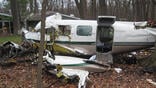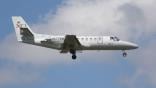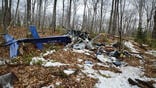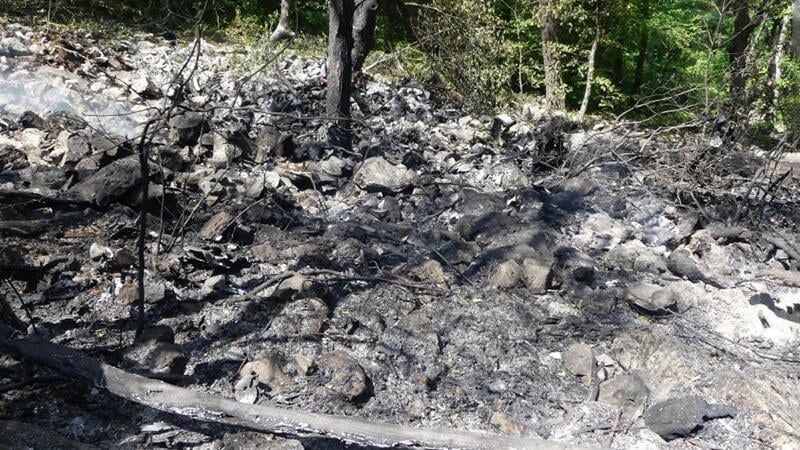
The site of the Cessna Citation crash.
There really was not much left.
That is what NTSB investigator Adam Gerhardt and his team discovered when they reached the wreckage. It had been a brutal 3-hr. hike through the rugged Virginia mountains to get there. Gerhardt later told me they faced the threat of bears and snakes.
The wreckage was located on steep, rocky terrain, heavily fragmented and with evidence of a post-impact fire. Trees and the wreckage distribution were, in the words of NTSB, “consistent with a high-velocity, near-vertical descent.” ADS-B data revealed the aircraft plummeted into the ground at more than 30,000 fpm. Although the airplane supposedly had a cockpit voice recorder, it was not located in the wreckage.
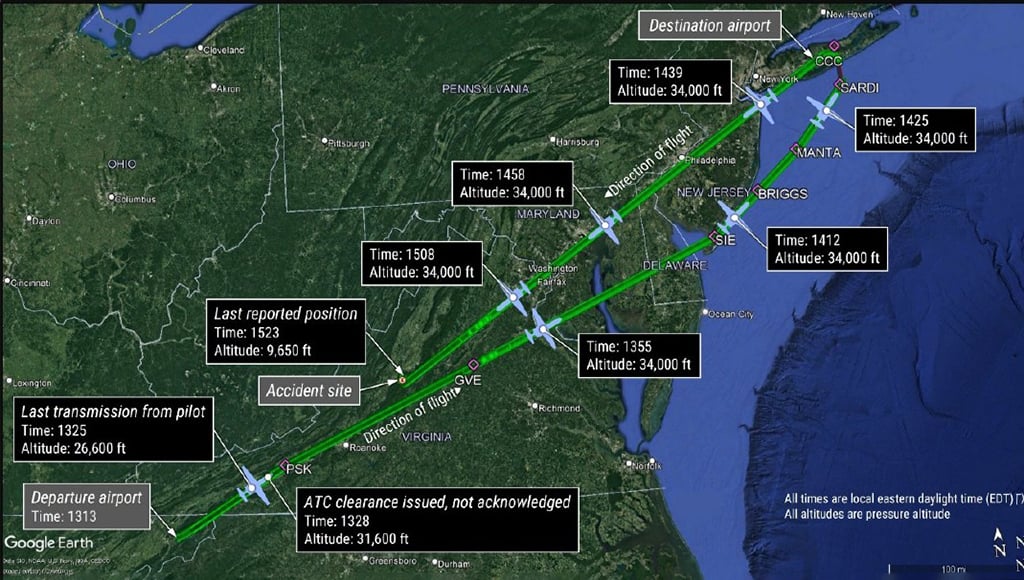
The day of the accident, June 4, 2023, the sole pilot, a 69-year-old with around 34,500 flight hours, departed Melbourne, Florida, in N611VG, a 1990 Citation 560, and flew to Elizabethton, Tennessee. There he picked up the aircraft owner’s daughter, their toddler granddaughter and nanny. The plan was to fly the trio to Islip, New York, before ferrying the 33-year-old Citation back to Florida.
While climbing through 26,000, Atlanta Center cleared the jet to FL340, a clearance the pilot acknowledged. However, 3 min. later, ATC amended the clearance for the airplane to stop the climb at FL330 due to crossing traffic. There was no response from the pilot, and despite numerous radio calls to the pilot, for the next 2 hr., there would be no further responses from the pilot.
Almost certainly on autopilot, the airplane followed the filed flight plan routing to Islip, before making a 180-deg. left turn to a heading of 240 deg. and heading back in the direction of the departure airport. For the next hour, the airplane remained at FL340 while maintaining the 240 heading.
U.S. Air Force scrambled F-16s to intercept the Citation. The pilots fired flares in a vain attempt to get the pilot’s attention and, like air traffic controllers, they had no success in reaching the pilot on the radio. During their rapid pursuit, the fighters exceeded the speed of sound, sending a sonic boom over the nation’s capital. Once reaching the wayward plane, the fighter pilots observed no breaches of the airplane structure or doors, and no smoke in the cockpit or passenger cabin. They saw the person in the Citation’s left seat completely slumped over onto the co-pilot seat. There was no movement in the passenger cabin.
Most of us had quickly surmised this was another sad case of pilot incapacitation, perhaps due to hypoxia. We have seen it before—most notably, the 1999 crash involving golfer Payne Stewart. However, what is particularly disturbing about this crash is the circumstances that enabled it.
In 2015, the aircraft was sold and exported to Venezuela, where it remained until February 2023 when the new owner purchased it. The new owner previously owned a different Citation—one that required two pilots. According to the person who sold the accident airplane, the pilot told him that the owner was “sick of paying two pilot salaries” and that this airplane was purchased with the sole purpose of eliminating the need for two pilots.
On May 10, 2023, at the request of the accident pilot, a mechanic provided a basic visual walk-around inspection of N611VG. No panels were removed, nor was there any in-depth examination of components. The mechanic provided the pilot with a discrepancy report with a list of 26 discrepancies. These items included multiple corrosion spots on the aircraft belly, elevator and stabilizer; major fuel leaks on bottom of both wings; the emergency exit door seal sticking out of the airplane; the aft baggage door seal was torn; and the hinges were completely broken. However, according to NTSB, the owner declined to address these issues.
Three days before the crash, the pilot reported to the owner that the avionics would occasionally shut off during flight. There was no corrective action, but repairs were scheduled for the following week. Two days before the crash, the same mechanic who did the May 10 inspection noted the same issues he previously identified, with the added finding that the pilot’s oxygen mask was missing. He also noted that the passenger oxygen was below the minimum serving level. With that low quantity of oxygen present, the masks in the passenger cabin would not automatically deploy if cabin altitude became excessive. At the time of the crash, there were also five overdue time-limited maintenance inspection items that had not been carried out.
The NTSB determined the probable cause of the crash was: “pilot incapacitation due to loss of cabin pressure for undetermined reasons. Contributing to the accident was the pilot’s and owner/operator’s decision to operate the airplane without supplemental oxygen.”
It always amazed me that someone would spend millions of dollars to purchase an airplane but then skimp on maintenance and other important things. The NTSB referred to this as an accident. The astute reader might note that I generally did not refer to this as an accident. According to my trusty Merriam-Webster app, an accident is defined as “an unforeseen and unplanned event or circumstance.” Surely, refusing to correct airworthiness items and continuing to fly the aircraft, and then having that aircraft involved in such a horrific crash, is not an unforeseen event. Sadly, the owner’s daughter, granddaughter and nanny perished, along with the pilot.
Robert Sumwalt has contributed to BCA for the past 3.5 years. He was a member of the NTSB from 2006-21, including being chairman from 2017-21. Before that, he managed a corporate flight department for a Fortune 500 company, and he previously was a pilot for US Airways.

Related Content