This article is published in Business Aviation & AAM Report part of Aviation Week Intelligence Network (AWIN), and is complimentary through Nov 07, 2026. For information on becoming an AWIN Member to access more content like this, click here.
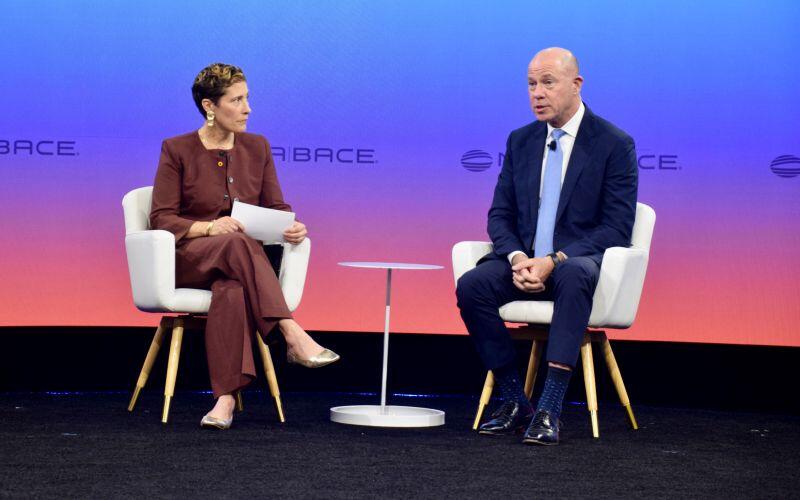
Kristie Greco Johnson, NBAA senior vice president for government affairs, interviews FAA Administrator Bryan Bedford in Las Vegas.
Maybe the idea is to shoot for Mars but settle for the Moon.
In the last two months, the Trump administration has broadened the scope of its Brand New Air Traffic Control System (Bnatcs) modernization effort, attaching a new pilot grant program to rebuild passenger terminals at medium hub airports. The expansion has increased the price of the modernization by $10 billion.
U.S. Transportation Secretary Sean Duffy unveiled the Bnatcs initiative in May 2025. The effort was originally expected to cost about $32 billion for a fast-track, three-year overhaul of the nation’s aging air traffic control (ATC) system infrastructure. Congress appropriated $12.5 billion to start the modernization in the 2025 One Big Beautiful Bill Act.
On Sept. 28, 2026, Duffy and Sen. Eric Schmitt (R-Mo.) announced the Modern Skies Act (S.5572)—new legislation that would raise $30 billion more from Congress for the second phase of the Bnatcs project as well as for airport terminal rehabilitation, upping the price of the modernization to about $42 billion.
The choice of Schmitt to spearhead the legislation was curious. Schmitt sits on the Senate Commerce Committee’s Aviation Subcommittee but is less known for aviation leadership than for recently mistaking the Atlanta Hawks basketball team for the University of Iowa Hawkeyes. That said, St. Louis Lambert International Airport and Kansas City International Airport in Schmitt’s state are categorized as medium hub airports by the FAA and presumably would be eligible for new terminals under the pilot grant program.
In the October edition of his Aviation Policy News publication, Reason Foundation Director of Transportation Policy Robert Poole notes that the Modern Skies Act in total would provide $18 billion for airports because it leverages another $5 billion to continue the airport terminal improvement program of the 2021 Bipartisan Infrastructure Law and $3 billion for additional grants under the Airport Improvement Program. Thus, if the legislation were to pass, effectively 60% of the $30 billion would go to airport facilities and only 40% to ATC modernization.
For ATC, the legislation seeks $10 billion “to complete [a] reliable digital architecture” for the Bnatcs, the Transportation Department (DOT) says, which includes $7.2 billion for a Common Automation Platform and a common controller workstation. Another $10 billion bucket would fund the replacement of aging ATC towers and facilities.
“One other important point has been absent from commentary on this sausage-making,” Poole writes. “The federal government does not have $30 billion it can spend on airports and air traffic control. Without offsetting spending cuts or increases to user fees or taxes, the entire sum is to be borrowed from future taxpayers (i.e., it is added to the federal budget deficit and hence the national debt).”
The language of the Modern Skies Act stipulates that the transportation secretary—not the FAA administrator—would issue grants to the sponsors of up to three “transitional hub airports.” The legislation describes a transitional hub airport as one classified by the FAA as a medium hub with a terminal building constructed before 1990 that remains in active passenger service.
During a brief interview Oct. 20 at the National Business Aviation Association (NBAA) conference in Las Vegas, FAA Administrator Bryan Bedford also referred to Duffy, a former five-term U.S. representative from Wisconsin, when asked if the additional $10 billion sought for new airport terminals could “tip the apple cart” of funding Congress is willing to provide for the Bnatcs.
“I think the Secretary absolutely knows we need the $10 billion to finish out what we discussed here in terms of modernizing air traffic control, but he also sees a huge need for air traffic control towers and a huge need to do a massive renovation on some of the [airport terminals],” Bedford told Aviation Week.
Medium hub airports “simply don’t have the ability to get funding through other sources, so he’s trying to be much more proactive about finding a more holistic solution that isn’t just limited to modernization but addresses infrastructure needs,” Bedford added. “I trust the Secretary’s judgment. He worked in that [congressional] environment. I don’t have a whole lot of background in that, so I trust his leadership and we’ll follow his lead.”
On another matter related to the Bnatcs, Bedford declined to comment on an Oct. 15 report by Politico that the FAA may acquire an ownership stake in Air Space Intelligence, the software engineering firm it has selected to provide the Strategic Management of Airspace, Routing and Trajectories system, an AI-enabled decision-support tool controllers will use to manage air traffic.
Asked if he could either confirm or deny the report, Bedford said: “well, there’s nothing today.”

Related Content