This article is published in Aviation Week & Space Technology and is free to read until Sep 25, 2026. If you want to read more articles from this publication, please click the link to subscribe.
Complex Operations Are Required To Keep Goodyear’s Blimps Flying
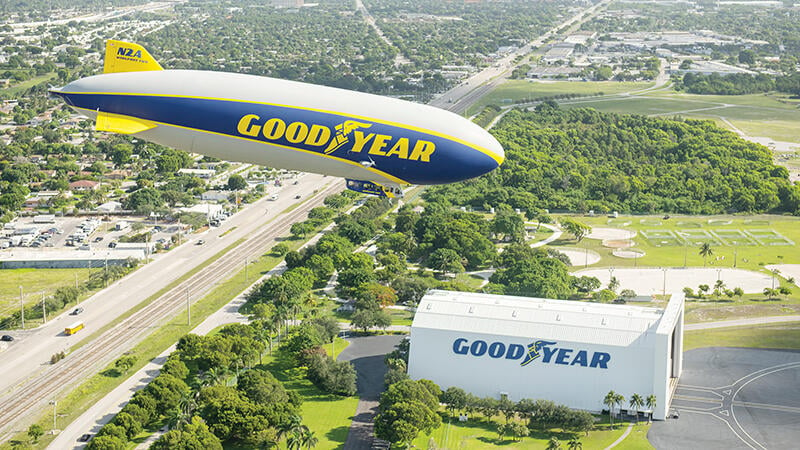
Goodyear operates maintenance hangars in Akron, Ohio, and Pompano Beach, Florida.
Many people have seen the famous Goodyear Blimp fly over a football game, concert or other event, but behind the airship’s recognizable appearance is a highly specialized crew and infrastructure dedicated to managing its unique maintenance requirements. During this year’s EAA AirVenture in Oshkosh, Aviation Week sat down with Adam Basaran, Goodyear’s chief pilot for training, safety and standards, to find out how operations and maintenance differ for these rare aircraft.
Goodyear flies three Zeppelin NT airships: Wingfoot 1, Wingfoot 2 and Wingfoot 3. They are powered by Lycoming IO-360 engines. “It’s the same engine you’d find on a lot of Cessna 172s, so that aspect of the ship is familiar,” Basaran says.
- The airships’ maintainers and pilots must have special training
- The tire specialist is investing in improved testing capabilities for its aviation products
However, the engine’s drive shaft goes through a 90-deg. gearbox that reduces the rpm of its 9-ft. propeller by almost 50%, enabling fairly quiet operation. “We’ll cruise at 45-55 kt., typically, which isn’t fast compared to an airplane, but for an airship, it’s moving along pretty well,” he adds.
Helium provides most of the airship’s lift, “so we could fly almost 24 hr. on just over 300 gal. of fuel” at minimum fuel burn, Basaran says, although typical missions are around 6-8 hr. While other aircraft lose weight as they burn fuel, the blimps are heavier when they land, as helium and air interact and change temperature inside its ballonets to maintain consistent pressure.
Inside the blimps, Basaran says the cockpits resemble those of modern helicopters. They have a fly-by-wire Garmin 500H series avionics suite and can be flown from the left or right seat. “What’s different is we have vector thrust, so the ship will take off and land kind of like a [Bell-Boeing] V-22 Osprey,” he says.
The blimps use standard aviation tires, but they experience less wear and tear because they do not land at high speed, Basaran says.
Goodyear’s blimps operate 5-6 days a week on a mix of missions, ranging from flying over college football games or music festivals to providing charity flights. Basaran says wind affects the airships’ range, but in a day, they can typically fly from San Francisco to Los Angeles or New York City to Akron, Ohio. Goodyear operates bases in Akron, San Francisco and Pompano Beach, Florida.
AIRSHIP MAINTENANCE
At just under 250 ft. long, the airships are larger than almost all widebody commercial aircraft, so they require a large hangar for maintenance. Goodyear’s hangar in Akron was originally built as a production facility for Zeppelin NTs during World War II.
“When the ship lands, we have a really robust maintenance department,” Basaran says. “We have our own repair station that’s in charge of the overall maintenance for the airship. As soon as it goes on our mast, we’ll moor the ship, and then we have a mechanic who will start a post-flight procedure or process with it, which could take an hour or two.”
After longer missions, such as multiweek road trips, the airships receive 100-hr. inspections. Maintenance performed outdoors can be tricky because the airship moves. In most cases, Goodyear’s maintenance teams use metal scaffolding with block-and-tackle mounting points underneath the engine gondolas. “And then we hoist the platform up to the engine gondola, about 30 ft. or so up in the air,” Basaran says. “Then you go up a rope ladder to work on the airship, so it’s very physical.”
Inside the hangar, Goodyear’s maintenance teams use lifts and platforms that can be positioned underneath the airship’s engines, “but we can do almost anything we need to in the field,” he notes.
For instance, when winds are light at Goodyear’s California base, where the weather is more consistent, the team typically ties the airship down to vehicles. “Then the mechanics can go up and do their work a little bit quicker,” Basaran says. “If you need to go down and get a tool, you don’t have to climb down a rope ladder.
“When it’s not being flown, there’s somebody on watch with the airship 24 hr. a day” to monitor conditions such as helium purity and pressure or issues with bad weather, he says. “If there’s any type of maintenance issue that comes up during that time period, they’ll communicate that to our repair station for write-up and then repairs in the morning.”
Once a year, the airships are flown to Akron for heavier maintenance, which requires removing all the helium, compressing it and storing it in a tanker truck behind the facility.
“The blimp goes from being lighter than air to weighing just under 20,000 lb., hanging from a center rail in the hangar,” Basaran says. “And then our maintenance team uses climbing gear, and we have an ascender system they latch into to go up into the ship to inspect the internal framework, which is carbon fiber and aluminum. Those things you wouldn’t do maintaining a Boeing 737, so it’s different and specialized.”
Dealing with compressed gases also requires specialized training and safety equipment. “We call it the world’s biggest confined space because the ship itself has limited egress in and out, so everybody has to go through confined space training,” Basaran says. “We have rescue gear on site. We have some processes worked out with local fire departments and things like that to do this all safely.”
Maintenance technicians for Goodyear must also be highly trained to work on airships. “It takes us several years once we bring on an [airframe-and-powerplant-certified technician]” to train them for the blimps’ unique maintenance needs, he says. “We have different levels of mechanics and different levels of inspection that they gain capabilities on over time for the type of work that they’ll be doing on the airship.”
FINDING TALENT
Competition for qualified maintenance technicians is high, and it is even more intense for Goodyear due to the job’s unique requirements.
“We try to find people who have a passion to do something and learn something that’s different,” Basaran says. “Even if you’ve been a mechanic working in the airlines for the past decade or two, you’re going to be learning something new.”
Goodyear’s pilots must also obtain lighter-than-air (LTA) airship ratings. The company prefers to hire pilots with flight instructor backgrounds because it also operates its own school, and finding LTA-rated instructors is difficult.
“You can’t really go anywhere to learn to fly blimps,” Basaran says. “We are our own blimp school, [and] my primary job [is to] teach our new pilots how to fly the ship.” One of Goodyear’s pilots is also a designated pilot examiner (DPE) and can perform check rides, which typically happen every couple of years in coordination with the FAA.
“Everybody’s trying to stay current, so it’s usually a whole thing when we have somebody going for their check ride,” he says. “Our DPE is doing it, the FAA is keeping him current, the FAA is getting their experience, and it’s a lot of coordination.”
TIRE IMPROVEMENTS
Beyond maintaining its fleet of blimps, Goodyear is looking at ways to optimize the performance and maintenance of its tire products.
“Maintenance starts long before the tires wear out,” says Karla Rhoads, account executive for Goodyear Aviation. “Maintenance also depends on the pilot and how they land, and some are a little harder on tires than others, but we’ve designed the tires for durability.”
This includes designing and testing tires for “all types of runway scenarios” and aiming to ensure durability that provides efficient cost per landing, she says. Rhoads notes that Goodyear is “heavily investing in our testing facilities on the aviation side,” including a high-speed dynamic tire testing project to increase testing capability for up to 175,000 lb. and up to 350 mph.
“That’s really for the most demanding takeoff and landing aspects,” she adds.
Goodyear also has a test wheel in Akron that does dynamic tire testing, including simulating extended taxi cycles. “In very extenuating circumstances where the aircraft is taxiing around,” Rhoads says, such as the reportedly long taxi times at Chicago’s O’Hare International Airport due to airfield construction work, “that could impact the life and performance of the tire.”
The company provides tire retreading services at its facilities and partners with maintenance, repair and overhaul providers, which send Goodyear tire casings to be swapped out.
Goodyear has begun implementing digital technologies for predictive maintenance in other segments, and Rhoads says the company is very interested in extending this to aviation.
“I think it’s going to come along,” she says. “It just depends on how many sensors are in the tire and what the operator wants to transmit to us to be able to predict wear patterns.”


Comments
A funny side story is that the hanger had sunk several feet over the 32 years the Goose was stored there, requiring a wait for low tide. But....no one told the guys that there was no toilet on that earlier blimp!