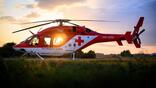
20/Twenty: The Bell 429 Twin: A Utility Infielder

On ground, the Bell 429 is available with either wheeled gear or skids.
Bell delivered its first 429 light twin in 2010 and 526 more through the end of 2025. New, out-the-door prices range from $7.5 million to $10 million depending on options or kits selected, and used retail prices start at $3.9 million for a 2010 model and average $5 million to $6 million, according to the Aircraft Bluebook.
Like all light twins, pre-owned models have seen strong demand, driven by their popularity with helicopter emergency medical services (HEMS) operators. Consequently, very few 429s are on the market at any given time. A recent database search showed six—or 1.13% of the fleet.
Powered by a pair of FADEC-controlled Pratt & Whitney Canada PW207-D1/D2 turboshaft engines (635 shp each, max continuous), the 7,000-lb. maximum gross weight (7,500 lb. via an increased gross weight kit where allowed—in 25 countries, but not the U.S.), eight-seat (two pilots, six passengers) Bell 429 has a fast cruise speed of 150 kt., a Vne (never-exceed speed) of 155 kt. and maximum range of 411 nm (472 mi.).
The range is 421 nm with the far less popular wheeled landing gear variant, and the 39-gal. auxiliary tank can add 40-60 nm to that. The Bell BasiX-Pro digital cockpit is single-pilot IFR-capable and includes an automatic flight control system.
The useful load is 2,535 lb. Remember that number, because it partially explains the market trajectory of the 429.
The raison d’être for the 429 was to provide the marketplace with a helicopter matching the speed of a Leonardo AW109, with a larger cabin than the darling of the twin-engine HEMS sector, the Airbus H135, and an airframe less maintenance-hungry than either.
And it succeeded. The 429 was certified with MSG-3 (Maintenance Steering Group–3) “on condition” maintenance requirements, similar to how airliners are maintained. The combined flat-floor cabin and baggage hold provided, for its category, a voluminous amount of space—204 ft.3—enough for one or even two patients and two to three medical crew plus the pilot. Optional rear clamshell doors make medical litter loading easy—as do the massive, 62-in.-wide sliding rear doors on both sides and the 60-in.-wide cabin.
Four-bladed main and tail rotors, combined with Bell’s Liquid Inertia Vibration Eliminator system, deliver a smooth ride. But all this goodness comes with a weight penalty. The 429 is big, comfortable, durable—and fat. And on HEMS missions, that was a problem.
At the time the 429 was certified, the average medical kit weighed 600-800 lb. Add 800 lb. of crew and patient, and that made the helicopter a 2-hr. machine, without reserves, and less with a larger patient or extra medical equipment.
Meanwhile, the much lighter Airbus and Leonardo machines offered useful loads that were 800 to 1,000 lb. more. Bell attempted to address the problem by petitioning the FAA for an exemption to the Part 27 certification rules that impose a 7,000-lb. maximum weight limit, allowing the 429 to be operated at an increased gross weight of 7,500 lb.
While two dozen other regulatory bodies, including Transport Canada, granted the exemption, the FAA declined, noting that approving it would place other manufacturers at a competitive disadvantage. This not only hurt 429 HEMS sales in the U.S., but also limited the types of executive interiors that could be installed in the cabin. Not surprisingly, only 15% of the 429 fleet is engaged in HEMS—for now—and much of it in Europe, where the distances are shorter and operators place a premium on the 429’s good high-
altitude performance: a 20,000-ft. ceiling, with one-engine inoperative up to 11,930 ft.
But technology moves ever forward, and in recent years Bell has developed a lighter-weight executive interior (its “designer series”), and its suppliers have devised medical interiors that weigh as little as 250 lb. So prospective customers who had weight concerns are taking another look.
The two largest U.S. air ambulance companies—Air Methods and Global Medical Response—placed fresh orders for 429s last year. However, even before the lighter interiors became available, the 429 developed a solid reputation as a multi-mission aircraft for law enforcement and as a patrol aircraft for militaries worldwide. Those customers in the U.S. include police agencies in Arizona, Delaware, Florida, Illinois, Minnesota and Virginia. The Canadian Coast Guard operates a fleet of 16 search-and-rescue/patrol 429s from nine bases.
Pilots are generally pleased with the 429’s comfort, speed and handling.
Aside from early problems with the cockpit displays, largely solved when Bell switched suppliers, operators report good product support and reliability. Past squawks have included rotor blade abrasion strip cracks caused by a since-remedied manufacturing defect and sensitive torque pedals.
BCA welcomes comment and insight from aircraft dealers and brokers for its monthly 20/Twenty pre-owned aircraft market feature. The feature aircraft for April is the Embraer Lineage. To participate, contact [email protected].
Related Content