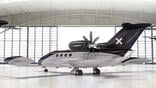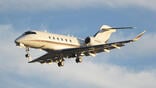
Dassault Falcon 7X
Alarms went off at Dassault’s St. Cloud headquarters in the late 1990s, when the 6,500-nm (7,480-mi.)-range, 0.80-Mach cruise Gulfstream G-V and Bombardier Global Express made their debuts. The 4,750-nm-range, 0.76-Mach cruise Dassault Falcon 900EX no longer was competitive in the top-most large cabin segment.
Dassault responded by announcing Falcon 7X at the 2001 Paris Air Show. The French planned to leapfrog their North American competitors, not by offering more range and speed, but by introducing the world’s first digital flight control system (also known as fly-by-wire) business jet, capitalizing on 40 years of fly-by-wire development for its military jets.
Designers at St. Cloud predicted large cabin operators would not need more than a 5,950-nm range because the Falcon 7X could fly between operators’ most frequently visited city pairs. Instead, the new jet would offer impressive runway performance, three-engine redundancy and best-in-class fuel efficiency.
Fly-by-wire offered carefree handling, increased fuel efficiency, a more comfortable ride for passengers and enhanced safety margins. The Falcon 7X’s three-section, 39-ft.-long cabin was 3-4 ft. shorter than its North American competitors, but it was 6 ft. longer than the Falcon 900EX, making it an attractive step up for longtime Falcon afficionados.
Other features include the first sidestick controls in a business jet, a soft-ride flexible wing structure, trailing link main landing gear, speed-proportionate steer-by-wire solely through the rudder pedals and ground-only auxiliary power unit (APU). (Dassault said that the third engine eliminated the need for a flight-rated APU.)
The trijet quickly earned high marks for its light structural weight, excellent flying qualities, low fuel burns and product support, plus a standard second lavatory up front. Over time, dispatch reliability and Dassault’s product support also became strong points. The EASy II flight deck, considerably more capable and reliable than the jet’s original EASy I kit, eventually became a major asset.
Typical 12-14-passenger floor plans have 20-in. side chairs, with four in club in the forward cabin, four seats together in conference grouping in mid-cabin and an aft private stateroom, accommodating four to six occupants. Floor plan layouts are a bit limited because of required access to the single, mid-cabin emergency exit over the right wing.
A 50-in. right-side forward galley, left-side galley annex and third crewmember chair are standard. Average cabin sound levels were 52 dB on early units, but later deliveries with improved insulation reduced this by 3 dB-5 dB. Popular Falcon 7X options include an extended galley, left-side crew rest area in place of the galley annex, head-up display, FalconEye enhanced flight vision system and Ka-band satcom.
The 10.2 psid pressurization system affords passengers 4,000 ft.-5,000 ft. cabin altitudes at typical cruise altitudes. The 140-ft.3 aft baggage compartment, fully accessible in flight, is 10% bigger than on previous Falcon jets. Operators say range performance is sufficient for nonstop trips between most North American and European city pairs.
Falcon 7X can climb directly to FL410 at max takeoff weight (MTOW), but it will not cruise faster than 0.81-0.82 Mach when heavy, owing to high-altitude thrust limitations of the fuel-miserly 6,400-lb.-thrust Pratt & Whitney PW307A turbofans. Mach 0.83 cruise is a sweet spot, operators tell BCA. At lighter weights, it can cruise at 0.85 Mach, but range drops to 5,200 nm. Operators typically cruise from FL360 to FL400, unless maximum-range performance is a consideration.
Operating Flexibility
Day-to-day operating flexibility is a major selling point for the aircraft. Max landing weight (MLW) is 89% of MTOW, so operators can hop-scotch between airports to pick up or leave off passengers, then cross the Atlantic without having to stop for fuel. Based on our experience flying the aircraft, it is as comfortable in a Falcon 7X to use small general aviation runways as it would be in a light jet. You will cross the landing threshold as slow as 105 knots indicated airspeed. It will stop in as little as 2,100 ft.
When we first flew it in 2006, we immediately were impressed with how easy it was to control, especially in turbulence. The flightpath-stable fly-by-wire control law allows the pilot to move the sidestick to set trajectory and then relax while the digital flight control system holds the nose stable with speed and configuration changes. Low- and high-speed envelope protections made it virtually impossible to stall the airplane or exceed its VMO/MMO redlines.
According to resale broker Aerocor, operators can plan on 2,500 lb./hr. average fuel flows. Budget $1,350/hr. for engine reserves, assuming 7,200 hr. TBOs for the three PW307As, plus $2,234/hr. for maintenance and $359/hr. for miscellaneous trip costs, such as catering and consumables. Operators with in-house maintenance typically budget a total of $3,000-$3,500 for direct operating costs. Contract maintenance considerably increases direct operating costs.
Maintenance inspection intervals are 25–50% longer than with older Falcon jets. Scheduled A checks are due at 600 hrs. every 9 months. B checks are slated for 2,400 hr. Major C checks come at 96 months/4,000 cycles and they can be pricey, running upward of $2 million–$5 million for 2C checks and $750,000 for 16-year landing gear overhauls, assuming rebuilt units from Messier Dowty are available.
Dassault FalconCare contract maintenance can take much of the sting out of the C check bills. It typically runs $2,500–$3,500 per hour, depending where the aircraft is based, annual utilization and landing cycles versus flight hours.
Dassault delivered 300 units between 2007 and 2023 when production ended, roughly half the deliveries of either G550 or the Global Express series. Chalk that up to Falcon 7X’s shorter range and smaller cabin, plus cruising at lower altitudes and slower speeds.
Most Falcon 7X resale market buyers are upgrading from Falcon 900EX, Falcon 50 and 2000-series jets, not Gulfstreams or Globals, according to Aerocor. There are 290 Falcon 7X aircraft in the current active fleet, split evenly between North America and other regions, typically in Europe, Brazil and Asia.
The Falcon 7X is a niche aircraft. Few regularly change owners. Most operate their aircraft for 68 months before trading for a different model. Currently, there are 8 units on the market, priced between $19 million and $28 million.
There is stiff competition in this resale market segment. The Gulfstream G550 has a slightly narrower—but longer—cabin, plus 500 nm more range. It cruises higher and faster, yet it consumes more fuel and has a stiffer ride. The Bombardier 6000 also has more range and just as soft a ride as the Falcon 7X, along with a longer and wider cabin. However, its highest-in-class fuel consumption gives it a high profile in an increasingly eco-conscious world.
Much of the Falcon 7X’s allure is its fighter jet DNA, technical innovation, design elegance and flight deck sophistication. Compared to larger, heftier and more powerful jets, flying a Falcon 7X is more akin to waltzing with a French fashion model than doing the Lindy Hop with an Olympic weightlifter.

Related Content