
Aircraft Overview: De Havilland Twin Otter Series 400 / Twin Otter Classic 300G
Aircraft Overview: De Havilland Twin Otter Series 400 / Twin Otter Classic 300-G
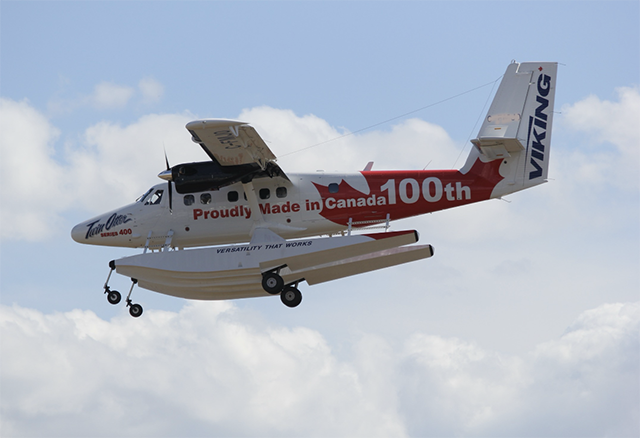
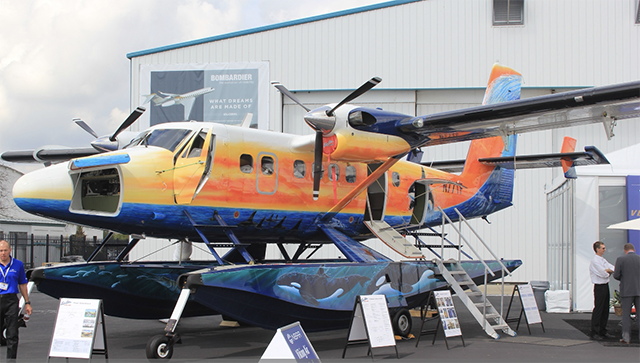
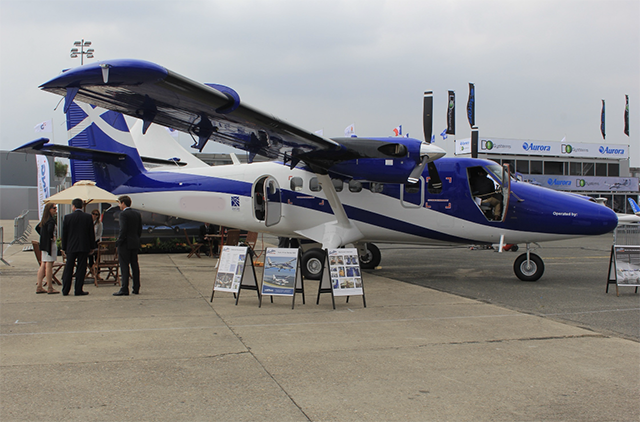
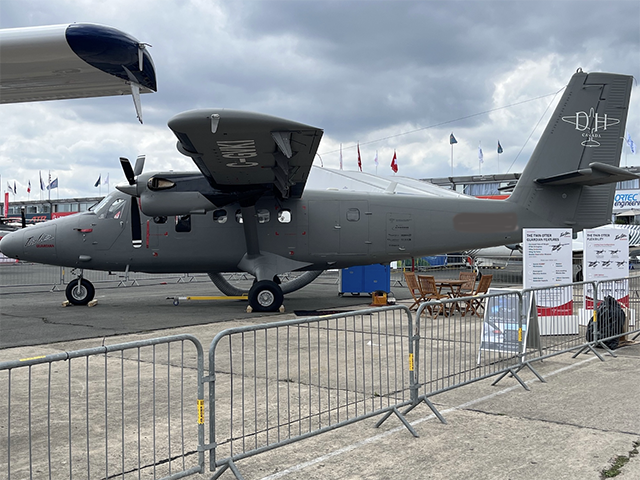
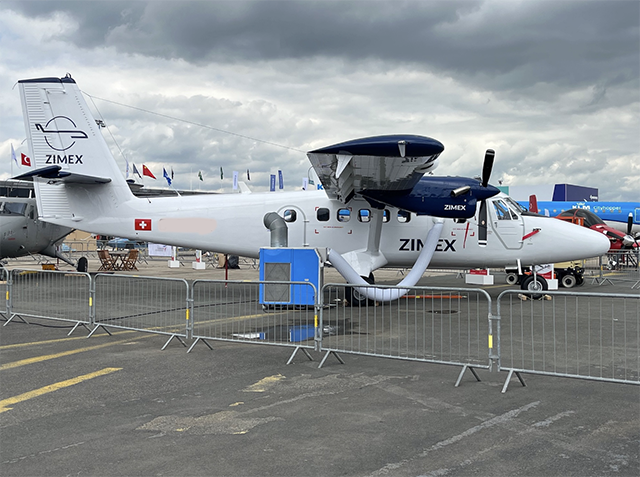
The DHC-6 Twin Otter Classic 300-G and the Twin Otter Series 400 are high-wing, twin-engine, turboprop airplanes produced by De Havilland Aircraft of Canada Limited, and which are marketing designations of the company’s DHC-6 type.
Representing the fourth generation of the DHC-6 type, production of the DHC-6 Series 400 began in 2008, with that variant certified by Transport Canada on June 24, 2010, and the first airframe being delivered to Swiss operator Zimex Aviation in 2010.
Subsequently, on June 19, 2023, at the Paris Air Show, De Havilland Canada launched the upgraded, fifth-generation version of the DHC-6, the DHC-6 Twin Otter Classic 300-G.
At the 2025 Paris Air Show, the airframe manufacturer stated that the Classic 300-G would also enter service with Zimex Aviation.
Cabin
According to the Transport Canada type certificate data sheet (TCDS) for the DHC-6, the DHC-6 Series 400 has a maximum occupant capacity of 19—not including the pilot seats—a capacity that the Twin Otter Classic 300-G will retain.
Those passengers are accommodated in a cabin that has a length of 18 ft. 5 in., width of 5 ft. 9 in. and height of 4 ft. 11 in.
The Classic 300-G’s cabin interior, which has been “completely redesigned,” is promoted as improving the comfort of passengers and “significantly reducing the aircraft’s [b]asic [e]mpty [w]eight.”
Avionics
All series of the DHC-6 are certified to be operated by one pilot, with the pilot(s) operating the Twin Otter Series 400 by utilizing Honeywell’s Primus Apex Integrated Flight Deck that has four displays.
In contrast to the Series 400’s Honeywell avionics, another change made to the Classic 300-G is the installation of Garmin’s G1000 NXi Integrated Flight Deck.
De Havilland Canada states that the features of the Classic 300-G’s avionics include an autopilot, flight management system (FMS), flight-tracking system, ground proximity warning, satellite communications, synthetic vision, traffic advisory, video display and weather radar.
Unlock the data behind the charts with Aviation Week Intelligence Network’s Fleet & Data Services. Learn more at aviationweek.com/bcaaircraftoverview.
Utilization Overview
For a comprehensive Program Profile including recent articles, program suppliers and current operators, please access via AWIN subscription here.
Variants
The DHC-6 Series 400 is powered by two Pratt & Whitney Canada PT6A-34 turboprop engines that have takeoff and maximum continuous ratings of 620 shp.
In contrast to the Series 400, the Classic 300-G is equipped with PT6A-27 engines as standard, while the PT6A-34 is available as an option.
The basic weight of the Twin Otter Classic 300-G is also lowered by 400-500 lb., a reduction which allows that version of the DHC-6 to have greater range or carry additional payload.
Despite those differences between the Classic 300-G and Series 400, both have a common 12,500-lb. maximum takeoff weight (MTOW), 12,300-lb. maximum landing weight (MLW) and 2,576-lb. standard fuel capacity, with a 3,176-lb. extended fuel capacity also possible.
Mission and Performance
The cabins of the Twin Otter Classic 300-G and Series 400 can perform missions such as cargo, medevac and VIP transport, as well as special missions.
Additionally, both versions of the DHC-6 can be equipped with different types of landing gear, to include floats or amphibious floats, intermediate flotation gear, skis and wheels.
The performance limitations of the DHC-6 Series 400 include a maximum operating limit speed (VMO) that varies between 170-kt. calibrated airspeed (KCAS) from sea level to 6,700 ft., and 115 KCAS at the 25,000-ft. maximum operating altitude.
In addition to those certified maximum speeds, both the Series 400 and Classic 300-G are capable of a maximum cruise speed at sea-level altitude of 170-kt. true airspeed (KTAS).
Furthermore, when carrying no payload and equipped with the standard fuel tanks, Series 400 airframes with wheeled landing gear have a maximum range of 763 nm, a range that is increased to 925 nm on airframes that have long-range fuel tanks.
Assuming an airplane equipped with wheeled landing gear and operated at the MTOW, the Series 400’s takeoff field length to 50 ft. is 1,490 ft. Comparatively, at the MLW and from 50 ft., the landing field length is 1,510 ft.
Although the takeoff and landing distances of the Classic 300-G are the same as the Series 400, the maximum ranges of the former DHC-6 with no payload and a 2,270-lb. payload are 871 nm and 803 nm, respectively.
Aviation Week Network is home to market-leading data and intelligence products. Find out which database is best for your business.
www.aircharterguide.com/
www.aircraftbluebook.com
www.acukwik.com/Products
www.airportdata.com
www.fleet.aviationweek.com