PC-12 Runway Incursion Highlights Risk At Caribbean Airport, BEA Says
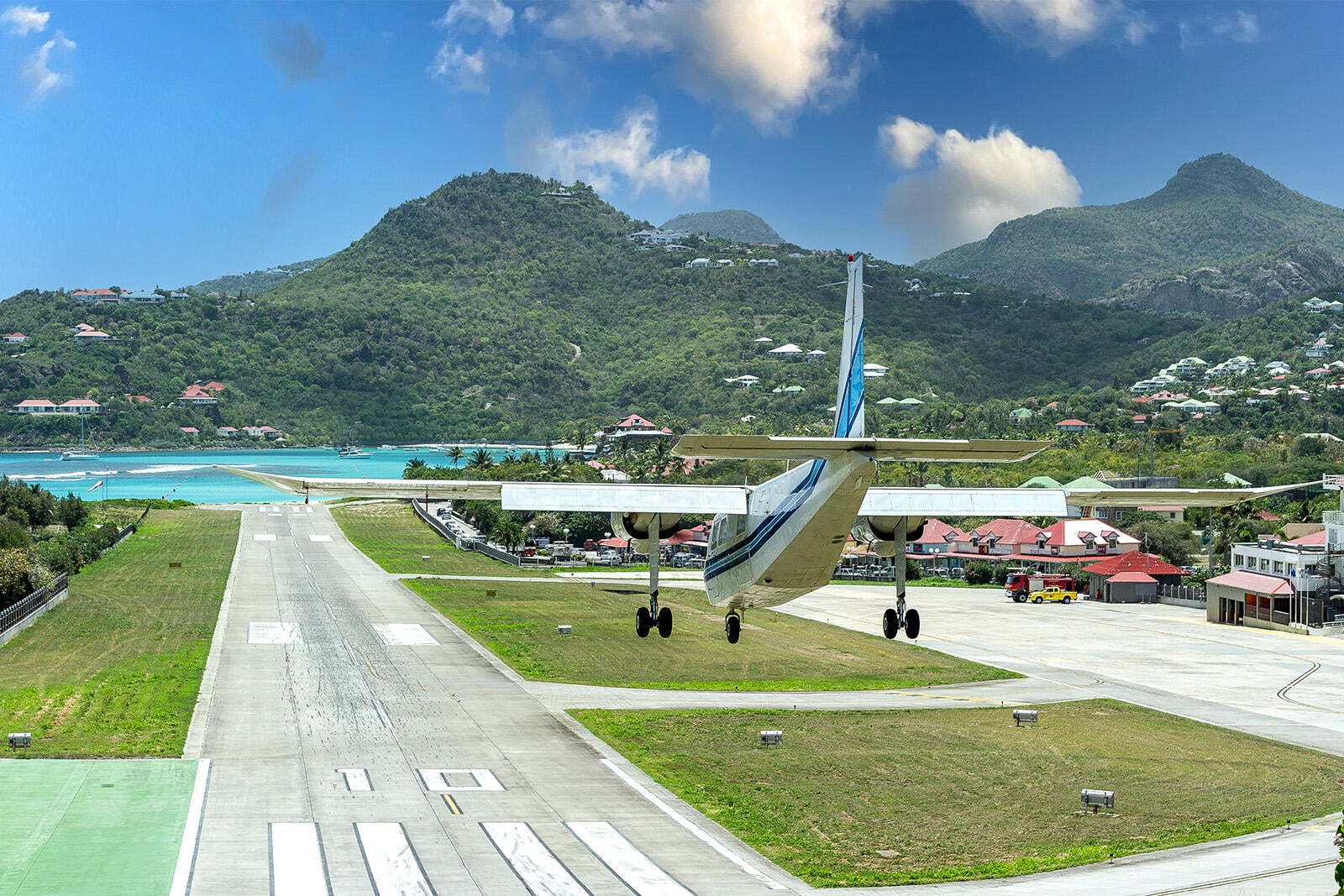
Saint Barthelemy Airport
LYON—The unannounced U-turn of a Pilatus PC-12 on Saint Barthelemy Airport’s runway took place as a De Havilland Canada DHC-6 was landing at the other end on Jan. 29, 2025, signaling a lack of crew situational awareness and underlining the absence of authority of Aerodrome Flight Information Service (AFIS) agents, investigators from France’s Bureau of Enquiry and Analysis for Civil Aviation Safety (BEA) say.
During the probe and in the months before, BEA was notified of several incidents in the aerodrome pattern, including nearly avoided runway collisions. Instead of air traffic controllers, whose role includes giving orders to crews, the busy Saint Barthelemy airport—a luxury destination in the Caribbean—has AFIS agents, who only provide information. In a final report, the BEA classified last year’s event—all the more dangerous as the runway is only 2,120 ft. long—as a serious incident.
Some 32 min. before sunset, the pilots of the DHC-6 twin turboprop operated by Winair—a Dutch government-owned regional airline based in Sint Maarten—announced on the AFIS frequency that they were extending the downwind leg of their approach trajectory to create enough separation from the PC-12 turboprop single, operated by Tradewind Aviation, a U.S. based aircraft operator providing private charter service. The DHC-6 was carrying 16 passengers and the PC-12 one, both with two crewmembers, on scheduled flights. The DHC-6’s crew saw the PC-12 and began final approach to Runway 28 just 40 sec. after the single.
At that point, the AFIS agent informed the DHC-6’s crew that the PC-12 was on the runway and had to vacate at the end. The PC-12’s crew was not aware of the DHC-6’s proximity, the BEA says, deeming it likely the position of the Sun, as well as terrain shadow on the runway, prevented the other crew from seeing the PC-12.
Contrary to the AFIS agent’s assumption, the PC-12 made a U-turn and taxied to the main apron, thus facing the DHC-6 for 300 ft. The PC-12’s crew had not announced their intention. The AFIS agent reiterated to the DHC-6’s crew that the PC-12 was on the runway but did not mention the U-turn.
The DHC-6, descending through 47 ft., was about to reach the Eden Rock point, after which the approach can no longer be interrupted. The crew did not abort the approach because Winair’s procedures did not provide for an interruption in case the runway was busy and landed as the PC-12 was still on the runway, the BEA says.
Among the contributing factors, the investigators noted the DHC-6’s crew left insufficient separation from the PC-12. Both crews had low situational awareness because of the insufficient information they and the AFIS agent shared. The fact such agents have no authority was a factor, too, the BEA adds.

Related Content