This article is published in Aviation Week & Space Technology and is free to read until Jun 17, 2026. If you want to read more articles from this publication, please click the link to subscribe.

Port Authority To Bolster Vehicle Surface Safety After LGA Collision

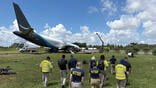
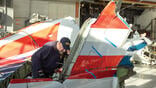
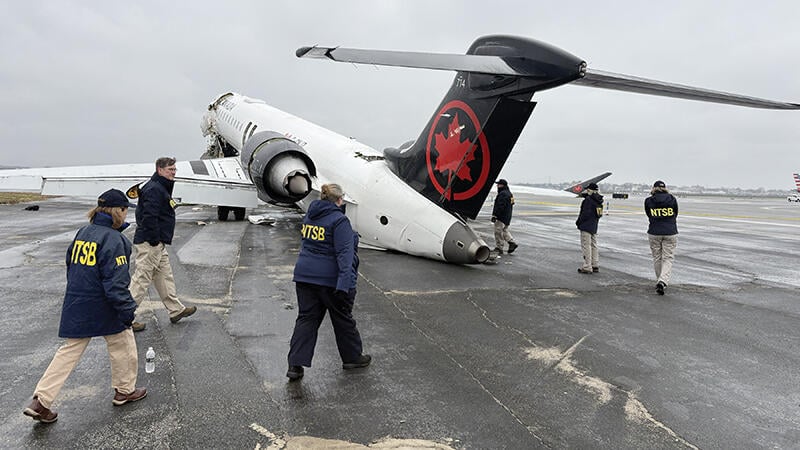
NTSB investigators around damaged Air Canada jet

Investigators are examining the performance of two important collision prevention systems in the March 22 crash at LaGuardia Airport.

Credit: NTSB

The Port Authority of New York and New Jersey plans to add transponders to airport operations vehicles in the wake of March’s fatal collision between an Air Canada Jazz regional jet and a fire truck.

The NTSB probe into the March 22 accident at New York LaGuardia Airport (LGA) is in its early stages (AW&ST April 6-19, p. 30). A preliminary report released April 22 confirms that the Airport Surface Detection Equipment, Model X (ASDE-X) surface surveillance system was operating.

  • NTSB preliminary report flags gaps in airport surface safety systems
  • The runway entrance lights were working, but they were not heeded
  • Lack of vehicle transponders hampered the surface collision-warning system

But the fire truck that was leading a group of first responders and using call sign Truck 1 was not detected as a collision threat as it approached the active runway. None of the seven vehicles in the convoy had a vehicle movement area transmitter (VMAT), which broadcasts accurate location and trajectory data.

“Without transponder-equipped vehicles, the ASDE-X system could not uniquely identify each of the seven responding vehicles or reliably determine their positions, or tracks,” the report stated. “As a result, the system was unable to correlate the track of the airplane with the track of Truck 1 (or any of the other vehicles in the group) and did not predict a potential conflict with the landing airplane.”

VMATs are recommended by the FAA but not required. The Port Authority had begun testing them in December at New Jersey’s Newark Liberty International Airport.

“We will be expanding that capability across our airports, building on the technology already in place,” said the authority, which also manages New York’s John F. Kennedy International Airport and Stewart International Airport as well as Teterboro Airport in New Jersey.

The lack of VMATs on the responding convoy is one of several issues emerging as key factors in the accident. The convoy’s lead vehicle, an Oshkosh Striker 1500, ran through illuminated runway entrance lights (REL) before entering Runway 4, where the Air Canada Jazz Bombardier CRJ-900 was landing, investigators confirmed.

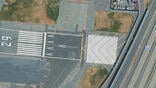
The RELs illuminated when Truck 1 was near the intersection of Taxiways D and AA, about 460 ft. from the edge of Runway 4 and not yet at the runway entrance’s hold-short line.

The series of six lights extends out from the runway’s centerline to hold-short lines along the intersecting taxiway. During the 30 sec. they were illuminated, Truck 1 received clearance to cross Runway 4 and traveled about 360 ft., crossing the hold-short line and the initial RELs.

“A review of airport surveillance video recordings revealed that the RELs illuminated for the arrival of the accident airplane, as Truck 1 and company were stationary in the vicinity of the Taxiway AA and Taxiway D intersection, about 300 ft. away from the Runway 4 hold-short line on Taxiway D,” the report stated. “The RELs on Taxiway D remained illuminated until about the time Truck 1 reached the (near) edge of runway, when they extinguished, about 3 sec. prior to the collision.”

RELs, triggered automatically by arriving and departing aircraft, are meant as a safety net and should never be crossed if red. If they conflict with air traffic control (ATC) instructions, a driver or pilot should ask for clarification, FAA guidance says.

ATC had cleared the regional jet, operating as Air Canada Express Flight AC8646, to land on Runway 4 at 23:35:07, when it was on a 5-nm final flying at an altitude of about 1,900 ft., the report’s timeline shows. The emergency response vehicles rolled from their station 21 sec. later and gathered on an adjacent taxiway.

Truck 1, which moved to the front of the convoy when another vehicle tried and failed to reach ATC, received runway crossing clearance for the group at 23:37:07 local time. At that point, Flight AC8646 was about to cross the Runway 4 threshold, some 3,700 ft. from the Taxiway D intersection and at less than 100 ft. altitude.

At 23:37:12, ATC ordered Truck 1 to stop. Five seconds later, the CRJ-900’s main landing gear touched down as Truck 1 was crossing the hold-short line, about 200 ft. from the runway edge at about 24 mph.

At 23:37:20, ATC again ordered Truck 1 to stop. The truck was about 100 ft. from Runway 4 and accelerating. The other vehicles stopped.

Four seconds later, at about 23:37:24, the truck and the CRJ-900 collided. The truck veered left just before impact, and the CRJ-900’s rudder deflected left about 6 deg.

Both pilots were killed in the collision, and six of the 74 others onboard the CRJ suffered serious injuries.

Two controllers were in the LGA tower at the time of the accident—one local controller (LC) and one ground controller (GC) who was also the controller-in-charge (CIC). Staffing was “consistent with the midshift basic watch schedule,” the report stated. “Both were qualified and current on all control positions at LGA.” Each controller had been on duty for less than 1 hr. when the accident occurred.

The LC was handling all arrival and departure traffic, surface traffic and “aircraft operating within assigned airspace,” investigators found. The GC/CIC was “coordinating ground operations” with an aircraft that had returned to the gate area after two rejected takeoffs. That aircraft declared an emergency, prompting the multivehicle emergency response caravan.

Sean Broderick

Senior Air Transport & Safety Editor Sean Broderick covers aviation safety, MRO, and the airline business from Aviation Week Network's Washington, D.C. office.

Comments

1 Comment
It's about time! It's negligence in my opinion to not have transponders on emergency vehicles. That was just plain stupidity and arrogance.