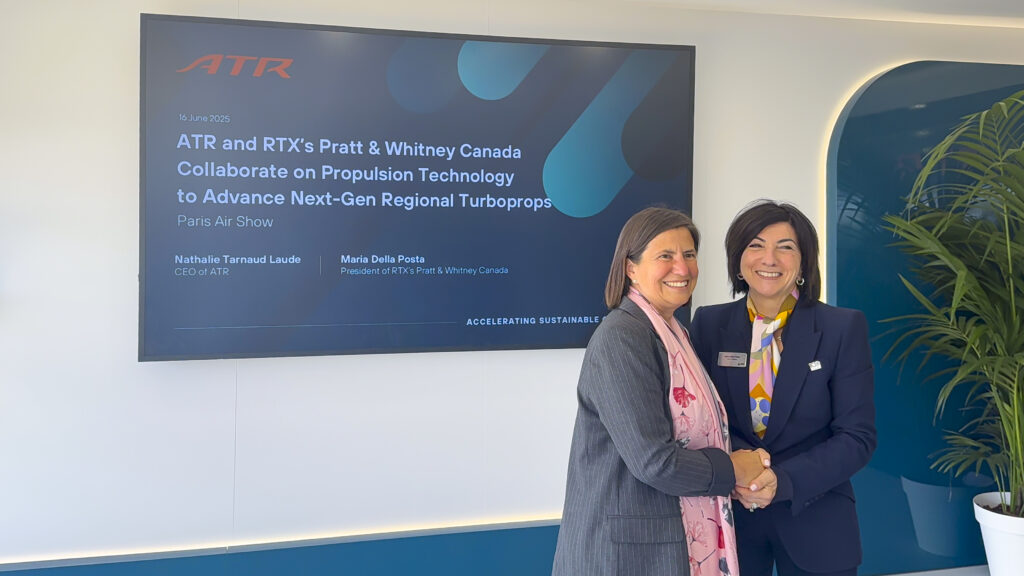
ATR CEO Nathalie Tarnaud Laude (left) and RTX Pratt & Whitney Canada president Maria Della Posta.
Turboprop manufacturer ATR has teamed up with existing partner Pratt & Whitney Canada (P&W) to work on future engine iterations, including potential powerplants for ATR’s planned EVO hybrid-electric aircraft family.
ATR and P&W began working together on the PW120 in the 1980s, leading to today’s PW127XT, which powers the ATR 42-600 and 72-600.
“As we work together on further improvements to the PW127XT-M, we are shaping the technologies that will drive the next generation of regional aircraft—a key step in the feasibility study for the ATR ‘EVO’ concept,” ATR CEO Nathalie Tarnaud Laude said.
Plans for the hybrid-powered EVO family were first released in May 2022, with a planned entry into service (EIS) in the early 2030s. However, ATR delayed its go-ahead decision from 2023 to early 2025, with EIS slipping to 2032. Since then, the program has slipped further because of battery performance issues.
Under their partnership, ATR and P&W will focus on sustainability, fuel efficiency, performance, durability and operating costs. This will involve thermal efficiency improvements to reduce fuel burn; advanced materials for better engine durability, reliability and reduced maintenance costs; and optimized engine, nacelle and aircraft integration to improve aerodynamics.
“We are now setting our sights on the next generation of engines, advancing fuel efficiency, reducing carbon emissions and enhancing operational performance,” Tarnaud Laude said.
The P&W-powered ATR fleet spans around 1,300 aircraft in service, including over 60 powered by the PW127XT-M, which entered service in 2022 and has accumulated more than 300,000 flying hours to date. The PW127XT-M is 3% more fuel efficient than its predecessors and 40% more durable, with 20% lower maintenance costs.