This article is published in Air Transport World part of Aviation Week Intelligence Network (AWIN), and is complimentary through Jan 04, 2026. For information on becoming an AWIN Member to access more content like this, click here.

Spanish LCC Volotea Is Growing Fast And With Purpose

aircraft on tarmac

Volotea’s fleet of Airbus A319s and A320s has allowed it to rapidly grow its small- and mid-sized route network.

Credit: Marc Glen Photographie/Volotea

Spanish regional airline Volotea intentionally sits below the radar. Volotea’s network has quietly grown to serve 420 point-to-point routes that most airlines overlook. Although a Spanish carrier, it is more active in France and Italy than in Spain. Volotea also had the dubious accolade of being the final Boeing 717 operator in Europe.

“That was the happiest funeral ever,” Volotea CEO Carlos Muñoz joked, reflecting on the retirement of the 125-seat 717s in 2021.

The 717 was an unusual choice when Muñoz launched the airline in April 2012, but it speaks volumes about Volotea’s unusual business model. Back then, easyJet, Vueling, Ryanair and Norwegian operated Airbus A320 and Boeing 737 variants. The 717 had 50 fewer seats, meaning Volotea could seize the market between the regional carriers and LCCs. Since then, European LCCs have upgauged to larger narrowbodies. Volotea has moved to A319s and A320s, intentionally staying one capacity step behind.

“As the big guys move up, we move up into to that middle space,” Muñoz told ATW.

Volotea was the first European LCC to make thinner routes its core strategic focus, flying point-to-point between smaller underserved cities. More than half of Volotea’s routes have no direct competition. “Typically, two-thirds of the routes that we start did not exist before,” Muñoz said. “People don’t want to drive two hours to get to an airport.”

Muñoz said Volotea does not “shy away” from thicker routes, but its average city pair is under 30,000 seats a year. He compares this with Vueling, another Spanish LCC that Muñoz co-founded, which targeted dense routes averaging around 180,000 seats per year. “EasyJet and Ryanair would be between 80,000 and 100,000,” he said.

This means Volotea’s network planners had to learn on the job because there were no existing experts in thinner low-cost routes. It didn’t always go to plan.

“We were so smart and so successful that we launched 90 routes, and we closed 40 at the end of year one,” Muñoz recalled, laughing. “Trust me, that was a vivid and hard learning experience.”

Muñoz estimates that Volotea has launched around 600 routes to get to the existing network of 420. “Being an innovator has its downside. No matter how smart you are, you’re going to make mistakes,” Muñoz said. “The flip side of that is, over the years, you build unique expertise in being able to predict which routes are going to work well, and which will not.”

After 13 years of specialized route analytics, Volotea has become “very, very, very numbers driven.”

Today, Volotea serves 110 airports and has 19 bases, including 10 in France (Bordeaux, Brest, Lille, Lyon, Lourdes, Marseille, Nantes, Rodez, Strasbourg and Toulouse), seven in Italy (Bari, Florence, Naples, Olbia, Palermo, Venice and Verona), and just two in Spain (Asturias and Bilbao).

Volotea’s reputation has been central to this growth. “In big cities, everything, including people, becomes more anonymous,” Muñoz said. “In small cities, people will talk about you, for good or for bad, much more often. Word of mouth is even more critical.”

This niche strategy is paying off. Volotea expects to carry 11.5 million passengers in 2025, generating around €840 million ($976 million) in revenue. This is set to deliver an EBIT of €70-80 million, more than double the €33.5 million achieved in 2024 and paving the way for the strongest financial results in Volotea’s history.

“Looking ahead to 2026, we continue to see strong market dynamics and almost endless opportunities,” Muñoz said. “And we anticipate stronger growth, above 10% [reaching nearly 14 million seats], limited only by the number of aircraft available.”

Volotea has built a fleet of 41 leased Airbus aircraft (17 156-seat A319s and 24 180-seat A320s). “Three or four years ago, we were thinking of changing to neos,” Muñoz said. However, engine issues have had a knock-on effect on leased aircraft availability.

Muñoz sees supply chain problems continuing for the next couple of years, but he believes Airbus reaching an annual output of 75 A320 family aircraft will signal a turning point. “That’s the number to watch for,” he said. “In 2024 they postponed it to 2025. Now they’re saying 2027. That is the key driver. That’s the bellwether number, in my opinion.”

Following the 717 transition, Volotea jumped from 125 seats per aircraft to 167 on average, a shift which was handled by managing frequencies. However, another fleet decision is looming, given that there is no A319neo. Within two to four years, some midlife Airbus A220s or Embraer E2s could be on the horizon.

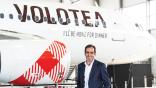
CEO handshake on tarmac
CEO Muñoz (center-right) opened Volotea’s10th base in France at Brest in April 2024. Credit: Marc Glen Photographie/Volotea

The shift away from 717s also raised Volotea’s sustainability credentials. On Sept. 17, the airline announced it had met its 2030 target six years early, reducing CO2 emissions by 51% per passenger kilometer versus 2012. This was achieved through more than 50 separate initiatives, including the fleet renewal, sustainable aviation fuel (SAF) and descent profile optimization. Volotea has also invested in direct air capture developer 280 Earth, and Dovetail Electric Aviation, which plans to fly a commercial electric aircraft prototype in 2026.

Volotea has used more than 2.4 million liters of SAF since 2022, partly on the Hamburg–Toulouse shuttle flights that it performs for Airbus, which ran with average 21% SAF blend in 2024. “I think we’re probably one of the highest, if not the highest, relative user of SAF,” Muñoz said.

Would this be the right time to do an IPO? Muñoz said Volotea was 72 hours from going public in January 2016, but market conditions were too volatile. Today, things are similarly unsettled and Muñoz puts the likelihood of an IPO at around 5-10% for the next 12 months. However, Volotea has raised €56 million from Greek carrier Aegean, US investment fund PAR Capital and the management team since 2024, the final €10 million of which was finalized in September 2025.

Aegean and Volotea began with a codeshare partnership in 2021, and the Greek carrier holds an equivalent 20% stake in Volotea. Muñoz said the partnership works well, but the two companies will remain operationally independent. Likewise, a 20-aircraft transatlantic joint venture with Latin American airline holding company ABRA Group is now off the cards because Turkish Airlines is investing in Air Europa, rather than IAG. Any remedies from the TAP Air Portugal privatization, for which the ABRA JV was targeted, will be “a natural temptation” for Volotea.

Volotea has doubled in size since the pandemic and Muñoz plans to double this again by 2030. The network team has identified 1,200 routes with strong potential; triple the size of the existing network.

CEO Interview: Volotea's Carlos Muñoz

Victoria Moores

Victoria Moores joined Air Transport World as our London-based European Editor/Bureau Chief on 18 June 2012. Victoria has nearly 20 years’ aviation industry experience, spanning airline ground operations, analytical, journalism and communications roles.