This article is published in Air Transport World part of Aviation Week Intelligence Network (AWIN), and is complimentary through Jan 03, 2026. For information on becoming an AWIN Member to access more content like this, click here.

CEO Interview: Volotea's Carlos Muñoz

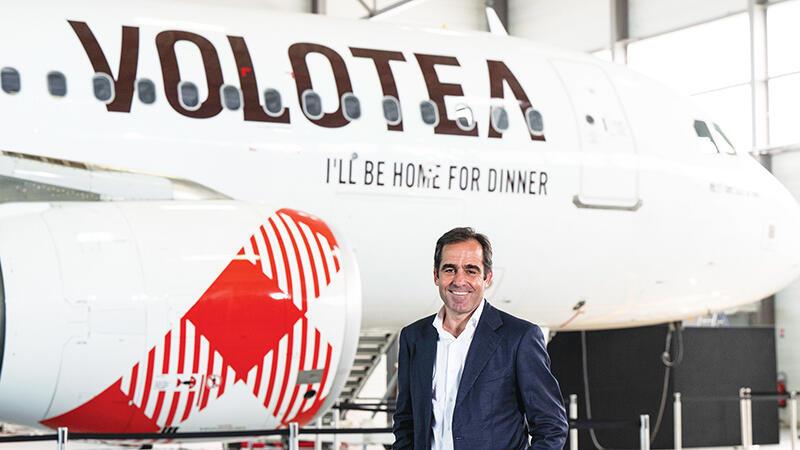
Volotea CEO and founder Carlos Muñoz

Volotea CEO and founder Carlos Muñoz.

Credit: Volotea

Carlos Muñoz has co-founded two Spanish LCCs. His first, Vueling, was ultimately acquired by International Airlines Group (IAG), while he still leads Volotea. Over the past 14 years, Volotea has carved out a niche flying secondary routes to small- and mid-sized European cities.

How is Volotea different from other European LCCs like easyJet and Ryanair? Volotea is unique in its focus on small- and mid-sized markets. Year-on-year, we keep growing. Pre-COVID, we were generating €440 million ($516 million) in revenue. We have almost doubled that figure and passengers are up by probably 60%. As Volotea grows, [capacity] overlap with the largest LCCs goes down, not up. You imagine it would be the other way around. How can I grow an airline from zero to 13 million seats in a mature LCC market and not increase overlap? We keep on finding places with very limited overlap. Every year we launch 40 to 50 new routes. The vast majority of them didn’t exist before. For example, Verona-Paris. Is Paris in my strategy? No, but I am one of the largest players in Verona, and it’s not well connected with Paris. Probably our 25th or 26th destination out of Verona is Paris. So that’s how we sometimes end up going to large markets. We’re the only airline in Europe that makes a major strategy around small- to mid-sized cities.

Ryanair has spoken out against French tax increases and Spanish airport fees. These are two of your core markets. How are you navigating those costs? France and Spain are probably 70% of my activity, with France being much bigger. Taxation has been pretty high. We agree on that. We are, however, acting differently. We remain committed to those markets. This year, we increased [French] capacity, and we will again next year, despite the tax increase. It was not minor—it went up approximately €7 per passenger—it’s definitely very detrimental to the industry. In Spain, Ryanair is saying small- and mid-sized airports are not discounting enough. In our case, those airports are our core strategy. Other people serve them too, but it’s more of an afterthought, or second priority. There are many factors at play, and the biggest one is demand and supply constraints. That makes it a good idea for us to still grow in those markets. Ryanair, by reducing [capacity] in my markets, also helps drive that [lower overlap] percentage.

Your boardroom walls are filled with photos tracking Volotea’s growth from 1 million to 75 million passengers. What has fueled that growth? One element of our DNA that is different to some LCCs is the way we treat our clients. Certainly, Volotea is at the upper end of that spectrum. We always start and finish every decision thinking, “How does it impact the client?” That doesn’t mean we sell tickets for free or give them champagne and caviar. That would be beautiful, but it wouldn’t last, right? So, we factor that in. It all starts with a very solid operation.

Maintaining schedule reliability can be challenging, especially with European ATC delays. How did 2025 go? The summer was very good. In April, May and June, European airline CEOs were all very concerned [about disruption], but it’s been much better than expected. That doesn’t mean it was a walk in the park. There were ATC issues in France and some weather disruptions during July. But average intra-European on-time performance (OTP), within 15 mins of scheduled arrival time, improved probably three to four points among the competitors that we track. Volotea performed five points higher than last year. Our net-promoter score last year was around 40 and it will be much higher this year. No other airline in Europe is publishing a number like that. Some are 10-15. Most don’t publish it. Our aspiration is to jump from 40 to close to 50. We’re already improving. I think we’ll end up at 46-47, conservatively.

Volotea aims to double in size by 2030. Can you share more about your five-year strategy? We actually don’t disclose that. The main reason is that we’re quite flexible about it. We’re not married to any growth objective, per se. That’s a direct consequence of the fact that we’re pretty unique in our market. When I was running my old company [Vueling], there was a race against the clock. It was crazy. We needed to cover space quickly before somebody else took it. Not at Volotea. When we launch our base in Brest [France], I don’t really think anybody else is going to do it. So that gives us a lot of flexibility to be the masters of our own growth rhythm.

You operate 17 Airbus A319s and 24 A320s. What are your short-term fleet plans, and are you considering a replacement for your A319s in the mid-term? We’re definitely looking at adding more mid-life CFM-powered A320s. It’ll be around five to 10. For the mid-term, I am open and I am in dialogue with the manufacturers. The Airbus A220 is a possibility. I won’t say whether it’s a high or low, but it definitely is a possibility. I need to replace the 150-seat A319s and obviously the competition is the A220 or the Embraer E2. There is no A319neo, so it will be either the A220 or the E2. Those are the two natural candidates.

Are there still untapped opportunities out there? We continue looking at numbers all the time. We start with a database of 10,000 city pairs. We pass them through a lot of filters and we end up with 1,000-1,300 routes that we would like to launch tomorrow, if we could. That’s triple the size that I have right now. It’s very obvious to me that European small- to mid-sized cities still need better connectivity. There is a long way ahead and we have the good fortune of having become the specialist in that.

Spanish LCC Volotea Is Growing Fast and with Purpose

Victoria Moores

Victoria Moores joined Air Transport World as our London-based European Editor/Bureau Chief on 18 June 2012. Victoria has nearly 20 years’ aviation industry experience, spanning airline ground operations, analytical, journalism and communications roles.