
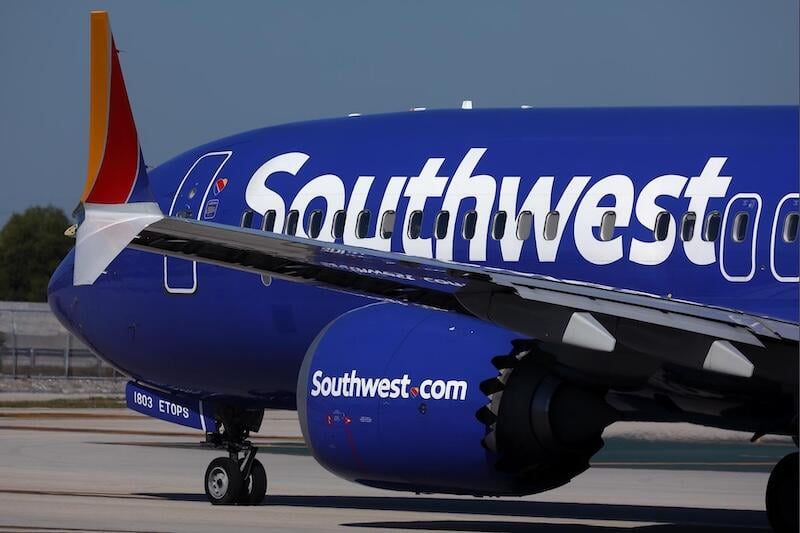
Southwest Airlines is eyeing potential long-haul international flights within the next five years as part of an ongoing effort to provide product offerings “our customers want,” CEO Bob Jordan said.
Speaking May 28 at the Bernstein Strategic Decisions Conference, Jordan said the changes the airline has made—including implementing assigned seating and tiered fares—have been positively embraced by passengers, evidenced by a strong first-quarter revenue performance. First-quarter revenue per available seat mile increased 11.2% year over year.
Jordan said Southwest wants to continue to “meet our customers’ needs,” which likely includes long-haul international flights.
“I think it's likely that we'll ... delve into long-haul international” flying within five years, he said. “We're not going to become Delta and United and American in terms of serving 120 far-international destinations. It took them decades to build that.”
Jordan envisions Southwest potentially operating to eight to 12 long-haul international destinations, which would account for “the vast majority of the places that our customers want to go,” he explained. “So, we don't have to be Delta, American or United in terms of that huge, wide long-haul network, but through the right destinations we can be highly relevant in our customer base in terms of where they want to go.”
Southwest has more than 300 Boeing 737-8s in its fleet and is the launch customer for the 737-7, which FAA Administrator Bryan Bedford said May 28 he expects to be certified this year.
According to Boeing, the 737-8 has a range of 3,500 nm (approx. 4,030 mi.), while the 737-7 has a range of 3,800 nm. Both aircraft can reach multiple destinations in Europe from the U.S. East Coast.
While Jordan cautioned it is too early to discuss specific long-haul international routes, he said “Baltimore would be a natural hopping-off point.” Baltimore/Washington International Thurgood Marshall Airport (BWI) is Southwest’s largest East Coast airport, where the carrier has a more than 70% market share.
Southwest is not “far enough along” to talk about which long-haul routes it could serve, Jordan said. “These are really ideas. I think you start with ... what is it our customers want from Southwest Airlines that we cannot provide today. I want to give our customers fewer and fewer reasons to have to choose United, Delta, American and others. They don't want to. They love Southwest Airlines. We are the brand that they love. They want to choose us, and they simply can't because we don't offer them the thing that they want, like flying long haul.”
Southwest currently offers service to more than 120 destinations across the U.S., the Caribbean, Belize, Costa Rica and Mexico. The carrier serves Hawaii and this month launched its first flights to Alaska, adding Ted Stevens Anchorage International Airport (ANC) to its network. The carrier will fly to ANC 2X-daily on a seasonal basis through mid-September from both Denver and Las Vegas. Alaska became the 43rd U.S. state the airline serves.
Southwest started growing its network again this year after adding no new destinations from 2021-2025.
“We're continuing to add destinations at a very swift pace here in 2026,” Jordan said, adding: “You’ve got to constantly be looking at the network and be willing to make changes ... You have to be aggressive.”
Southwest has traditionally been a point-to-point carrier, and Jordan said offering a high number of nonstop domestic routes continues to be a strength. But he acknowledged the carrier has evolved and connections at airports such as BWI are now an important component of Southwest’s business.
Long-haul operators generally feed traffic into hubs from which international destinations are served.
“I would say we're a hybrid,” Jordan explained. “We have very large cities that we do more connecting in. But one of the core strengths of this company is that we have ... the most nonstop flights [in the U.S. domestic market], and consumers choose nonstop flights,” he said.
"You're always going to adapt,” Jordan noted. “We're now roughly [operating] 4,000 flights a day. You have more dots on the map, and you can't escape having more connectivity as you add more dots, and that is really what's happening versus a desire to become more hub-like.”

Related Content




Comments
Yes but can they come back in winter nonstop? Marginal with the Max. I think WN is going to need to buy some XLRs or something else.