HONG KONG—Singapore Changi Airport is sharpening its focus on attracting air service to connect with emerging markets in Central Asia, Europe and the Middle East, while pursuing new digital and automation solutions to counter rising costs.
Lim Ching Kiat, Changi Airport Group’s (CAG) executive vice president for air hub and cargo development, tells Aviation Week on the sidelines of Routes World in Hong Kong that there are gaps in connectivity to Kazakhstan and Uzbekistan. “More work needs to be done” to open such links, Lim says. The markets, he observed, are “too far for conventional narrowbodies but too thin for widebodies.”
“With aircraft generally in short supply across airlines, carriers are being conservative. They go for the tried and tested rather than invest in new markets. That is the reality of the current situation. But never say never,” Lim continues, adding that Changi will welcome MIAT Mongolian Airlines in November with services from Mongolia's capital Ulaanbaatar.
In the Middle East, CAG is in discussions with Singapore Airlines and startup Riyadh Air to introduce long-overdue service to the Saudi Arabian capital Riyadh. CAG is also looking to leverage its strong Australasia transfer traffic to support Madrid as well as secondary European points such as Geneva and Warsaw.
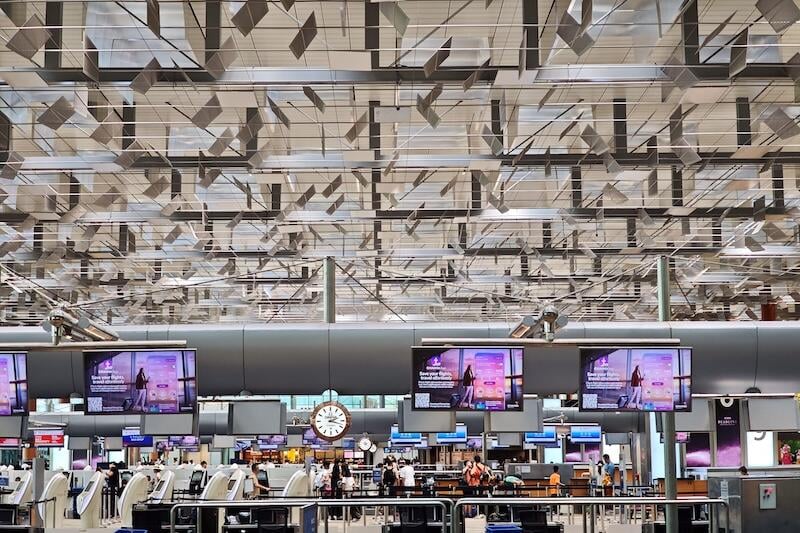
At the same time, Lim highlights the role of automation in tackling cost pressures in high-cost Singapore. Changi is expanding self-service kiosks, passport-free immigration gates to keep staff headcount low and computer-vision systems to monitor ramp activities, enabling faster turnarounds, leaner ground operations and tighter gate utilization.
“The best way to reduce costs is to take away redundancies and run it tight, because that’s the only way to get out of it,” Lim says.
CAG also seeks to strengthen airlines’ business cases by facilitating new opportunities via Singapore. For example, it is supporting MIAT’s ambitions to tap Australia’s mining market by linking the carrier with operators of Australian routes for potential codeshares and transfer traffic on top of engagement with consumer and other business bodies.
To bring its existing facilities in line with Changi Airport's planned mega Terminal 5 in the mid-2030s, CAG is investing around S$3 billion ($2.3 billion) to upgrade its current terminals, particularly Terminal 3. Unlike Terminal 2, which was closed for upgrades during the pandemic, T3 remained fully operational.
With overall capacity of 90 million passengers annually, Changi’s four terminals are currently handling about 69 million. CAG aims to use this “head space” to push forward infrastructure improvements, including new baggage storage and handling systems as well as apron enhancements to accommodate larger aircraft such as the Boeing 777-9.

Related Content