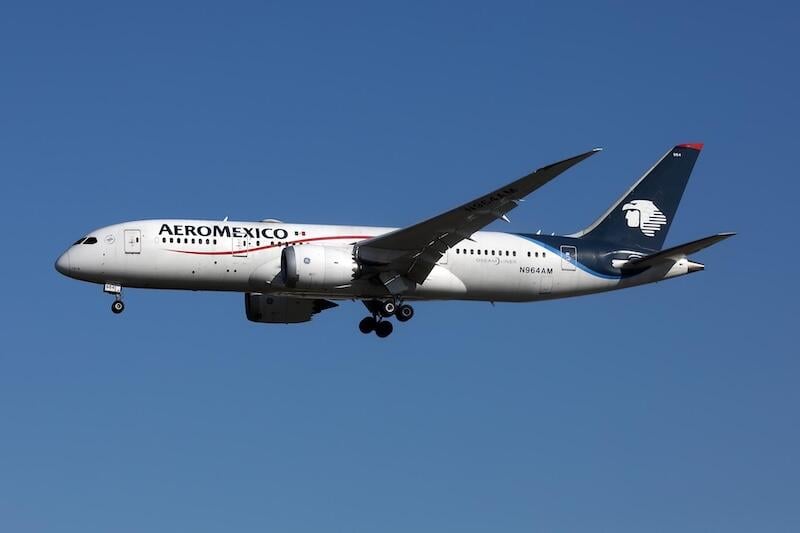
Aeromexico, Alaska Airlines and American Airlines each plan to add new transatlantic routes over the coming weeks.
Mexico City-Barcelona
Aeromexico will return to Barcelona this summer, reinstating service from Mexico City as part of a broader expansion of its European network.
The carrier plans to resume flights between Mexico City Juarez (MEX) and Barcelona (BCN) on March 28, operating 6X-weekly using a mix of Boeing 787-8 and 787-9 aircraft. The service will offer more than 3,000 seats per week during the summer season and run through Oct. 24.
The Barcelona route marks a reinstatement for the SkyTeam member, which last served the market from June 2019 until the onset of the pandemic in 2020. Aeromexico says the move “reaffirms [the airline’s] commitment to the Spanish market,” noting that its total Spain operation will reach up to 40X-weekly frequencies in summer 2026, including service to Madrid from Mexico City, Guadalajara and Monterrey.
The return also revives a competitive dynamic that predates COVID-19. When Aeromexico launched MEX-BCN in July 2019, it did so amid opposition to Emirates’ planned fifth-freedom Dubai-Barcelona-Mexico City service. At the time, Aeromexico argued that competing with a “subsidized” Gulf carrier would be “very difficult,” but Emirates proceeded to launch the route in December 2019. The airline currently operates a daily 777-200LR, providing about 4,200 weekly seats in the market.
Sabre Market Intelligence data shows 148,700 passengers traveled between Mexico City and Barcelona in 2024, down 14.4% year on year, with about 70% flying nonstop. Madrid was the largest one-stop connecting market.
Beyond Barcelona, Aeromexico will add a new European gateway from northern Mexico with the launch of Monterrey-Paris Charles de Gaulle service on April 13. The route will operate 3X-weekly using 787-9 aircraft, adding more than 1,500 seats per week through Oct. 23. While the airline already connects Monterrey with Madrid, Paris will become its second nonstop European destination from the city.
Seattle-Rome
Alaska Airlines will inaugurate transatlantic service on April 28, launching nonstop flights between Seattle-Tacoma International Airport (SEA) and Rome Fiumicino (FCO) as it makes its long-anticipated entry into Europe. Flights will operate 4X-weekly using 787-9 aircraft.
The 5,673-mi. (4,930-nm) sector represents a strategic milestone for the carrier, which gained access to widebody aircraft following parent Alaska Air Group’s acquisition of Hawaiian Airlines in late 2024.
Until the Hawaiian deal, Alaska lacked the fleet to support long-haul international flying. The acquisition brought three 787-9s into the group fleet, with nine more on order, creating a platform for intercontinental expansion from its Pacific Northwest hub.
Rome will become Alaska’s third long-haul destination from Seattle, following the launch of Tokyo Narita service and the planned start of Seoul Incheon flights in 2025. The airline has outlined ambitions to serve at least a dozen long-haul destinations from SEA by 2030, with nonstop service to London Heathrow beginning in May.
The Seattle-Rome market is underpinned by solid underlying demand. Sabre Market Intelligence data shows nearly 44,800 two-way passengers traveled between the cities in the 12 months to June 2025, making Rome the largest unserved European destination from SEA at the time of Alaska’s announcement. The traffic mix reflects a combination of leisure, VFR and premium demand tied to Seattle’s technology and corporate base.
Alaska’s move has also prompted a competitive response from Delta Air Lines, which will begin its own 4X-weekly Seattle-Rome service on May 6 using Airbus A330-900 aircraft. Delta will add Barcelona the following day, expanding its transatlantic network from SEA to five European destinations alongside Amsterdam, Paris Charles de Gaulle and London Heathrow.
New York JFK-Edinburgh
American Airlines will inaugurate Airbus A321XLR international service on March 8, deploying the long-range narrowbody between New York John F. Kennedy International Airport (JFK) and Edinburgh Airport (EDI).
The seasonal route, scheduled to operate through Oct. 24, will mark the first transatlantic deployment of the A321XLR by a U.S. carrier. American began operating the aircraft in December on transcontinental flights between JFK and Los Angeles, using the route to build operational familiarity ahead of extended overwater service.
American’s A321XLRs are configured with 155 seats, including 20 business-class suites, 12 premium economy and 123 economy seats—significantly lower than the aircraft’s maximum high-density layout. The configuration underscores the airline’s intent to target premium-heavy, long-thin markets where widebody economics may be less optimal year-round.
The move adds a new competitive dimension to the New York-Edinburgh market. According to OAG Schedules Analyser data, United Airlines currently operates daily Newark-Edinburgh flights using 757-200s, while Delta Air Lines will resume daily JFK-EDI service on March 8 with 767-300s. JetBlue Airways is also scheduled to restart daily seasonal summer flights on April 29 using A321neos.
American, which has 50 A321XLRs on order, is positioning the aircraft as a central pillar of its long-haul strategy—using it to unlock thinner European markets, stretch seasonal routes and add frequency flexibility from capacity-constrained gateways such as JFK.

Related Content