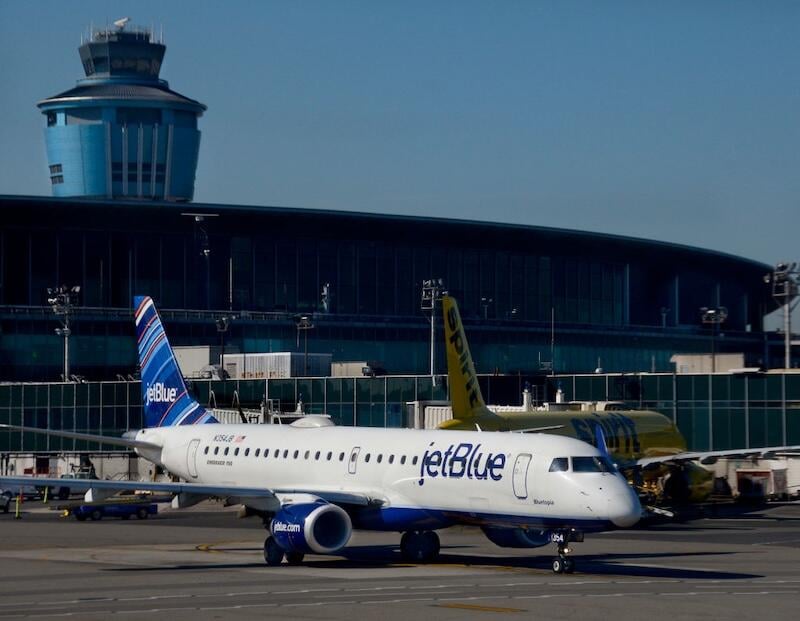
The FAA’s tentative approval of JetBlue Airways’ acquisition of 22 former Spirit Airlines slots at New York LaGuardia Airport (LGA) has opened a wider debate over who should control scarce airport capacity and how slots should be treated during airline bankruptcies.
Frontier Airlines, Breeze Airways and the Association of Value Airlines (AVA) want any future lease or trade limited to LCCs. Airports Council International-North America (ACI-NA), meanwhile, has called for reform of U.S. slot policy, arguing that bankruptcy courts treat slots as saleable assets while the FAA regards them as operating permissions.
The calls follow the FAA’s Aug. 31 tentative decision to allow JetBlue to acquire the slots for $58.5 million. Under the proposed conditions, JetBlue would be unable to lease or trade them until after April 2028 and would be barred from selling them.
None of the comments submitted to the FAA opposes JetBlue’s purchase. However, they focus on restrictions governing any future transfer of the slots and, in ACI-NA’s case, how slots should be handled during airline bankruptcies.
Frontier, which submitted the second-highest bid for the LGA slots, wants any future transfer, lease or trade limited to what it defines as value airlines, such as Frontier, Allegiant Air, Breeze or Avelo Airlines. “This would help ensure that scarce airport capacity continues to support low-fare competition,” the Denver-based carrier says.
Frontier was designated as the alternate purchaser after offering $57.5 million, $1 million below JetBlue’s successful bid. However, the ULCC is not seeking to overturn the auction result or prevent JetBlue from receiving the slots.
Breeze has also called for restrictions that would “guarantee retention by a value airline.” The carrier says access to slot-controlled airports would allow it to connect more unserved and underserved markets but argues that it cannot launch such routes without securing operating authorizations.
“Guaranteeing access for value carriers such as Breeze via slot transfer restrictions is also in the best interest of the consumer,” the airline says. “It is an excellent way to connect communities and expand low-fare offerings.”
AVA broadly supports the FAA’s tentative approval but also urges the agency to restrict any later disposition of the slots to another value airline. AVA says smaller carriers play an important role in disciplining fares at capacity-constrained airports, where new entrants cannot simply add flights in response to demand. It argues that the competitive benefits associated with the Spirit slots could be weakened if they eventually moved to one of LGA’s largest incumbents.
“Access to airports is among the most consequential barriers to creating meaningful airline competition that commands fare discipline amongst carriers and gives consumers more, and more affordable, choices,” AVA says.
JetBlue currently holds 31 operating authorizations at LGA, representing about 2.7% of the 1,141 carrier-held slots. Acquiring Spirit’s 22 authorizations would increase its portfolio to 53 and its share to approximately 4.6%.
JetBlue would therefore remain below the 5% threshold previously used by the FAA to identify airlines with a limited presence at slot-controlled airports. By comparison, Delta Air Lines and American Airlines together hold 838 operating authorizations, accounting for 73.4% of the total.
In a comment filed to the FAA, ACI-NA raised a broader concern over how U.S. slot policy interacts with airline bankruptcy law. Rather than taking a position for or against the JetBlue transaction, the organization called for a comprehensive federal review.
ACI-NA says bankruptcy courts treat slots as “liquid assets” that can be sold to the highest bidder, while the FAA and U.S. Transportation Department regard them as authorizations to take off or land at a specified airport and time.
It therefore argues that bankruptcy proceedings can determine access to scarce airport capacity through price rather than the competitive, operational and connectivity criteria normally considered under slot-allocation frameworks. “A high bid is not a public-interest proxy,” the airport trade body says.
JetBlue has said the LGA transaction could support up to 12 additional daily roundtrips from the airport during 2027 but has not identified potential destinations. Its existing network from the airport is concentrated on Florida leisure markets, particularly Fort Lauderdale and Orlando.
The FAA will consider the comments before issuing a final decision.

Related Content