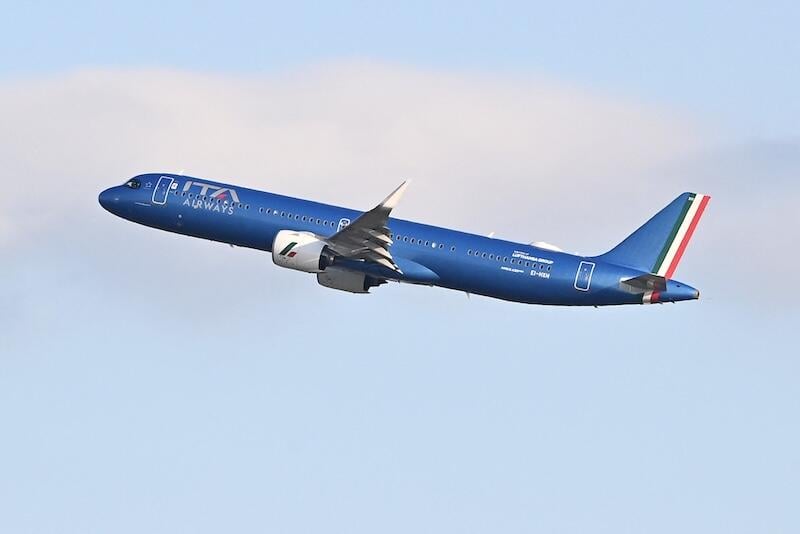
The U.S. Transportation Department (DOT) wants Lufthansa, United Airlines and Air Canada to show which new routes and passenger benefits depend on ITA Airways joining their transatlantic joint venture (JV), as it decides whether to extend antitrust immunity (ATI) to the Italian carrier.
The latest request comes after Lufthansa pressed DOT to approve the application. In a Nov. 4 letter, the group said the U.S. Justice Department had raised no comments or objections following a July submission on its merger with ITA, and that the partners were ready to bring the airline into the venture once the DOT approved.
However, on Nov. 23 DOT said the existing submissions did not provide enough information to reach a decision. “Our review indicates that further information is required to evaluate the issues raised by the application,” the department said.
Air Canada, Lufthansa and United applied in September 2025 to add ITA to the A++ partnership under its existing ATI. DOT paused the review timetable a month later to check access to supporting documents under confidentiality rules and determine whether the application was complete.
Among the latest questions, the department has asked the airlines to calculate the benefits for passengers if ITA joins—and how those would compare with Lufthansa owning ITA but keeping it outside the venture. It points to Lufthansa’s Asian joint ventures as possible models for cooperation without ITA joining A++. Lufthansa, Austrian Airlines and Swiss belong to joint ventures with All Nippon Airways and with Air China and Shenzhen Airlines. Brussels Airlines is outside both arrangements but participates in the Singapore Airlines venture.
“Could these other JV models be used over the North Atlantic should the joint movants not receive ATI from the [DOT]? If not, why not?” the DOT asked.
United and Air Canada’s recent growth in Italy is also part of the review. DOT has questioned why adding ITA is needed to support their existing and planned flights when both have already expanded without an immunized partnership with the Italian airline.
OAG schedules data shows the two carriers offered a combined 2.09 million summer seats to Italy in 2026, up 19.2% from 2024. United grew its summer Italy network from eight to 12 airport pairs over that period, adding Denver-Rome, Newark-Palermo, Washington Dulles-Venice and Newark-Bari. Its capacity increased 23.2% to 1.33 million seats.
Air Canada’s Italian capacity grew 12.6% to about 760,000 seats, with Montreal-Naples and Montreal-Catania joining its network. For winter 2026-27, United has scheduled about 407,000 Italy seats, up 18.7% year over year, while Air Canada’s capacity is down 3.6% to about 154,000 seats.
DOT has asked the partners to identify which additional U.S. and Canada-Italy flights they expect to offer if ITA joins. It also questioned whether additional ITA frequencies could succeed without support from the existing partners, and whether additional Air Canada frequencies could succeed without ITA.
DOT is also looking at how the growth in nonstop North America-Italy services has affected the venture’s established hub-to-hub routes. It wants evidence of any impact on passenger traffic, fares, load factors and the viability of services such as Washington Dulles-Frankfurt/Munich and Toronto-Frankfurt.
For ITA, the department is seeking financial forecasts through 2030, where available, showing how the airline would perform with and without JV membership.
Lufthansa’s Nov. 4 letter made clear how closely it links the partnership to ITA’s development and its agreement with Italy’s Ministry of Economy and Finance (MEF). “ITA’s participation in the A++ JV was an essential element of Lufthansa’s commitments to MEF,” the group said.
Lufthansa argued that the partners’ sales networks, corporate and loyalty programs, and connecting passengers would help ITA achieve sustainable growth and profitability while supporting year-round services from Rome. Lufthansa exercised its option June 1 to increase its ITA stake from 41% to 90% although the purchase had yet to close.
DOT is also examining whether competition remedies associated with the Lufthansa-ITA transaction have addressed concerns involving Rome-San Francisco, Rome-Toronto and Rome-Washington services.
Additionally, DOT wants the airlines to explain which destinations passengers could reach through Rome, which are already served through the partners’ other hubs, and how much extra traffic the partnership would attract from U.S. cities described in the application as “heartland” markets.

Related Content