This article is published in Air Transport World part of Aviation Week Intelligence Network (AWIN), and is complimentary through Jul 11, 2026. For information on becoming an AWIN Member to access more content like this, click here.
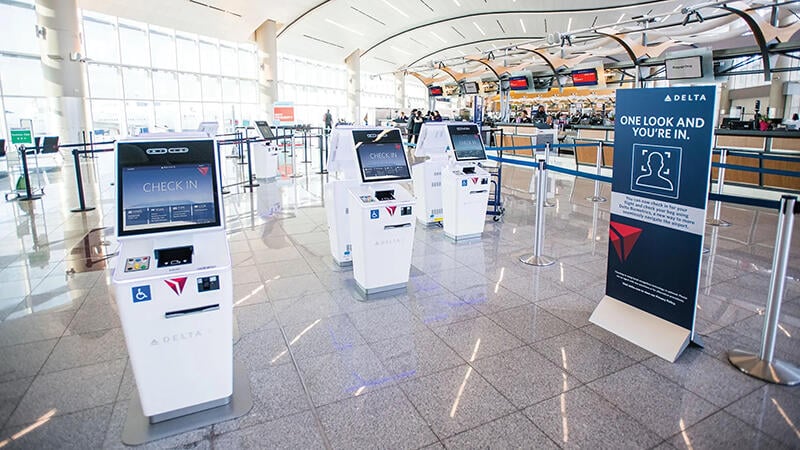
Hartsfield-Jackson Atlanta International Airport uses biometric to speed passenger throughput.
Airport executives believe artificial intelligence (AI) can dramatically reshape the way major hubs are managed and operated, improving passenger flows, enhancing security and—most importantly—enabling airports to grow capacity without adding physical infrastructure.
This is critical because passenger numbers are expected to surpass 10 billion globally in 2026 and are headed toward 18.9 billion per year by 2047, according to Airports Council International World.
“The ability for airport capacity to grow at the same rate as demand is quite difficult,” SITA VP innovation, apps and data for airports Nick Batchelor told ATW.
“Building more space and more capacity, whether that’s runways or terminal space, is tough and it takes a lot of time,” Batchelor said. “In terms of airport capacity generally, things are starting to get stretched all over the world.” Technology that allows faster and more efficient passenger throughput can be a vital means of growing capacity, he added.
Airport executives envision an AI-enabled future in which passengers move seamlessly through terminals—perhaps not even stopping at a security checkpoint—as concessions placement is optimized, gates are precisely managed, and autonomous ground vehicles perform airfield tasks.
With the passenger process becoming largely automated over the last 10-15 years and airports deploying thousands of cameras to monitor activity, airport executives now have access to enormous amounts of data. AI can make sense of that data, often in real time, and share it across various airport departments, airlines, ground handlers and air traffic control, technology experts say.
“A core foundation of what you need to make AI effective is data,” Batchelor explained. “Our ability to collect that data and share it is now massively greater than it ever has been. What we can then use AI to do is make connections between how those data points interact with each other and start to make predictions and optimizations in real time around how we make sure that the flows of people, bags and aircraft are as slick and efficient as possible. And how, if there is a problem with any of those flows, we recover back to normality as fast as we can.”
SITA and Abu Dhabi Airports signed an MoU in late 2025 to co-develop an AI-driven “intelligent total airport management platform” for Zayed International Airport (AUH). The system—which would integrate, share and analyze data across the airport ecosystem—would anticipate disruptions, more effectively manage resources and increase efficiency, according to SITA and Abu Dhabi Airports. The goal would be for AUH “to become one of the world’s first truly connected digital airports,” allowing the airport to grow capacity faster and passengers to have “smart, seamless journeys,” Abu Dhabi Airports CIO Andrew Murphy said.
COMPUTER VISION
Hartsfield-Jackson Atlanta International Airport (ATL) is the busiest airport in the world, handling over 106 million passengers in 2025 and the only airport in the world to process more than 100 million passengers annually. Keeping pace with these traffic levels, including high numbers of connecting passengers at Delta Air Lines’ home hub, has led ATL to lean heavily into exploring the potential of AI.
“When we have that many people going through our facility, we have to constantly try to get better and better at how we process as many people as possible—safely, securely and efficiently,” ATL CTO Chris Crist told ATW, adding that AI was changing how airports operate “in a pretty substantial way.”
ATL has 7,000 surveillance cameras that enable the airport to take advantage of “computer vision,” a system in which AI is used to constantly process and analyze video feeds. The airport is then able to create an “AI overlay” of terminals in which all activity is automatically overseen and data is gathered to understand how efficiently and securely the airport is operating.
“As far as an airport is concerned, that’s like having 7,000 pairs of eyes scanning the entire operation, feeding back valuable information utilizing camera analytics,” SITA’s Batchelor said. “In the past, the vast majority of airport surveillance footage simply was never looked at because it’s just not possible. You cannot have enough people to scan that footage at all times. Now effectively you’ve got the equivalent of hundreds of people scanning that footage automatically in real time, spotting events, things of interest, and then alerting back to the human operators to say, ‘Well, something’s going on over here. You need to go look at it.’ That is incredibly powerful.”
ATL’s Crist envisions a future “where passengers can simply come to the airport and walk directly to the gate without ever having to stop,” he explained. “Because this AI overlay in the future could potentially recognize you [via surveillance camera biometric facial recognition] as you come into the airport and say, ‘Okay, you’re [passenger name] and you’re here and you’re flying out today at 2 p.m. on Delta. You’re going to a specific gate.’ It recognizes that you have a reason to be at the airport. Then we can scan you for any objects that look threatening and go from there. It can streamline the process significantly.”
Passengers would provide data, including biometrics, to the government, airline and airport in advance to be able to participate in this touchless movement through the airport. ATL in March installed the hardware to “to get started with the proof of concept” on such a system, Crist said.
While this use-case is likely many years away from becoming reality, there are already applications utilizing facial recognition at ATL and a number of other major airports to allow passengers to use biometric identification at bag drop, security checkpoints, boarding aircraft and going through customs—all with AI systems matching identity to pre-provided information and identification documents on file.
Crist pointed to the example, now widely deployed across ATL, of passengers boarding flights via facial recognition. “They no longer have to pull out passports or their tickets or really anything else, and they’re simply allowed to board,” he said. “That saves anywhere between 5 to 10 seconds per passenger, sometimes more. When you see 300,000 passengers every day, that’s a significant benefit to us.”
AI also has the potential to streamline baggage scanning. Newer, advanced baggage screening systems “use machine learning to identify prohibited items with a high degree of accuracy,” according to a report from aviation insurance firm Global Aerospace. “The scanner’s algorithms can detect anomalies in a bag’s contents and automatically flag potential threats, with a traveler’s belongings remaining neatly packed unless further inspection is warranted.”
Cameras using computer vision can be trained to immediately spot unaccompanied bags in terminals, even in some cases identifying the individual who left the bag, Crist and Batchelor said.
FUTURE PLANNING
Beyond real-time monitoring of operations using AI, the technology’s biggest potential value may be aggregating and analyzing operational data to facilitate advanced planning.
Crist said airports can leverage cameras to observe gate activity, in the terminal and on the tarmac, to understand how to improve future operations.
An arriving aircraft must be refueled and cleaned, bags unloaded and loaded, boarding bridges connected and boarding passengers lined up. “Today, we don’t really have objective data on the efficiency of all that,” Crist said. “We have ideas. We have hunches. We have experience over the years, human experience. But with [cameras gathering data and AI systems analyzing it], we’ll be able to come up with actual black and white trends that show us what is efficient and what’s not at one gate. We have roughly 200 gates and why is one gate consistently more efficient than others? We don’t have that information today. Through this AI overlay, you could objectively determine what is making that gate more efficient. We can learn from that and then apply it to all the other gates.”
Another example is gathering granular data on passenger flow. “By leveraging AI technology, airports can reduce wait times in queues,” according to a report from Scylla, a firm that offers AI technology for video surveillance. “AI-powered solutions can monitor and analyze foot traffic through airport facilities, identify crowd patterns and bottlenecks, estimate waiting times, and use these insights to help optimize queue and crowd management.”
Concessions placement is another potential AI application. “From a business perspective, a significant portion of an airport’s revenue is generated from its retail and concession spaces,” Kyle Barnes, customer delivery architect for the US public sector at AI infrastructure development firm Cisco, noted in a recent blog post on the company’s website. “By leveraging AI to understand individual passenger preferences and real-time location … airports can deliver highly relevant and timely offers. This intelligent targeting significantly increases the probability of a passenger making a purchase … In essence, AI makes the airport’s vast real estate a more effective money-maker by guiding passengers to services and products they are more likely to buy, directly boosting non-aeronautical revenue.”
Though such applications are not in effect now at ATL, they could be in the near future, Crist said. “For example, we could identify that more people are at this Starbucks than another one,” he explained. “Right now, we have a hunch, but we’ll finally be able to say, you know what, we should probably move that Starbucks over here, or we should probably go ahead and look into adding this restaurant to this location … We will be able to look at general behavior and patterns throughout the airport.”
AI PITFALLS
Of course, there are risks and challenges to deploying AI in airports. Foremost are passenger privacy concerns and the consequences of reducing (or eliminating) human involvement in decision making. Passengers will have to be comfortable with computer vision continuously tracking and analyzing their movement through terminals.
Batchelor said cameras and AI can make the airport safer and more passenger friendly. “I think the main thing to say is that in order for an airport to run safely and efficiently, there needs to be an element of understanding what’s going on around the campus, an element of understanding where the people flows are,” he explained. “It becomes a key factor in making sure that there’s a good passenger experience, but also, more important, there is a safe passenger experience. Being able to identify security incidents potentially more quickly: that’s the real reason the cameras are there. There is a public good in allowing that level of surveillance. As we know, security around air travel is an absolutely critical element.”
What about “AI hallucination” in which AI systems produce false information? “The aviation industry has the most extraordinary safety record and on no account is that going to be put at risk,” Batchelor said. “What we need to find are areas where AI can safely play a part, where it can become an assistant or a sort of augmentation for the human operators to allow human managers to make the best decisions. AI will break down the set of options needed to make the best decision. I think we can have humans in the process for a very long time to come.”
But he conceded that “all new technologies come with some risk, and it’s incumbent on suppliers like SITA, as well as the rest of the industry, to be very clear about how we identify that risk and how we mitigate it. For example, I use ChatGPT and I know that sometimes the answers it gives me are weird … There are all sorts of techniques we can use to make sure that we’ve mitigated the risk and [the AI systems] are safe. It’s a challenge that we’ve always had in technology, and it’s really no different with AI. And the key thing is to recognize what those risks are and make sure we’ve addressed them appropriately.”
There is still a long way to go towards full implementation of AI at airports. Crist noted a key future development is autonomous vehicles performing a variety of tasks, from perimeter security to runway and taxiway monitoring—including automatically removing debris—to lawn work and shuttle buses. “Who knows where we may go from there?” he said.
Batchelor added: “I think we probably are in the fairly beginning stages of using AI, to be honest. We will increase the capability and the number of scenarios where we can apply AI at airports. AI is becoming more and more powerful on a monthly basis. It’s extraordinary.”