This article is published in Air Transport World part of Aviation Week Intelligence Network (AWIN), and is complimentary through Aug 12, 2026. For information on becoming an AWIN Member to access more content like this, click here.
Can Airports Fix The Passenger Experience?
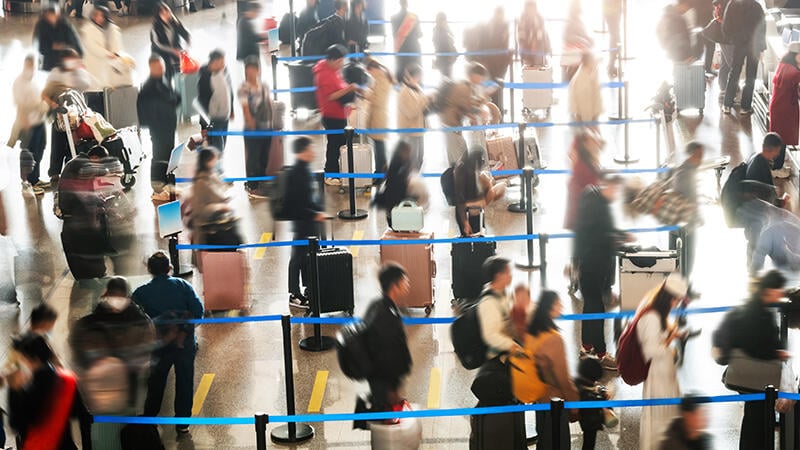
The modern airport is one of the greatest contradictions in travel. Never have passengers had so much technology at their disposal. Travelers can order food, summon transport, translate languages, navigate unfamiliar cities and access almost limitless information within seconds. Yet the moment many travelers step into an airport, the experience often feels rooted in another era.
We queue to prove who we are, to check bags and for security. We queue for border control, at the departure gate and even on the airbridge. Sometimes we queue simply because everyone else is queuing.
Remarkably, most of these processes were designed for a world that no longer exists. Aviation has spent decades becoming more efficient in the air. Aircraft burn less fuel. Flight planning is more sophisticated. Operational systems have become increasingly intelligent. Yet the passenger journey on the ground remains stubbornly fragmented.
The irony is that the industry knows more about their customers than ever. Airlines understand travel history, purchasing habits, loyalty preferences and increasingly even behavioral patterns. Airports collect vast quantities of operational data. Retailers have sophisticated insights into consumer spending. Governments have invested heavily in digital identity systems. Notwithstanding data privacy, they need to find better ways to collaborate.
The airport passenger experience often treats every traveler as if they are arriving for the first time. The problem is not a lack of technology. The problem is a lack of imagination. Passengers do not wake up in the morning hoping for a frictionless security process. They wake up wanting to see family, attend a meeting, begin a holiday or return home. The airport experience should support those goals rather than becoming an obstacle between departure and destination.
Too often, airports are designed around the convenience of institutions rather than the convenience of travelers. A family traveling with young children has different needs from a frequent business traveler. An elderly passenger navigating a complex hub faces different challenges compared to a digitally native traveler moving through an airport for the tenth time that month. Yet many airports still force all of them through largely identical processes.
Personalization has transformed almost every consumer industry. Retailers anticipate our preferences. Streaming services predict what we want to watch. Financial services adapt products around individual behavior. Airports remain largely organized around standardization.
That model is becoming increasingly outdated. The next generation of passenger experience should not be about creating futuristic terminals filled with gadgets; it should be about reducing complexity. The best airport experience is often the one that passengers barely notice.
Imagine arriving at an airport where the journey has already been anticipated. Preferred transport options are integrated into the itinerary. Security resources are dynamically allocated based on passenger flows. Real-time information is tailored to the specific journey rather than broadcast generically across thousands. Families are directed toward services relevant to them. Frequent travelers move through familiar processes with minimal intervention.
None of this is science fiction. Much of the technology exists. Some airports already deploy the technology. However, what is often missing is the willingness to redesign the passenger journey from the traveler’s perspective.
Artificial intelligence (AI) will inevitably become part of this transformation, but perhaps not in the way many expect. The greatest value of AI is unlikely to be visible, and passengers are not interested in algorithms. They are interested in certainty. They want to know whether they will make their connection. They want confidence that their baggage will arrive. They want disruption managed before it becomes stressful. They want information that is relevant rather than overwhelming.
The real opportunity lies in making airports feel less reactive and more anticipatory. The future should be about preventing them from becoming problems in the first place. This matters because passenger expectations are changing rapidly.
Today’s travelers compare airport experiences not only with other airports but with every digital experience they encounter elsewhere in their lives. The benchmark is no longer another terminal. It is the simplicity of a smartphone. Passengers expect services to recognize them, adapt to them and remove unnecessary friction. Airports that fail to meet those expectations risk becoming increasingly disconnected from the broader consumer environment.
That challenge becomes more urgent as passenger volumes continue to rise. Global aviation is expected to carry more than five billion passengers annually. Many major airports are already operating close to capacity. Physical expansion remains important, but there are limits to how much infrastructure can be built.
The next phase of growth will require airports to become smarter rather than simply larger. That means viewing technology not as an operational tool but as a passenger experience tool. It also requires confronting uncomfortable truths. Many airport processes exist because they always have. Layers of procedures have accumulated over decades, often introduced in response to specific events or historical requirements. Few industries have been as successful at adding processes. Fewer still have been as reluctant to remove them.
The result is a passenger experience that can feel unnecessarily complex even when everything works exactly as intended. Travelers rarely remember the sophistication of airport systems. They remember confusion. They remember delays and uncertainty. Most importantly, they remember how the experience made them feel. That emotional dimension is frequently underestimated.
Airports are not simply transport facilities. They are environments where people experience excitement, anxiety, anticipation, frustration and relief, often within the space of a few hours. Designing around those emotions may prove just as important as designing around operational metrics. The airports that thrive over the next decade are unlikely to be those with the most impressive architecture or the largest retail footprints. They will be the airports that understand something deceptively simple: passengers do not want more technology. They want less effort. And the greatest success of the next generation of airports may be measured not by what travelers notice but by everything they no longer have to think about.


Comments
Translation: Flying sucks.