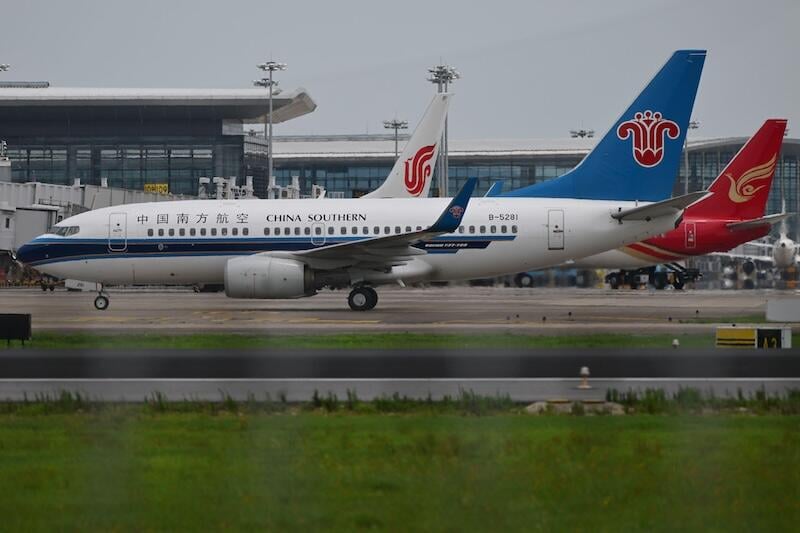
Chinese airlines have urged the Trump administration to withdraw its proposal to bar them from flying through Russian airspace on routes to and from the U.S., warning that the plan would lengthen flights, raise costs and harm bilateral air service recovery.
In formal filings to the U.S. Transportation Department (DOT) this week, Air China, China Eastern Airlines, China Southern Airlines, Hainan Airlines, Sichuan Airlines, Xiamen Airlines and Beijing Capital Airlines said Washington’s proposed restriction would have serious adverse effects on passengers and operations.
The Oct. 9 order would prohibit Chinese airlines from using Russian airspace on U.S.–China passenger and combination (passenger-cargo) services. The DOT said the rule is needed to “level [a] competitive disparity” that has existed since 2022, when Moscow closed its skies to U.S. and most Western carriers after its invasion of Ukraine. Chinese carriers were not affected and have continued to use Russian routes on some long-haul services.
China Eastern said the order “fails to protect passenger rights and the public interest,” warning that detouring around Russian airspace “would extend flight times by two or three hours” on key routes and “significantly increase passenger fatigue and discomfort.” It added that the change “would lead to increased fuel consumption resulting in higher fares,” calling the proposal “inconsistent with the core principles of improving efficiency, enhancing accessibility and serving the public interest that are consistently advocated by DOT.”
Xiamen Airlines echoed those concerns, saying the proposal “will create significant inconvenience and operational complexity for airlines.” The carrier said “longer flight times will directly affect travelers between China and the U.S., disrupting normal exchanges and inflicting unnecessary burdens on the traveling public.” It added that rerouting “introduces additional risk factors ... and is particularly unfavorable for flight safety during the upcoming winter season.”
Air China separately asked DOT for more time to respond to the show-cause order, calling the two-business-day deadline “unusually short.” The airline said the proposal “will undoubtedly undermine the public interest by adversely affecting a substantial number of passengers ... who have already made their travel arrangements.” China Southern and Sichuan Airlines supported Air China’s motion, describing the rule as “a significant policy shift” and urging more time for “well-considered feedback.”
However, DOT rejected the request in an Oct. 14 order, stating there was “no compelling reason for further delay.” The agency said the overflight practice “has been underway for a significant period” and “resulted in a disparity that rises to a level for which the public interest requires the department’s intervention.” It added that affected airlines would have a 30-day wind-down period if the restriction is finalized.
U.S. carriers and industry groups have backed DOT’s stance, arguing that Chinese airlines gain an “unfair advantage” by flying shorter and cheaper routes through Russian airspace, which remains closed to U.S. and most Western carriers. “This has resulted in substantial adverse competitive effects on U.S. air carriers,” DOT said in its original order.
If approved, the condition would apply to all passenger and combination (passenger-cargo) flights operated by seven mainland China-based airlines to or from the U.S., but not to all-cargo carriers such as Air China Cargo or SF Airlines.
The order comes as U.S.-China air connectivity remains far below pre-pandemic levels. OAG Schedules Analyser data shows U.S. carriers are operating about 27,700 two-way seats compared with 31,400 by Chinese airlines—a combined total of about 59,100 weekly seats, less than one-third of the 196,000 recorded at the same point in 2019.
With only four of 18 nonstop U.S.-China routes operated by mainland China-based airlines recently entering Russian airspace, the immediate effect of the proposed ban looks to be modest. However, the impact could grow if more routes return or if Washington widens the policy to include other foreign carriers, such as Cathay Pacific and Air India.