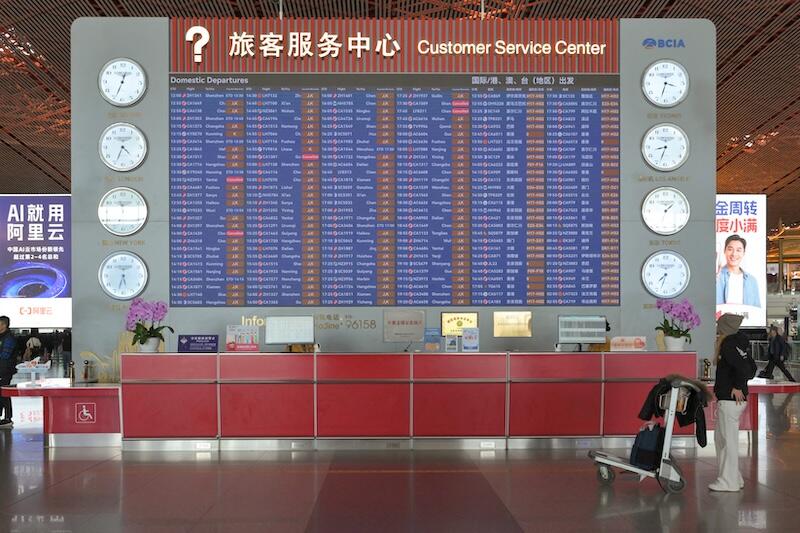
A traveler looks at an info board at Beijing Capital Airport on Nov. 19.
Chinese airlines have sharply pulled back their planned flying to Japan in December, slashing almost a quarter of capacity and frequencies compared with schedules filed in early November, according to analysis of schedules data from OAG.
The reductions follow weeks of political friction between Beijing and Tokyo after comments by Japanese Prime Minister Sanae Takaichi on Nov. 7 about the potential for Japan to intervene in a Taiwan conflict. China reacted by issuing travel and student advisories, restricting Japanese imports and tightening cultural exchanges.
Although the Civil Aviation Administration of China has issued no public directive instructing airlines to cut Japan services, the scale of the reductions is evident in revised schedules. As of Nov. 3, Chinese carriers had filed 1.85 million two-way seats and 9,813 flights for December 2025 on routes to and from Japan. Updated filings published on Dec. 1 show capacity falling to 1.42 million seats and 7,432 flights—cuts of 23.2% and 24.3%, respectively.
Overall China-Japan capacity in December—including all operators—now stands at 1.71 million seats and 8,901 flights, down from 2.15 million seats and 11,320 flights filed in early November.
The OAG Schedules Analyser data reveals that China Eastern Airlines, the largest operator in the market, has trimmed its December capacity by 13%, while Air China is down nearly 10%. China Southern has reduced capacity by 24%, Spring Airlines by 36.3%, Juneyao Airlines by 41.1% and Shenzhen Airlines by almost half.
Chinese carriers have also withdrawn routes from their December schedules. Twelve airport pairs that had been planned to operate, including Changsha-Osaka Kansai, Beijing Daxing-New Chitose and Fuzhou-Nagoya, will now see no nonstop service at all in December.
Among routes that remain, Osaka Kansai-Shanghai Pudong experiences the deepest cut in absolute terms, with about 44,000 fewer seats than originally filed—a reduction of 15%. Shanghai Pudong-New Chitose loses roughly 33,000 seats, or 43%, while Nanjing-Osaka Kansai drops by 27,000 seats, a 73% decline.
Overall, of the 97 routes Chinese carriers had planned to operate in December as of Nov. 3, only 85 will now be served, and just 20 have escaped capacity reductions.
The cuts—coupled with a downturn in demand to Japan—threaten to depress Chinese airline revenues during what would normally be a strong outbound period. “The large-scale reduction of China-Japan flights will undoubtedly exert short-term financial pressure on domestic airlines, manifesting in substantial ticket refunds and lost revenue during the peak Chinese New Year travel season during February 2026,” ASM Consultant Hang Zhao says.
“Currently, airlines are working to reallocate capacity to other domestic and international routes to minimize the overall impact on China's aviation industry and ensure the situation remains manageable.”
Meanwhile, with Beijing advising citizens against travel to Japan, Chinese tourists are redirecting trips elsewhere. As reported by Aviation Week, Russia appears to be the biggest beneficiary after Moscow introduced 30-day visa-free entry for Chinese nationals on Nov. 18.
For Japan, the drop-off leaves the country’s tourism sector exposed. According to the Japan National Tourism Organization, 8.2 million mainland Chinese visitors arrived from January to October 2025, representing nearly one-quarter of all international arrivals.

Related Content