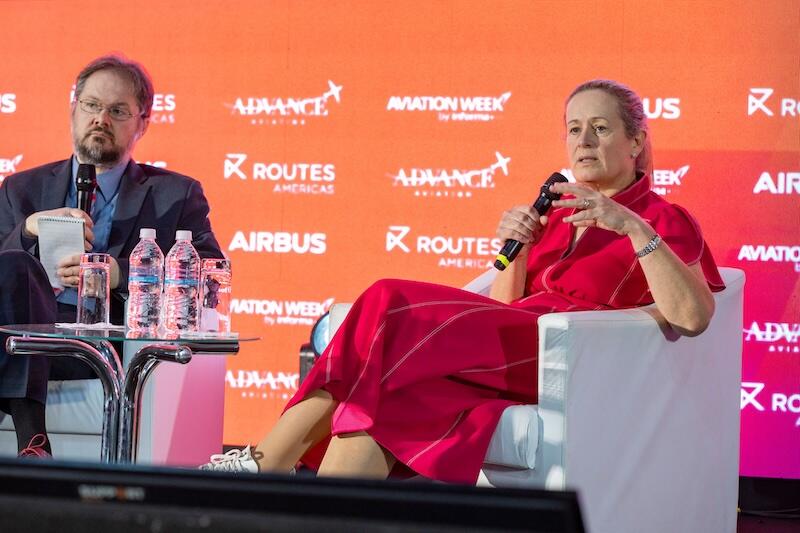
Maria del Mar Whittaker, Abra Group’s chief corporate responsibility officer, on stage at Routes Americas 2026.
Airlines in Brazil are unsure of how they will comply with the government’s sustainable aviation fuel (SAF) mandate that takes effect in 2027.
The Fuel of the Future legislation, passed in Brazil in 2024, requires airlines to reduce carbon dioxide (CO2) emissions on domestic flights by 1% in 2027 by replacing fossil fuels with SAF. The mandate then calls for the escalation in reductions yearly, culminating in a required 10% CO2 reduction on domestic flights via SAF compared to current emissions levels by 2037.
The government is agnostic on how much SAF is used or what kind of SAF is used, so long as the percentage reductions in CO2 emissions are achieved.
But airlines in Brazil are expressing concern that not enough SAF will be available next year to meet the 1% CO2 reduction requirement, particularly at reasonable costs.
“We have a mandate, but we don't have SAF in Brazil,” GOL Linhas Aéreas Vice President of Corporate Affairs Renata Fonseca told the Routes Americas 2026 conference in Rio de Janeiro. “We cannot import SAF from outside Brazil because the cost is very high—it's about three or four times more expensive than regular jet fuel. We don't have tax incentives [for producing SAF domestically]. We don't have producers in Brazil. So that's a big issue for us right now. We are trying to understand from the government how we're going to meet the 1% [CO2 reduction] mandate without having SAF here in Brazil. That's a challenge.”
Brazilian civil aviation regulator ANAC said in a paper submitted to ICAO that “the Brazilian government has very limited resources in its national budget to provide subsidies or direct incentives for [an SAF production] industry to flourish.” ANAC explained that the development of an “SAF industry in Brazil relies mainly on private investment and initiatives.”
So far, there is no serious SAF production in Brazil even though there are a variety of potential feedstocks available in South America’s largest country.
“There are no projects that have gone past the final investment decision [threshold] in Brazil, and the mandate starts next year, so availability is an issue,” Maria del Mar Whittaker, Abra Group’s chief corporate responsibility officer, told Aviation Week.
Abra owns 80% of GOL. The group also includes Colombia’s Avianca and Spain’s Wamos. Brazil’s airlines have noted that traditional jet fuel is highly expensive in the country, taking up around 40% of a carrier’s costs, and SAF is significantly more expensive.
“Even more so than availability in Brazil is the affordability side of things because ticket prices are going to go up as part of this mandate under the current conditions,” del Mar Whittaker said. “So we're working with the government of Brazil on mechanisms to reduce the impact of the price of SAF.”
Brazil’s National Monetary Council in late 2025 approved loans to the country’s airlines supporting various elements of operations, including purchasing SAF. The country’s Ports and Airports Ministry said the approvals allow loans to airlines from the National Civil Aviation Fund, which was created by the country’s legislature in 2024.
The support includes BRL4 billion ($762 million) available for loans with six financing lines. Interest rates on the loans will vary from 6.5% to 7.5% per year depending on the credit line.
In addition to SAF, loans can cover the purchase of domestically built aircraft from Brazil’s Embraer, as well as engine maintenance, aircraft maintenance and infrastructure support.
“Brazil has a potential to produce SAF from different feedstocks, some of them very unique to the Brazilian geographical position and climate conditions,” ANAC said. “In this regard, the Brazilian government has established a partnership with the most prominent national research centers, such as the Brazilian Agricultural Research Corporation, the University of Campinas, the University of Rio Grande do Norte UFRN and the Getulio Vargas Foundation to finance up to $2 million in research related to SAF production in Brazil.”
But this has not translated into producing SAF, and cost remains a big concern regarding potential future SAF production.
“Brazil has done a good job in terms of the incentives for the production of SAF, but as we can see in Europe, incentives to produce SAF do not translate into a reduction in price,” del Mar Whittaker said. “So the conversation now is firmly on price and how we protect the Brazilian passenger and the connectivity that Brazilian cities and regions need from airlines, while also supporting the ambitions of Brazil to develop SAF and reduce emissions. Discussions are firmly focusing on how we address the issue of price and demand in order for these SAF projects in Brazil to get funding.”
ANAC said, “A close collaboration between the public and the private sector is needed to provide the right incentives and policies to incentivize, in the most effective way, the private sector to ramp up their investment in the production of SAF.”

Related Content