Analysis: Almost No Network Overlap Shapes Allegiant-Sun Country Merger Case
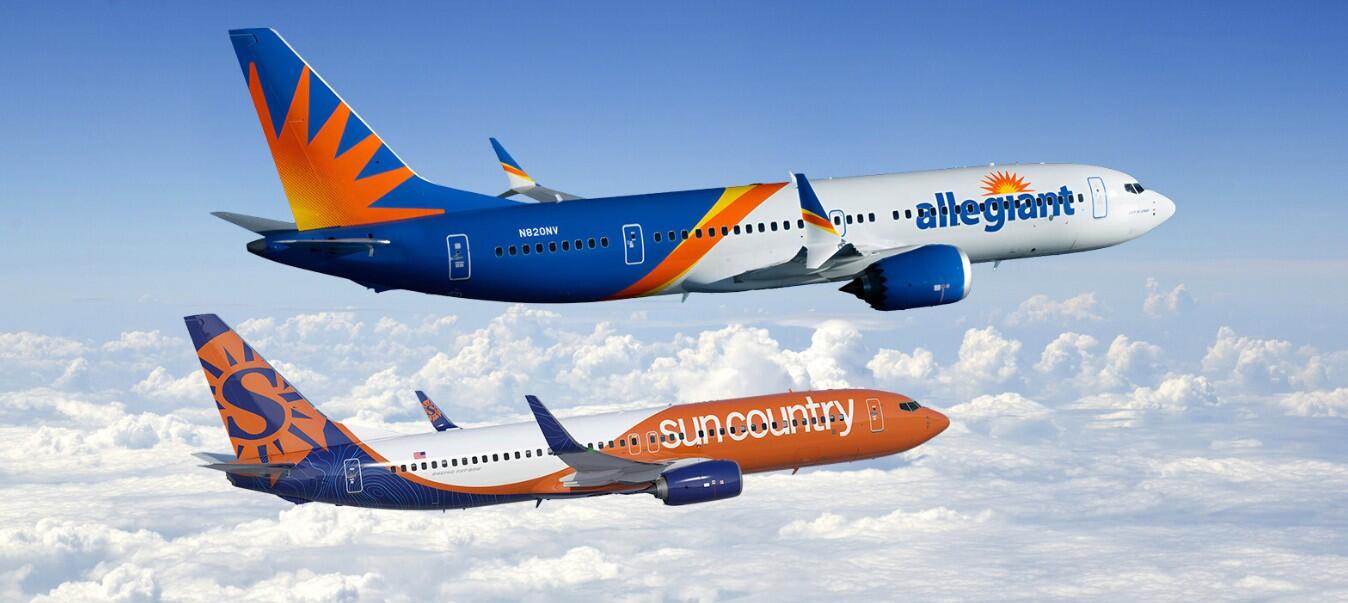
Allegiant’s agreement to acquire Sun Country Airlines will combine two U.S. leisure carriers with almost no route overlap—a network structure that could simplify regulatory review.
During the winter 2025-26 season, Allegiant offers 462 nonstop scheduled routes, while Sun Country operates about 100. The airlines overlap on only two of those routes—Appleton, Wisconsin–Southwest Florida and Nashville–Bozeman Yellowstone—with the Nashville–Bozeman service limited to a short window in January. Looking ahead to summer 2026, OAG Schedules Analyser data shows just one overlapping market, Appleton–Southwest Florida.
That near-total network separation sets the deal apart from recent U.S. merger attempts. When JetBlue Airways and Spirit Airlines unveiled their proposed tie-up in late 2022, the carriers went head-to-head on about 55 airport pairs offered during the month, competing heavily in Florida and the U.S. northeast. Allegiant and Sun Country, by contrast, approach consolidation with minimal need for route rationalization.
In scale terms, the combination does not meaningfully alter competitive rankings but does broaden the combined airline’s leisure footprint. Based on January 2026 schedules, Sun Country is offering about 347,400 seats systemwide, making it the 12th-largest U.S. carrier this month. Allegiant, with 1.56 million seats, ranks ninth. Combined, the two would remain ninth-largest by seats, still behind Spirit Airlines, which is eighth with 2.74 million seats.
Sun Country’s scheduled service is anchored at Minneapolis-St. Paul International Airport (MSP), where it offers about 151,000 departure seats in January and holds a 9.7% share of capacity, according to OAG data. The airport is dominated by Delta Air Lines, which controls roughly three-quarters of departing seats, leaving Sun Country positioned as a secondary carrier focused on point-to-point leisure flows.
From MSP, Sun Country targets sun destinations, particularly Florida, which accounts for more than one-third of its capacity from the airport this month. Its network is built around relatively low-frequency service—averaging about 4.2 flights per week from MSP—supplemented by higher-frequency routes to core leisure markets such as Orlando, Phoenix, Fort Myers and Las Vegas. Internationally, Cancun is Sun Country’s largest overseas market and its fourth-largest airport overall.
Allegiant’s network, by contrast, is less hub-centric and more distributed, with a route map of nonstop flights linking small and midsized cities to vacation destinations. In January, the ULCC’s largest markets are Orlando, Punta Gorda, St. Pete-Clearwater and Phoenix Mesa Gateway, with Florida accounting for about 35% of system capacity. Allegiant’s average frequency—about 2.7 flights per week—is even lower than Sun Country’s.
From a route development standpoint, the combination offers optionality rather than immediate expansion pressure. Sun Country gains access to Allegiant’s extensive set of underserved origin markets, while Allegiant gains a larger-city leisure customer base and an established international platform into select destinations in Mexico and the Caribbean.
Beyond scheduled passenger flying, the combination also links two carriers that have leaned on diversification to manage seasonality and utilization. Sun Country has spent recent years prioritizing cargo and charter operations, including Boeing 737-800 freighter flying for Amazon, which constrained scheduled growth but provided stable revenue and operational flexibility.
Sun Country’s passenger fleet is made up of 737NGs, while the airline also operates 737-800 freighters for Amazon. Allegiant flies a mix of Airbus A320-family aircraft and 737-8-200s. The companies said the combination will allow better utilization of Allegiant’s 737 MAX fleet and orderbook.

Related Content