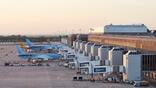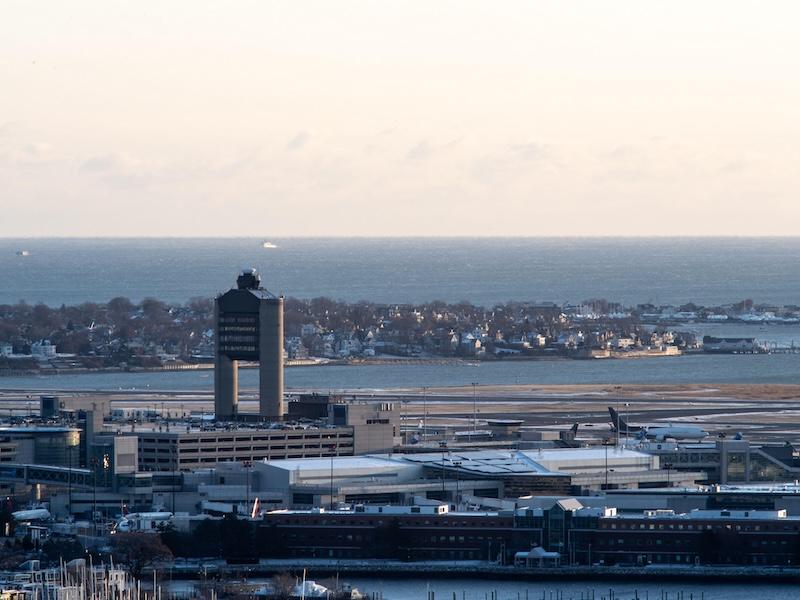
Boston Logan International Airport.
The latest news on airports globally, with updates on financing, infrastructure expansion and sustainability initiatives.
The Massachusetts Port of Authority (Massport) issued a draft strategic plan for the next decade that includes several proposed initiatives at Boston Logan International Airport (BOS). These include a “major renovation or replacement” of the airport’s air traffic control (ATC) tower and “modernizing Logan's terminal core to enhance the passenger experience.” Massport noted in the draft that BOS is under “increasing pressure to accommodate further market demand,” but faces serious expansion constraints. The airport is largely surrounded by water. “Logan’s particular constraint is a geographically limited footprint—with a campus of 2,400 acres, it is one of the nation’s smallest major airports,” Massport said. The organization, which runs BOS, noted that Denver International Airport (DEN) sits on 33,000 acres and Dallas-Fort Worth International Airport (DFW) has an 18,000-acre footprint. In addition, Massport pointed out that BOS “is one of the country’s oldest [airports], underlining the necessity for addressing critical pieces of aging infrastructure that are nearing the end of their useful life.” The ATC tower was built in 1973. Massport said $100 million needs to be committed “to extend its useful life by 10 to 15 years, ensuring operations through 2040 … However, the long-term solution will be the construction of a new ATC tower that meets the latest FAA requirements for the next-generation air traffic system. Based on current funding, siting, feasibility, design, construction and certification processes, this effort will take more than a decade to complete.” Massport added that BOS’: “terminal core likewise needs reinvestment. Terminal C was built in 1967 and is one of Logan’s busiest terminals, handling about 26% of our passenger volume. Although targeted investments have been made over the years, including new connections to Terminal E and Terminal B, the underlying building infrastructure and layout is from another era.” Massport said planning for Logan’s future must also take “into consideration the impact of how travel to the airport will change with the adoption of emerging technologies like [air taxis] and autonomous [ride-service] vehicles.” The airport currently handles around 44 million passengers annually and expects demand to increase by around 10 million yearly passengers over the next decade.
Airports Council International (ACI) World projected global annual passengers will reach 10.2 billion in 2026, which would be up 3.9% year over year, and will continue to grow at an average rate of 3.4% yearly to reach 18.8 billion annual passengers by 2045. But the organization warned that airports’ ability to meet demand is under pressure from "mounting capacity constraints.” ACI World Director General Justin Erbacci said “long-term growth is not guaranteed without coordinated action” to expand capacity. “To accommodate rising demand, the [aviation] industry must accelerate investment in airport infrastructure, airspace capacity and operational resilience, while strengthening collaboration across airports, airlines, governments, regulators and industry partners,” he said. “Without collective action, capacity constraints jeopardize the industry’s ability to meet the projected demand and create operational bottlenecks … At the same time, insufficient investment to meet the projected demand would result in missed economic development opportunities at regional and national levels.”
Ankara Esenboga Airport (ESB) has completed €230 million ($270 million) in infrastructure projects over the last three years, TAV Airports said. Istanbul-based TAV has a concession to manage the Turkish capital’s airport through 2050. The completed projects include a new 3,750-m (12,300-ft.) runway, a new 27,000-m2 (290,625-ft.2) taxiway, an 85,000-m2 cargo apron with six aircraft parking positions and a 77-m-high air traffic control tower. ESB is connected to 79 destinations, including 46 international points. The airport handled 14 million passengers in 2025.
Seattle-Tacoma International Airport (SEA) completed a $546 million upgrade of its passenger terminal. Included was the installation of SEA-based Alaska Airlines’ automated bag drop kiosks. As part of the project, SEA added a check-in/bag drop area on the level of its Skybridge pedestrian walkway that connects automobile parking to the terminal. The airport also refurbished its baggage claim area and updated restrooms. A security checkpoint was upgraded to create more space, including reconfiguring six lanes. Terminal doors and wheelchair access ramps were additionally modernized. Heating, ventilation and air conditioning equipment was upgraded, as were the airport’s electrical and plumbing systems.
Singapore Changi Airport (SIN) has deployed two autonomous baggage tractors. The driverless tractors are moving checked bags airside between the Terminal 1 and Terminal 4 baggage handling areas. SIN plans to deploy more autonomous baggage vehicles later this year and next year. “More than 10 sensors and cameras on each of these tractors work together to enable the vehicles to safely navigate the complex airside environment in all conditions—day, night and rain,” SIN said. “The autonomous tractors are also monitored in a control center during operations, where a remote operator can step in immediately should human intervention be required.” Another six autonomous tractors will be deployed later this year to move checked bags from Terminal 2's baggage handling area to aircraft stands. The fleet will be expanded to 24 driverless vehicles by the end of 2027, with some tractors used to tow cargo and equipment in addition to carrying baggage. “Autonomous tractors free up airside workers from driving tasks, enabling them to focus on last-mile operations, which are more difficult to automate,” SIN said. “To ensure that the autonomous tractors operate safely alongside workers, clear autonomous vehicles zone markings have been painted in the airside. Clear labels have also been attached to all autonomous vehicles.” Liu Yanling, SIN’s senior vice president of airport operations strategy and transformation, said the airport is “shaping a future-proofed working environment where autonomous vehicles can function safely and seamlessly with other human-driven vehicles.”

Related Content