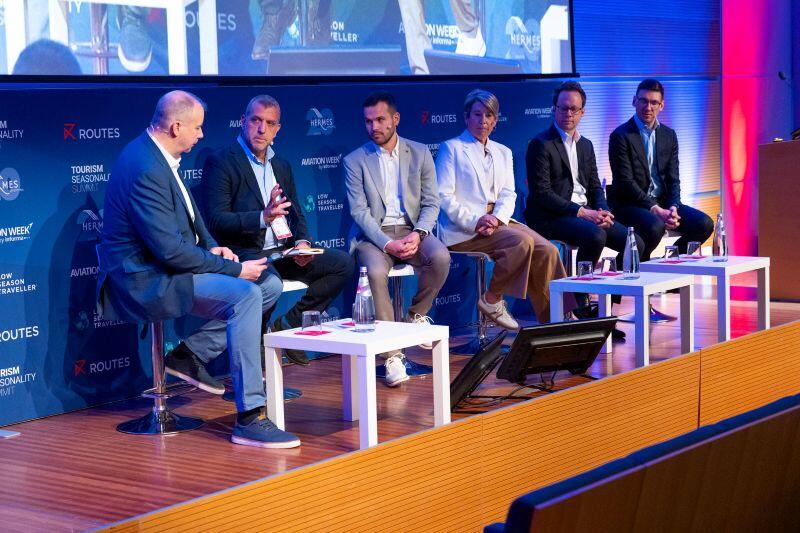
(L-R): Jochen Schnadt, CEO, FLY4 Airlines; Panicos Tsolias, senior business development officer, Hermes Airports; Marc Fischer, head of networks, SunExpress; Peggy Croes, Curacao Airport, SVP; Reinald Frankewitz, head of airport and network relations, Eurowings; and Mantas Vrubliauskas, VP network management, airBaltic.
RIMINI, Italy—Seasonal swings in travel demand are forcing airlines, airports and tourism authorities to work more closely together to grow traffic outside peak summer periods.
That was the message from panelists during an onstage discussion at the Tourism Seasonality Summit, which took place ahead of Routes Europe 2026 in Rimini, Italy.
Airline and airport executives said overcoming seasonality will increasingly depend on stronger coordination between aviation and tourism stakeholders, more flexible scheduling strategies and improved use of data to identify emerging travel trends beyond traditional peak summer periods.
Rather than focusing solely on filling the weakest winter months, several panelists argued that the more immediate opportunity lies in strengthening shoulder-season demand and building year-round travel habits gradually.
Marc Fischer, head of networks at SunExpress, said the Turkish leisure carrier has prioritized improving traffic performance in February, March, April and November before attempting larger-scale winter expansion. “We were trying to fix the shoulder problem first,” Fischer said. “Once we have fixed this, we are looking into the very dark months of the winter season.”
For Cyprus-based Hermes Airports, efforts to reduce seasonality have centered on broadening the destination’s tourism offering beyond traditional sun-and-sea demand. Panicos Tsolias, senior business development officer at Hermes Airports, said Cyprus has worked to develop inland tourism, gastronomy, sporting events and conference traffic to support demand throughout the year.
More News And Analysis From Routes Europe 2026
“We have developed a series of authentic experiences,” Tsolias said. “Cyprus has a lot to offer in the inland part of the country, but also in the seaside areas.”
Panelists also highlighted the increasing importance of network flexibility as seasonal demand patterns become less predictable.
Mantas Vrubliauskas, vice president of network management at airBaltic, said the Latvian carrier has experimented with deploying aircraft into alternative winter markets, including the Canary Islands, to offset weaker seasonal demand in the Baltics. “We are trying to be brave and trying to find new markets,” Vrubliauskas said. “Sometimes it really works.”
Reinald Frankewitz, head of airport and network relations at Eurowings, said airlines are increasingly moving away from rigid seasonal schedules and adjusting capacity more dynamically in response to changing demand patterns.
“We are in a phase where the flight schedules become customized,” Frankewitz said.
He added that airline planning is becoming increasingly complex because traditional slot systems and traffic rights frameworks are often not designed for rapidly changing operational models.
The role of artificial intelligence (AI) and advanced data analysis also featured heavily in the discussion, with panelists arguing that AI could help airlines and destinations identify new customer segments and emerging travel patterns more quickly.
“I think AI will play a big role in the provision of data,” Tsolias said. “You will have the opportunity to identify specific segments and specific interests through AI.”
However, panelists cautioned that technology alone would not solve the industry’s seasonality challenges. Peggy Croes, SVP at Curacao Airport, said destinations must still focus on delivering authentic visitor experiences and understanding traveler behavior beyond data models. “Don’t underestimate the power still of us as humans,” Croes said.

Related Content