This article is published in Air Transport World part of Aviation Week Intelligence Network (AWIN), and is complimentary through Aug 15, 2026. For information on becoming an AWIN Member to access more content like this, click here.
The latest player hoping to capitalize on Vietnam’s growth story is Sun PhuQuoc Airways.
A famous Vietnamese and Chinese idiom—“emerging from the mud unstained and pure”—describes the Vietnamese national flower, the lotus, and the country’s economy, which has emerged from the turbulent years of the 1970s to become one of the fastest-growing in the Asia-Pacific region.
Vietnam’s aviation sector has mirrored that transformation, evolving from a tightly controlled system into one of Southeast Asia’s most dynamic air transport markets. Today, the country’s airlines range from state-backed flag carrier Vietnam Airlines and dominant LCC Vietjet Air to privately owned operators like Bamboo Airways, Pacific Airlines, Vietravel Airlines, VASCO and startup Sun PhuQuoc Airways.
Vietnam’s long, narrow and mountainous geography means flying is one of the most efficient ways to travel across the country. In April, the Hanoi-Ho Chi Minh City route was the world’s third-busiest domestic route.
The launch of LCC Vietjet Air in 2011 ushered in a new era of privately owned operators that sought to eat into Vietnam Airlines’ monopoly grip. Vietjet’s meteoric growth over the past decade has seen it capture around 42% of the domestic market.
Vietnam Airlines is well aware of its new competition. “Over the last two years, we have seen that the situation has changed so there is now a very good balance between the low-cost and the full-service carriers,” Vietnam Airlines EVP Nguyen Quang Trung told ATW.
He added that while Vietnam’s domestic market is maturing, it remains far from saturated. Domestic traffic grew 7% year-on-year (YOY) in 2025 and by a further 11% YOY in the first quarter of 2026.
But Vietnam’s rapid aviation expansion has also exposed structural weaknesses. Pacific Airlines, the LCC subsidiary of Vietnam Airlines, suspended operations temporarily in March 2024 and returned all the Airbus A320s it had leased from a third party. Pacific has since resumed operations with three A320s leased from its parent company and is seeking a new investor as part of a restructuring effort.
Bamboo Airways also expanded aggressively after launching in 2019, rapidly adding Airbus and Embraer narrowbodies alongside Boeing 787s. However, the pandemic, mounting financial pressure and multiple management changes forced the airline into a fleet restructuring in late 2023.
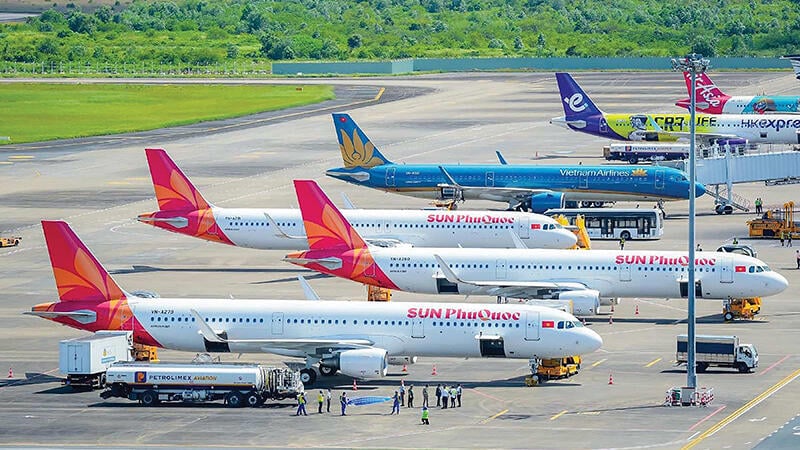
The latest player hoping to capitalize on Vietnam’s growth story is Sun PhuQuoc Airways (SPA), which is backed by travel and hospitality conglomerate Sun Group. The carrier aims to leverage rising demand for flights to Phu Quoc Island while positioning itself as a privately owned, full-service airline.
“Sun PhuQuoc Airways has no interest in competing on price or schedule frequency. We are building something different, an airline whose growth is deliberately tied to the growth of a destination,” SPA CEO Nguyen Manh Quan said.
“We are not going head-to-head with other carriers. We are growing via the pull of the destination itself.”
Vietnamese airlines are also operating increasingly large fleets to support future growth. Vietjet Air alone accounts for most of the country’s aircraft backlog, with 389 Airbus and Boeing aircraft on order, representing around 81% of Vietnam’s outstanding commitments.
Vietnam Airlines also signaled a major strategic shift in February with an order for 50 Boeing 737 MAX-8s, one of its largest aircraft purchases. Traditionally an Airbus A320-family operator, the airline said the Boeing narrowbody demonstrated strong operational efficiency while also helping to mitigate fleet risk and strengthen negotiating leverage.
The carrier expects to operate around 150 narrowbodies by 2035, with the Boeing deliveries contributing significantly to that expansion.
Reflecting Vietnam’s export-driven economy, Vietnam Airlines expected to induct its first A321 freighter in the first half of 2026 and a second by year end. The airline is also in discussions with international investors to establish a cargo joint venture in Vietnam.

SPA has similarly ambitious expansion plans. Since November 2025, the airline has added 10 Airbus A320/A321s within six months and plans to introduce two Airbus A330s by July. Its long-term target is to grow to 25 aircraft by the end of 2026, 100 aircraft by 2030 and 200 aircraft by 2035.
In February, during a broader Vietnamese state visit to Washington DC, SPA signed a $22.5 billion agreement for 40 Boeing 787-9s, which the company described as the country’s largest Boeing widebody order to date.
NEW AND IMPROVED AIRPORTS
Vietnam’s airport sector has undergone its own liberalization drive as authorities increasingly position aviation infrastructure as a catalyst for economic development. In 2018, Sun Group opened Van Don Airport (VDO) in northern Vietnam, the country’s first privately operated airport. The group is further expanding its airport footprint after taking over operations at Phu Quoc Airport (PQC) from Jan. 1. The company moved quickly to modernize operations, selecting Singapore Changi Airport International (SIN) to cooperate on the Terminal 2 project, which is scheduled to open in mid-2027, while partnering with SITA on end-to-end automated passenger systems.
Sun Group’s portfolio is set to expand further after it was selected to invest and build the new Phan Thiet Airport (PHH) in southern Vietnam.
Another partnership formed in 2024 between Cairo International (CAI) and Cam Ranh Airport (CXR) in the Vietnamese province of Khánh Hòa to improve commercial performance, connectivity and operations. Over the past two years, CXR has added 21 airlines and 17 city links. In 2025, passenger traffic increased more than 6%, while airport concession sales rose more than 25%, with spending per passenger seeing double-digit growth.
“We adopted a three-pronged approach to grow traffic: conversion, enhancement and diversification,” CXR terminal service director Matthew Tan said.
“This included converting charter flights into scheduled services, strengthening existing networks, particularly to key markets like South Korea, and developing new markets to attract passengers from different regions.”
Vietnam Airlines has welcomed the privatization trend, saying these airports often stimulate broader airline industry growth. However, Trung cautioned that airport development must remain aligned with travel demand and be integrated with supporting rail and road infrastructure to strengthen intermodal connectivity.
Airports Corp. of Vietnam (ACV) director of business and market development Nguyen Quoc Hung said more airports are likely to receive approval for private operations in the coming years.
At the center of Vietnam’s infrastructure ambitions is Long Thanh International (LTH), which is scheduled to open in the fourth quarter of 2026. Developed at a cost of VND336.63 trillion ($12.78 billion), the airport will eventually handle up to 100 million annual passengers, making it the country’s largest-ever aviation project and a future gateway into Indochina.
Hung said long-haul international services are expected to shift first to LTH, although airline allocations are still being finalized. Anchored by Vietnam Airlines, around half of the airport’s lounge space will be reserved for SkyTeam members and will include a dedicated SkyTeam lounge.
The airport will feature extensive automation and digital technologies, including biometric self-check-in kiosks, self-bag-drop counters and CT scanners to speed passenger processing and security screening.
However, bottlenecks remain. ATW observed lengthy immigration processing in Hanoi because of highly manual procedures. Although authorities introduced a digital arrival card initiative, the system is limited to Ho Chi Minh City and early teething issues have continued.
Beyond the country’s main hubs, authorities are also working to improve connectivity to secondary cities like Da Lat, Hai Phong and Hue. Authorities are also preparing to launch additional services from those airports to destinations across North Asia, which remain Vietnam’s largest tourism market, while exploring new routes to South Asia.
The outlook for Vietnam’s aviation sector remains strong, supported by a 2025 8% GDP growth and a rising middle class. Airlines, airport operators and investors are racing to position themselves for the next phase of the country’s aviation expansion. They are optimistic that the growth will mirror that of the national flower.