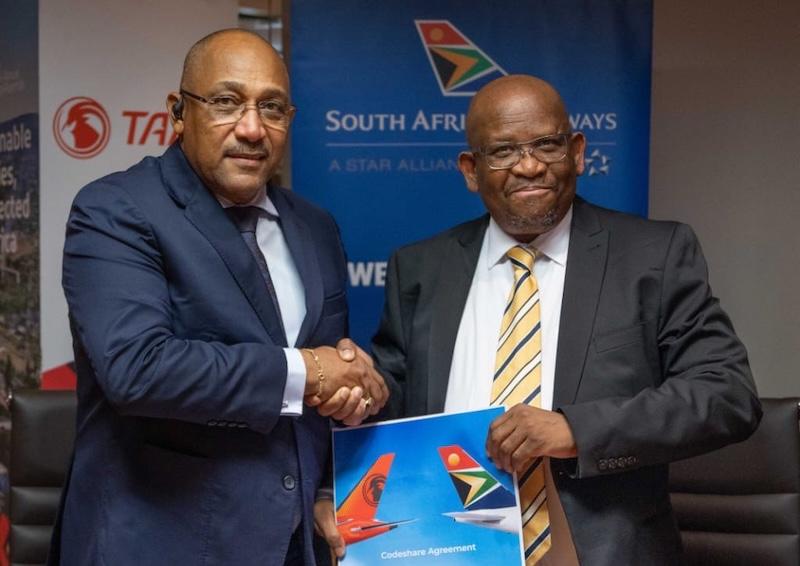
Nelson Rodrigues de Oliveira, CEO of TAAG (left), and Tebogo Tsimane, SAA’s CCO, sign a codeshare at the AFRAA annual meeting.
South African Airways (SAA) is ramping up its codeshare partnerships to bolster its network reach while seeking to grow its widebody fleet next year, said Tebogo Tsimane, SAA’s CCO, speaking to Aviation Week.
At the African Airlines Association annual meeting in Luanda, Angola, in early December, SAA signed a codeshare deal with AFRAA host carrier TAAG. SAA will add its flight code to TAAG-operated flights from Johannesburg and Cape Town to Luanda, with TAAG gaining access to destinations in SAA’s network, including Cape Town, Durban, Gqeberha, Harare and Lusaka.
State-owned SAA resumed operations in September 2021 after surviving near bankruptcy and has been in a slow rebuilding phase. “Our plan from the beginning, in the post-pandemic period, was that we would grow our aircraft capacity and also our virtual capacity,” Tsimane explained.
“We are now seeing an acceleration of this plan,” he said, with codeshare deals to be signed before year-end with Turkish Airlines, adding to deals sealed during 2025 with South African domestic carrier CemAir, Lufthansa and Emirates.
“There is also going to be a number of codeshare agreements that we are going to sign in the new year,” he added. Further deals are being prepared with Air Botswana, Air Zimbabwe and Air Eswatini. A codeshare with United Airlines is also in the pipeline.
At present, SAA is operating a fleet of 14 Airbus A320 narrowbodies plus two A340-300s and two A330-300 widebodies.
The A320 fleet has been increased by four leased aircraft this year, Tsimane said. A fifth A320 and a pair of A330-200s were scheduled to arrive in 2025 from various lessors, but their introduction has been delayed to 2026 as their operators opted to keep them for longer.
The delay in adding these three aircraft has “put our plan behind,” Tsimane said. “This capacity is important to improve our codeshares and our connectivity because we are a network carrier and we are building a connecting schedule around Johannesburg, and then secondarily, around Cape Town,” he noted.
“Then we are also looking for additional A330s to enter service in 2026,” he said, probably in the second half of the year.
However, these A330s and the other leased aircraft are a temporary solution. “There is a fleet renewal plan that is in the works, but in the meantime, we need the lift to bridge the gap,” Tsimane said.
SAA is expected to issue a request for proposals for a significant number of narrowbodies and widebodies before year-end, he said.
Washington, New York, Bangkok, Mumbai, Guangzhou, London and Frankfurt are all on SAA’s destination radar over the next few years as the carrier grows its widebody fleet and expands its long-haul network, he added.

Related Content