
This article is published in Aviation Daily part of Aviation Week Intelligence Network (AWIN), and is complimentary through Jun 25, 2026. For information on becoming an AWIN Member to access more content like this, click here.
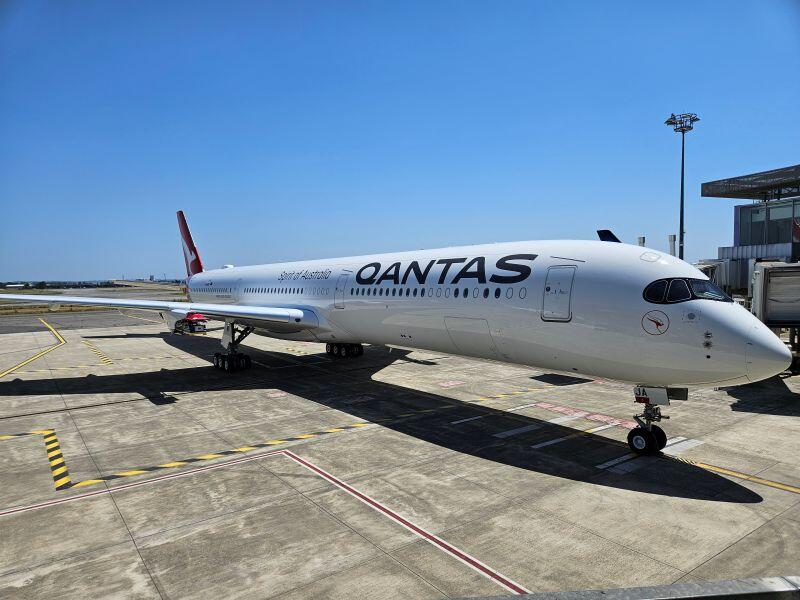
Qantas Airbus A350-1000ULR
TOULOUSE—Qantas plans to launch non-stop services from Sydney to London in October 2027, the airline’s CEO Vanessa Hudson announced at a company event in Toulouse.
The services will be daily and will be using Airbus A350-1000ULRs, the first of which was presented at the Airbus delivery center in Toulouse. The London flights will be followed by nonstop services from Sydney to New York soon afterwards, although Hudson did not give a specific timeline for the second route. Tickets for the London flights will go on sale in February.
Qantas announced that it wanted to fly the Kangaroo route nonstop in 2017. Both Airbus and Boeing submitted proposals. Boeing’s was based on the 777-8 whereas Airbus pitched a version of the A350-1000.
The airline ultimately placed an order for 12 A350-1000ULRs and also committed to twelve standard A350-1000s, orders that could presumably also be converted to the ULR variant should Qantas see the demand for it. Boeing subsequently delayed development of the 777-8 to prioritize the larger -9 and the freighter variant -8F.
The ULR features a rear center tank (RCT) that holds an additional 20,000 liters (about 5,300 gal.) of fuel bringing total capacity up to 168,000 liters. The A350-1000ULR has a maximum take-off weight of 324 tons and a range of up to 9,800 nm. That compares to 308 tons for the basic A350-1000 which has a range of 8,100 nm. The high gross weight version of the aircraft can fly up to around 9,100 nm.
The airline is taking the first ULR in April 2027, several months later than expected. Five additional aircraft will arrive between April and November of the same year and Airbus will have caught up on the original schedule by the fifth aircraft, according to Hudson. Another six aircraft will be delivered within the next 2.5 years and until 2029.
Qantas needs three aircraft each for a daily London or New York service, meaning it has an additional six ULRs to allocate in the future. Routes from Melbourne to the two destinations are also under consideration. But Qantas also plans to replace the 787-9s on the Perth-London route and on Auckland-New York. “These are pushing the limits of the 787-9,” Hudson said. The move will also enable the airline to allocate the type to other markets.
For the ULR, Qantas is also looking at additional destinations in Europe and North America. Hudson specifically pointed to Chicago, a route the airline announced three times over the years, but never actually flew. “Maybe it’s fourth time lucky,” she said. More points in Latin America are another possibility.
Airbus Chief Commercial Officer Benoit de Saint-Exupéry said the manufacturer is talking to other airlines that have shown an interest in the aircraft. However, most routes can be operated with the standard -1000 or the -900 or the competing Boeing aircraft.
Qantas plans to operate the aircraft in a four-class configuration featuring 238 seats. In a typical three class layout (at ten abreast seating in economy) the -1000 has space for 400 seats, according to Airbus. “Qantas was built on the belief that Australia’s distance from the rest of the world should never stand in the way,” Hudson said. “Since we first flew the Kangaroo route in 1947, where we stopped seven times on the way to London, every generation of aircraft has taken a stop out of the journey. Today we are taking out the last one.”
The business plan for Project Sunrise assumes a 20% premium across all cabins compared to one-stops flights, a level that the airline is achieving already on its Perth-London flights. Hudson argued that the services would have done well even in the current high fuel price environment, caused by the Iran war. “We would have seen massive demand for point-to-point flying,” she said. “Even in this scenario, I am convinced that this is the right aircraft.”
She noted the recent drop in fuel price which “has come down more quickly than the forward curve was predicting.”

Related Content



Comments
308t = 8,100nm
316t = 8,400nm
319t = 8,700nm
322t = 9,000nm