This article is published in Aviation Week & Space Technology and is free to read until Jul 24, 2026. If you want to read more articles from this publication, please click the link to subscribe.
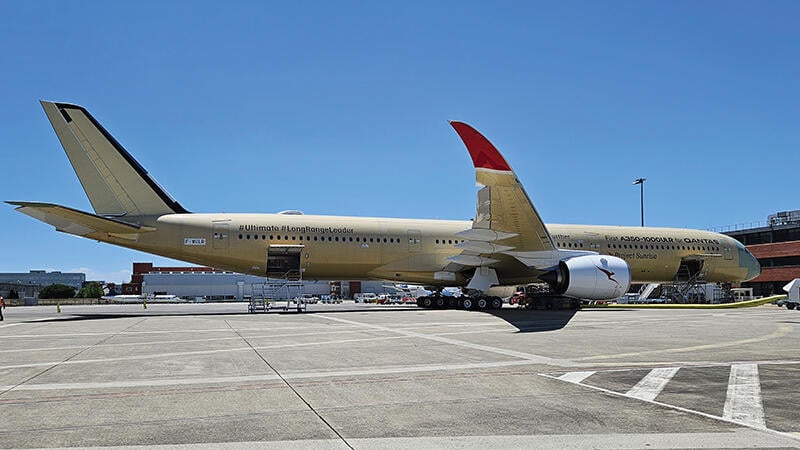
Airbus has started a short flight test campaign using Qantas’ first A350-1000ULR.
When Qantas introduces the first nonstop flights between Sydney and London in October 2027, passengers might find themselves on an unexpected route. Rather than the typical eastbound crossing of Australia or the extended passage over India, they might head directly north on the longest commercial flight to operate—a new polar route.
It has been almost 10 years since Qantas began chasing its ultimate frontier: The ability to fly nonstop from Sydney to London—or to anywhere in the world, for that matter. The premise began with a social media post challenging Airbus and Boeing to offer an aircraft that could conduct the mission. Boeing suggested a version of the 777-8, which at the time looked like it could be developed along Qantas’ schedule expectations. Airbus proposed an even longer-range version of the A350-1000, the A350-1000ULR. In the end, Airbus won the campaign when the airline placed an order in 2022 for 12 of the aircraft at the tail end of the COVID-19 pandemic and after a two-year hiatus.
- Nonstop Sydney-London flights are slated to start in October 2027
- The first Airbus A350-1000ULR delivery is planned for April
CEO Vanessa Hudson, who has led Qantas since 2022, asserts that Project Sunrise will secure a sustainable competitive advantage, making the airline’s long-haul network more resilient over the long term. The emotional aspect of the project should not be overlooked because it continues the pioneering spirit of an airline operating from a location far removed from much of the world. Hudson describes that as “breaking the tyranny of distance” when she and senior management presented the first and second A350-1000ULRs in Toulouse. “Qantas was built on the belief that Australia’s distance from the rest of the world should never stand in the way,” she says.
Project Sunrise is also great public relations.
Qantas’ famous Kangaroo Route, the traverse from Australia to London, used to entail up to seven stops and took several days. The longest nonstop leg, across the Indian Ocean, kept the Catalina flying boats aloft for 33 hr. During that passage, the Sun rose twice, hence the name Project Sunrise. While next year’s A350 services will be by far the longest flights in terms of distance covered (9,100 nm), they fall well short of what passengers and crew endured in the 1940s.
Over time, as aircraft technology evolved, the number of stops substantially decreased. But most passengers en route to Europe must still fly through an intermediate stop, typically Singapore. Qantas did introduce nonstop services from Perth to London using Boeing 787-9s in 2018, but these flights are considerably shorter than those now coming from Australia’s East Coast.
Flying Sydney-London nonstop is a major operational challenge that has been years in the making—involving aircraft enhancements, new flight planning and passenger well-being, among other factors. The northbound flight to London can last up to 21 hr., depending on prevailing winds; the return service can be 1-2 hr. shorter since the aircraft often benefits from tailwinds. Services to New York will pose fewer challenges, since the route is shorter.
The A350-1000ULR features a new rear center tank that holds an additional 20,000 liters (5,300 gal.) of fuel, bringing total capacity to 168,000 liters. The aircraft has a maximum takeoff weight of 324 tons and a range of up to 9,800 nm, compared with the standard version of the A350-1000 at 319 tons and 9,100 nm, which is not quite enough for the London run.
The airline is scheduled to receive the first ULR in April 2027, several months later than expected. Five more should arrive between April and November, and Airbus expects to catch up to the original schedule by the fifth aircraft, Hudson says. Another six aircraft should be delivered within the next 2.5 years through 2029.
Qantas’ daily London and New York services require three aircraft each, leaving an additional six ULRs to allocate in the future. Routes from Melbourne to the two destinations are under consideration, too. Qantas also plans to replace the Boeing 787-9s on the Perth-London and on the Auckland-New York routes. “These are pushing the limits of the 787-9,” Hudson says. The move would enable the airline to allocate the type to other markets.
For the ULR, Qantas is also considering additional destinations in Europe and North America. Hudson specifically highlights Chicago, a route that the airline announced three times over the years but never actually flew. “Maybe it’s fourth-time lucky,” she says. More points in Latin America are also possible.
Qantas is likely one of the few operators—if not the only one—that can justify purchasing a fleet of -1000ULRs at scale, due to the geographic location of its hub. The smaller size of the aircraft opens up more potential destinations than were possible with the Airbus A380 or Boeing 747-400.
Qantas plans to operate the aircraft in a four-class configuration featuring 238 seats. A small lounge area between premium economy and economy will allow passengers to stretch their legs. In a typical three-class layout (at 10-abreast seating in economy), the -1000 has space for 400 seats, Airbus says.
Qantas aims to fly the route with 14 cabin crewmembers and four pilots. The pilots will hold a common type rating for the Airbus A330 and will fly both types. In addition to the cabin crew’s rest compartment at the top rear of the economy cabin, the airline is installing a bespoke rest area for pilots with two bunk beds and two seats.
About 75-80% of Sydney-London flights will use the traditional route across Asia and the Middle East. But depending on prevailing winds, the airline might instead chose a new north polar flightpath, Chief Technical Pilot Alex Passerini says. Thus, counterintuitively, “about 20% of the time we will be approaching London from the north,” he says. The flightpath will come close to the North Pole and continue south near Iceland and Ireland before entering the UK. Qantas is using a flight-planning tool called Constellation, developed in-house, that it believes is better than other options. The polar route will have “a lot less airspace constraints and a lot less traffic,” Passerini says.
Navigating airspace constraints is a considerable complication: Russia’s airspace is closed due to Western sanctions, which effectively makes it impractical for Qantas to fly through China en route to London. The Iran war has made navigating the Middle East challenging for all airlines, as has the Russia-Ukraine war. Passerini says the constraints can add about 1 hr. of flight time.
Qantas’ service-entry project has been scheduled to last about three years. About 20% of its long-haul pilots and cabin crew will be “upskilled” for the A350-1000ULR operation. Eight of its pilots are flying A350-1000s with British Airways to gain experience; another group will fly with Cathay Pacific next year.
The airline has also been working with the Charles Perkins Center at the University of Sydney to develop techniques that will make ultra-long-haul flying more enjoyable for its passengers. “It is a major biological challenge to cross so many time zones,” says Professor Peter Cistulli, who leads the center. Sleep deprivation and dehydration combined with long periods of immobility are the main challenges.
But Cistulli says that jet lag can be reduced from an expected seven days to just two. “We can probably shift [adjustment to new time zones] by a few hours during flight,” he says. “That makes a huge difference.”
The university’s research shows that the biggest factor is light exposure, Cistulli says. Therefore, Qantas and Airbus have jointly developed light schemes in the cabin that resemble sunrise, daylight, sunset and night with subtle variations. Qantas will offer meals that are intended to reduce jet lag. There will be a “protected sleep window” during the flight in line with the destination’s nighttime. “It’s a new era—we are really disrupting the old ways,” Cistulli says.
Beyond operational challenges, Project Sunrise also has to work economically.
Ultra-long-haul flights represent a tiny, almost negligible fraction of the global airline network, and they come with unique difficulties: Extra fuel must be carried just to ensure the aircraft has enough to reach the destination, which has traditionally made it difficult to achieve profitability, particularly in a high-fuel-price environment, such as the one the industry has faced in recent years.
Hudson says the per-seat fuel burn on the A350-1000ULR will be similar to that of the one-stop A380 service. The fact that the aircraft takes off only once helps with efficiency, although the extreme distance is a disadvantage.
The business plan for Project Sunrise assumes a 20% premium across all cabins compared with one-stop flights, a level that the airline is achieving on its Perth-London flights. Hudson asserts that the services would have done well even in the current high-fuel-price environment caused by the Iran war. “We would have seen massive demand for point-to-point flying,” she says. “Even in this scenario, I am convinced that this is the right aircraft.”