This article is published in Aviation Week & Space Technology and is free to read until Feb 28, 2026. If you want to read more articles from this publication, please click the link to subscribe.
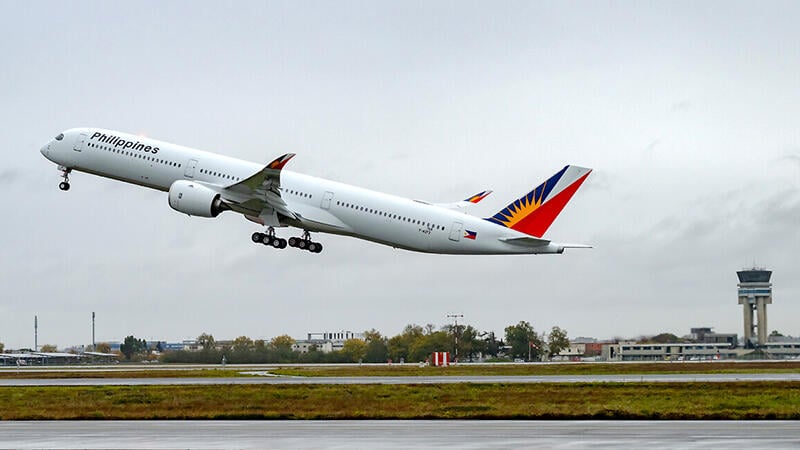
Philippine Airlines took delivery of its first A350-1000 in December, with more to follow this year.
If the Asia-Pacific region is the growth engine for the global airline industry, then Southeast Asia could be considered the engine within the engine.
Southeast Asian airlines have racked up massive aircraft order backlogs to cater to rapidly rising demand in the dozen countries that comprise this subregion. Of course, airlines here are not immune to industry headaches such as supply chain bottlenecks and delivery delays. And in the longer term, fleet growth will require infrastructure expansion. But several important airport projects are underway to address that issue.
Data derived from CAPA – Centre for Aviation shows there are 1,678 commercial jet aircraft on order by Southeast Asian airlines, versus an operational fleet of 1,579. By far the majority of orders—over 85%—are narrowbodies, reflecting the preponderance of low-cost carriers in this part of the world.
- Low-cost carriers will play a major role in fastest-growing subregion
- Hub development projects will boost airport capacity
Many carriers in the subregion saw deliveries begin to pick up in 2025, including the introduction of new fleet types in some cases. Delivery numbers are likely to increase again this year.
Airbus delivered 42 aircraft to Southeast Asian carriers in 2025, according to the manufacturer’s orders and deliveries reports. These included new deliveries via lessors. Boeing reported 15 deliveries to airlines in this subregion, not counting those to lessors.
The combined total is higher than the 38 aircraft delivered in 2024 by the two major manufacturers.
Southeast Asian airlines are scheduled to take delivery of 121 jet aircraft this year, according to CAPA projections. The annual total is due to rise again to 189 in 2027. However, delivery delays have made such schedules less reliable.
Over the longer term, Boeing projects that Southeast Asia will require about 4,900 jet aircraft deliveries through 2044, said David Schulte, Boeing commercial marketing managing director for Asia-Pacific, at the Association of Asia Pacific Airlines annual meeting in Bangkok in November. Of the total, 1,200 will be for replacement and 3,700 for fleet growth.
Surging demand will drive this dramatic fleet expansion. Boeing estimates that Southeast Asia’s passenger demand—as measured in revenue passenger kilometers—will increase by an average of 7% per year over the forecast period. Schulte said this is the fastest growth rate for any subregion, tied with South Asia.
Rising demand is spurred by expected GDP growth of 5% per year in Southeast Asia, in conjunction with higher tourism and a rapidly expanding middle class. The number of people classified as middle class in Southeast Asia has more than doubled over the past 25 years, Schulte said. It is forecast to double again by 2044. “This is important, because it [increases] the propensity to travel for many households, which is one of the major drivers for continued growth” in this market, he said.
Over the past 25 years, there has been a 200% increase in both monthly flights and connected city pairs in Southeast Asia, Schulte said.
Tourism is vital to airlines and economies in many Southeast Asian countries. Data from national tourism authorities shows that monthly visitors are at or above 2019 levels for countries such as Indonesia, Malaysia and Vietnam. Tourism to Thailand has dropped this year but is expected to bounce back.
Boeing projects that 80% of deliveries to Southeast Asia through 2044 will be narrowbodies, Schulte said. However, the size of those narrowbodies is increasing. The average capacity of narrowbodies in this subregion has been rising by about one seat per year as more airlines upgauge to larger models.
Many of the Southeast Asian full-service carriers are overhauling their fleets with new deliveries, albeit at a slower pace than they had planned. In some cases they are considering further orders.
Malaysia Airlines intends to grow its capacity by 50% in five years thanks to its delivery streams. The carrier expects to receive four Boeing 737 MAXs and seven Airbus A330neos in 2026. It is also planning to place new orders this year for about 16 long-range widebodies, Group Managing Director Izham Ismail said in November.
Philippine Airlines received its first Airbus A350-1000 in December—which also was the first of this variant to be delivered to any Southeast Asian airline. It expects to receive another four this year, according to airline President Richard Nuttall.
Another important milestone is due to occur late in 2026 when Philippine Airlines resumes taking deliveries of Airbus A321neos after a lengthy hiatus. It has 13 A321neos remaining on order.
Thai Airways took delivery of the first of its 32 A321neo orders in December. The carrier’s next new widebody deliveries—Boeing 787s—are not scheduled to start arriving until early 2028, so Thai is aiming to lease more widebody aircraft in the meantime. The carrier intends to double its fleet size to 150 aircraft by 2033.
Singapore Airlines still has some 787-10s and 737 MAXs remaining to be delivered for its passenger fleet, although its largest order is for 31 Boeing 777-9s. As with other 777-9 customers, Singapore Airlines’ fleet planning has been disrupted by major production and certification delays that have caused the first delivery target to slip to 2027.
Vietnam Airlines has no new deliveries pending, but it plans to place narrowbody and widebody orders, including firming up tentative agreements.
While these full-service carriers are making progress with fleet upgrades, low-cost carriers (LCC) are the ones dominating Southeast Asia’s aircraft orders.
Four LCCs—VietJet, AirAsia, Lion Air and Cebu Pacific Air—account for more than 1,000 of the jet aircraft orders destined for Southeast Asia, or 63% of the total.
The LCC model has proven to be particularly well-suited to the Southeast Asian market. LCCs account for 52% of weekly seats in this subregion, well above the LCC penetration rate of 33% for the broader Asia-Pacific region, 31% for North America and 40% for Europe.
VietJet boosted its narrowbody backlog to 341 with an order for another 100 A321neos in October. It now has 190 A321neos and 151 737 MAXs on order. The carrier also has ordered 40 A330neo widebodies, with deliveries due to start this year.
VietJet subsidiary Thai VietJet took delivery of its first 737-8 in November, and it already has eight in service with another 41 remaining on order.
AirAsia has 358 A321neos on firm order. It signed a memorandum of understanding in July covering 70 A321XLRs, and the carrier also has signaled it is considering an order for smaller narrowbodies from either Embraer or Airbus. AirAsia is in the process of merging with its sister carrier AirAsia X, which has 20 Airbus narrowbodies and 14 A330neos on order.
Lion Air has orders for 229 737 MAXs, and its Batik Air full-service subsidiary has 185 Airbus narrowbodies in its backlog. Cebu Pacific Air has 83 A321neos remaining on order.
Many of the aircraft orders for Southeast Asian airlines will be for replacement, but massive fleet growth will still occur in the long term. One of the big questions surrounding the impressive order numbers is whether airport infrastructure will be sufficient to accommodate the growth. So governments have begun ramping up airport development.
One of the largest projects in the Asia-Pacific region is the construction of Long Thanh International Airport near Ho Chi Minh City in Vietnam. This is planned to be Vietnam’s largest gateway, eventually catering to 100 million passengers a year. The initial phase will accommodate 25 million passengers per year.
Airline trial flights have landed at Long Thanh, and construction of the passenger terminal is in its final stages. Commercial operations are expected to begin in the first half of this year.
Another major airport project in this subregion is underway in Bulacan near Manila. The New Manila International Airport is also targeting an eventual capacity of 100 million passengers a year, with its first stage accommodating 35 million per year.
Development of this airport has begun, and the first stage is expected to open by the end of 2028.
At the same time, improvements are planned at Manila’s existing Ninoy Aquino International Airport to relieve congestion. The airport currently handles about 53 million passengers per year, and officials plan to increase annual passenger capacity to 62 million within two years.
Singapore’s Changi Airport has broken ground on a massive fifth terminal, which will be able to handle 50 million passengers a year and will be the new home for Singapore Airlines Group. Construction of Terminal 5 is expected to be completed in the mid-2030s.
Airports of Thailand plans to boost the capacity of Bangkok’s Suvarnabhumi Airport by 15 million passengers a year to a total of 80 million, to be achieved through the eastern expansion of the main terminal building, expected to be completed by 2030. Longer-term plans call for construction of a new south terminal and a fourth runway.