This article is published in Air Transport World part of Aviation Week Intelligence Network (AWIN), and is complimentary through Apr 09, 2026. For information on becoming an AWIN Member to access more content like this, click here.
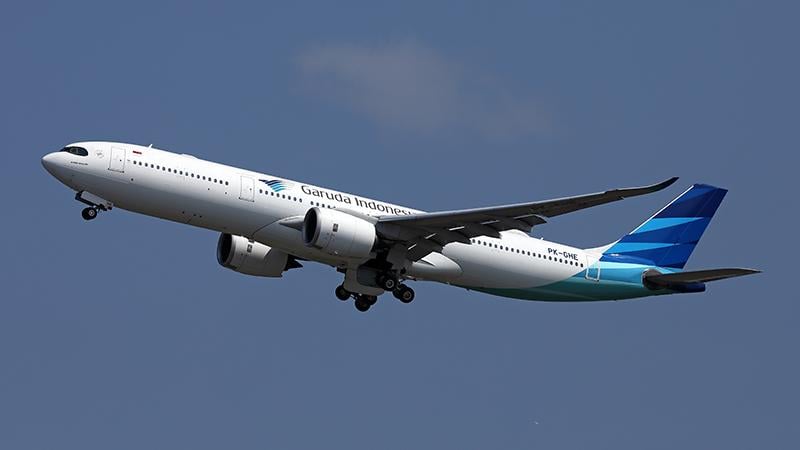
Cash-strapped airlines like Garuda Indonesia have limited resources to address sustainability goals
The 11 nations comprising Southeast Asia, known collectively as the Association of Southeast Asian Nations (ASEAN), form the world’s fourth-largest economy, with several posting annual GDP growth above 5%. Aviation is poised to expand in tandem: IATA expects passenger numbers in the region to double over the next decade, driven by robust economic growth and a rising middle class.
Despite strong feedstock potential for sustainable aviation fuel (SAF)—particularly agricultural residues highlighted in studies from Boeing and IATA—the region’s sustainability transition has been slow. However, momentum is starting to build.
ASEAN spans a wide range of geographies, political systems and levels of economic maturity. Yet most airlines have aligned with IATA’s target of net-zero carbon emissions by 2050 and are now assessing their pathways to compliance.
Mechanisms such as book-and-claim and carbon-credit schemes—including the ICAO Carbon Offsetting and Reduction Scheme for International Aviation (CORSIA)—have been identified as tools to mitigate limited SAF supply. But implementation remains uneven.
“It is ironic that our country has so much rainforest, but we struggled to find a project,” Malaysia Aviation Group chief strategy officer Bryan Foong said, noting the difficulty of identifying CORSIA-certifiable projects across the value chain.
IATA remains a strong proponent of CORSIA, particularly for nations with significant natural resources. “CORSIA can generate revenues and have an environmental impact, because taxation may generate revenues, but it has zero impact on the environment,” IATA director general Willie Walsh said at the Association of Asia-Pacific Airlines Presidents’ Assembly in Bangkok in November.
Across ASEAN, airlines and industry bodies commonly cite gaps in government understanding of CORSIA and limited coordination among energy, finance and transport ministries—issues that slow policy progress.
Still, developments are emerging. In Thailand, it is expected that airports will be ready to supply 2% of airline SAF needs in 2026 and 5-8% by 2030. The effort is largely voluntary and requires minimal capital expenditure because SAF will be co-processed in existing refineries.
Indonesia—the world’s largest palm oil producer—is pushing forward with SAF projects centered on used cooking oil. It has also explored pathways using palm-oil byproducts, though such feedstocks face scrutiny in Europe. Sustainability, however, remains low on the near-term agenda for many carriers, particularly financially strained Garuda Indonesia.
Singapore is taking the most structured approach, using whole-of-government alignment and its strong industrial base. Neste opened the region’s first SAF refinery in Singapore in 2007; today it is the world’s largest, producing 1 million tonnes annually. International producers, likewise, continue to invest: In November 2025, Aster’s Aether Fuels announced plans for a transformed Fischer–Tropsch SAF facility, targeting production in 2028 with 1,600 tonnes annual capacity.
Singapore has also implemented the region’s first national SAF levy on all departing passengers and cargo operators. The government determined that direct incentives were fiscally unsustainable, while a mandate would require airlines to procure SAF regardless of market dynamics. Instead, it adopted a fixed-cost model: levies collected by the Sustainable Aviation Fuel Company (SAFCo)—
a nonprofit under the Civil Aviation Authority of Singapore (CAAS)—are pooled to purchase whatever SAF volume the funding allows.
Levies range from S$1 ($0.70) for short-haul economy passengers to S$41.60 for long-haul premium travelers to the Americas. Existing fuel contracts are unaffected.
CAAS director general Han Kok Juan told ATW the model was tailored to Singapore’s operating environment, though the regulator is sharing lessons learned with international counterparts. Airlines have broadly welcomed the concept but are watching closely as full implementation approaches in late 2026.
Regionally, ASEAN adopted the ASEAN Sustainable Aviation Action Plan in 2023, outlining a 10-year roadmap for sustainable aviation. But many governments still need greater technical capacity and policy expertise to advance more complex projects.
CAAS chief sustainability officer Daniel Ng said the newly established Asia-Pacific Sustainable Aviation Centre (APSAC) was developing a suite of policy instruments to help countries advance their sustainability goals “taking into account their respective national circumstances.”
Singapore is also positioning itself as a carbon-credit trading hub. Climate Impact X (CIX), launched in 2023, serves as a global spot platform for carbon credits and renewable energy certificates, connecting resource-rich countries with airlines seeking credible offsets.
APSAC CEO Philip Goh told ATW the center was seeing “very strong demand” for capacity building and deeper understanding of decarbonization measures. Its first sustainable aviation training program in November 2025 drew 21 participants from 13 countries.
With CORSIA’s mandatory phase beginning in 2027, airlines face rising pressure to purchase carbon credits to offset international emissions.
“Eligible Emissions Units (EEUs) are in short supply and expensive,” Goh said. “There is a need for more host countries to issue Letters of Authorization so international airlines can access EEUs for their offsetting requirements. ICAO and IATA are actively engaging states on the urgent need for attention.”
As Southeast Asia enters a crucial year for aviation decarbonization, the region’s progress remains uneven but is moving forward. Governments are gradually strengthening policy frameworks; industry players are beginning to make tangible SAF commitments; and new institutions such as APSAC are helping to bridge long-standing knowledge and capability gaps. Yet with the CORSIA mandatory phase looming and credible carbon credits in short supply, ASEAN carriers face mounting pressure to accelerate action, with or without government blessing.
The coming years will determine whether the region can translate its abundant feedstock potential, growing policy momentum and emerging partnerships into a cohesive, scalable and resilient pathway toward net-zero aviation.