This article is published in Aviation Daily part of Aviation Week Intelligence Network (AWIN), and is complimentary through Jul 09, 2026. For information on becoming an AWIN Member to access more content like this, click here.
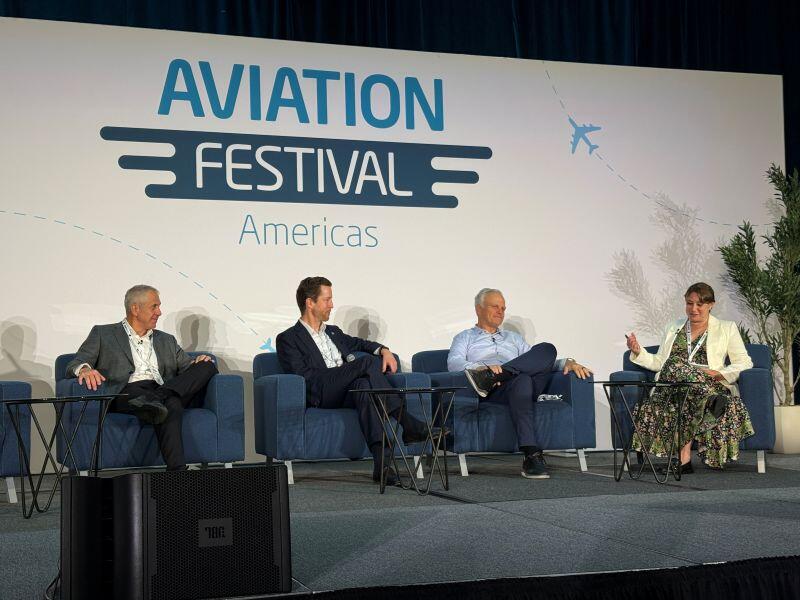
LATAM Airlines Group CEO Roberto Alvo; WestJet CEO Alexis von Hoensbroech; Breeze Airways CEO David Neeleman.
MIAMI—Airline top executives delivered a blunt message to engine OEMs during a panel discussion: make sure their products are technologically ready before they are delivered.
“I hope really that airframers refrain for a little while to bring new engines into new planes,” LATAM Airlines Group CEO Roberto Alvo said during a panel discussion with the heads of Breeze Airways and WestJet at the Aviation Festival Americas in Miami on June 3.
Their comments reflected industry concern over durability issues affecting next generation engines, including the CFM International LEAP, Pratt & Whitney geared turbofan (GTF) and Rolls-Royce engines, despite the fuel burn gains they deliver.
Alvo said airlines had become “the test beds of the technology altogether ... That’s simply not right.”
He added, “What I really hate about the situation is at the end of the day, it’s the customers who end up paying for this, because it disrupts our operation.” Newer engines burn “15% less fuel,” but he questioned whether the tradeoff was worthwhile if reliability continued to suffer.
“At the least, we have to pause and ask ourselves in the next round of technology, how to do it better?” Alvo said. “This new wave of technology has already been here 20 years, since the early 2000s, and we still have not solved the problem altogether.”
Alvo argued that the industry was approaching the practical limits of improvements in engine efficiency. “We’re getting to this point where the extra point efficiency is hard, it’s risky,” he said. “If we’re going to bring a new version of technology, it has to be much more reliable, much more dependable than what we’ve seen in the last 15 years.”
WestJet CEO Alexis von Hoensbroech described current engine challenges as “a fundamental reliability issue. The three of us can probably name the top three problems that a LEAP engine will have, or a Pratt & Whitney GTF will have. Right now, it’s easy to predict,” he said.
While praising the engineering advances behind the engines, von Hoensbroech said airlines were losing much of the fuel efficiency benefits through unplanned maintenance expense and operational disruption. “A lot of the fuel saving you actually pay through unplanned maintenance,” he said. “And AI will not solve it. This requires traditional engineering, re-engineering of the components, and development of industrial repair options.”
Von Hoensbroech also criticized the economics of the aftermarket business, arguing manufacturers profited from repair work tied to premature removals. “They produce a product, and then the product does not work the way it should,” he said. “Then they make money on repairing what does not work the way it should; so, it’s a great business model.”
He warned engine manufacturers risk damaging long-term airline relationships if repair costs and shop visit requirements continue escalating. “If the limits are tight, it forces you to bring an engine to the shop maybe earlier than it would be needed,” von Hoensbroech said. In some cases, he added, airlines were forced to replace components costing “$1.5 million” instead of performing repairs that could cost “$100,000.”
Still, von Hoensbroech acknowledged manufacturers understood the risks. He noted GE Aviation CEO Larry Culp recently invited him to address GE leadership directly about airline frustrations. “They are also aware that they need to put their customer into their focus,” von Hoensbroech said.
Breeze Airways CEO David Neeleman pointed to surging overhaul costs as another sign the engine market needed more competition. “I do not know what a CFM56 sold for new many years ago, probably $5 million or $6 million, and today to overhaul one is like $12 million,” Neeleman said. “Maybe it gives incentive for other [manufacturers] to come in at some point.”
After some 30 minutes discussing the topic, Neeleman closed with a line that drew laughter from the audience. “Can we change the subject?” he said. “I’m really depressed about engines.”