This article is published in Aviation Daily part of Aviation Week Intelligence Network (AWIN), and is complimentary through Dec 26, 2025. For information on becoming an AWIN Member to access more content like this, click here.
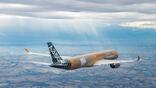
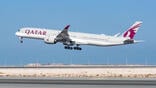
DUBAI—Airbus Commercial CEO Christian Scherer says the company could build a stretched version of the A350-1000 using a more powerful version of the Rolls-Royce Trent XWB-97 engine and is seeing increasing customer demand for such an aircraft.
“We are not prepared to launch the stretch yet,” Scherer tells Aviation Week on the sidelines of the Dubai Airshow, but several customers are “saying 'we want competition in the large capacity market.'”
“The A350 is an airplane that has the capability of being stretched,” Scherer continues. “People pretty much everywhere are talking to us [about it]. In the current market circumstances, there is a longing for larger aircraft.”
Airbus is currently looking at adding another four rows—or 40 seats—beyond what the A350-1000 can accommodate. “It is still flexible, it will be around that,” he says.
Emirates President Tim Clark has been the most vocal in demanding larger widebodies from both Boeing and Airbus. Clark believes it will be more difficult for Airbus to stretch the A350 further than for Boeing to do a 777-10 because Airbus would need a new engine.
But Scherer disagrees. “We have an engine that is certified and flies and an aircraft that flies and is certified,” he says, referring to the A350-1000 and the Rolls-Royce Trent XWB-97. “That is more than can be said about the 777X.”
Scherer adds that “the XWB-97 is an engine that is limited to 97,000 lb. of thrust. But it does not prevent the -1000 to be the longest-range aircraft in the world today.” He also refers to the upcoming upgrades of the engine that will bring it to “durability levels experienced by traditional engines in this region.”
He stresses that while the XWB-97 “may have the limitation in thrust-growth capability,” he does not see a loss of some range compared to the -1000 as a big problem. “If you stretch the engine and you are limited in thrust, then by definition you are going to lose some range. Is that a big deal? Not for the people we are talking to,” Scherer says. “We don’t need to fly from Auckland to London every day.”
Stretched Goals
Scherer did not say when Airbus might launch the aircraft. “We need to phase it in in terms of deployment of engineering resources. We have the [A350] ULR to finish, we have the freighter, the A220 stretch to do. But we can do it. We are not fundamentally resource constrained,” he says.
While talks about the larger A350 are picking up pace, the lengthened version of the A220 may come somewhat later than planned, Scherer hints. Airbus recently decided to reduce its monthly production target for the A220 to 12 aircraft per month in 2026, down from its previous growth goal of 14.
“There is no mechanical link [between the production decision and the launch date],” Scherer says. “Of course, it makes a decision a little bit more awkward if you push the break-even point of the program a little bit further to the right.” Airbus has said in the past that the A220 needs to be at 14 per month to break even. “Ideally you want to go to your shareholder and say, let me invest, the program is on an even keel,” Scherer says.
But the plan per se is not in doubt. “I am not concerned about A220 sales going forward, particularly when we have the stretch. A lot of our customers are saying I bought this airplane because it is great but if you do the stretch I have a growth path that Embraer cannot give us. Embraer is already smaller and less range but now we really differentiate ourselves in sales and escape from a dogfight with a cheaper, smaller airplane.”