This article is published in Aviation Week & Space Technology and is free to read until Sep 02, 2026. If you want to read more articles from this publication, please click the link to subscribe.
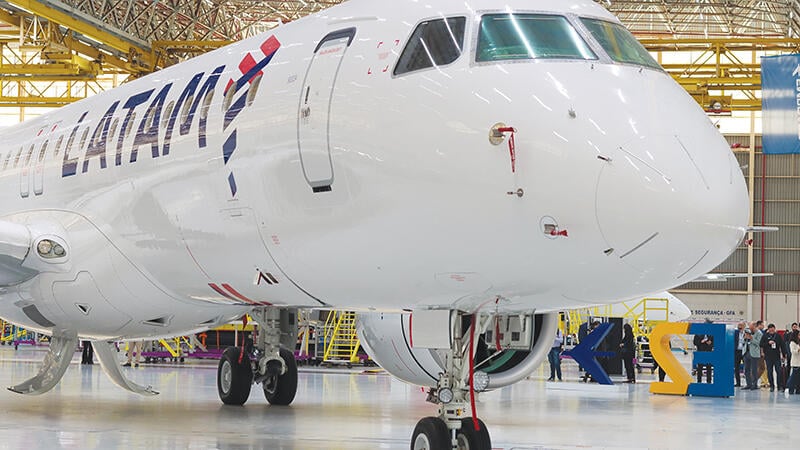
After years of trying to make strides in its home market, Embraer has made inroads with LATAM and Abra.
Just a year ago, Embraer’s prospects in its home region of Latin America were uncertain. Its only large Latin American customer, Azul, was cutting its E-Jet orderbook under Chapter 11 bankruptcy protection, and a rumored order from LATAM had yet to materialize.
But now Embraer has secured endorsements from South America’s largest airline groups—LATAM and Abra, both long-standing customers of Boeing and Airbus.
Although speculation grew late last year after LATAM’s order for 24 Embraer 195-E2s that its rival would have to respond, Abra would only publicly confirm that it was examining options to add smaller aircraft to its fleet.
- Abra’s first delivery is scheduled for late next year
- Will Embraer’s momentum in the region continue?
“It’s always a balance, right? Adding additional aircraft adds complexity,” Abra CEO Adrian Neuhauser said in December. Noting that the company was in no rush to add another type just to add capacity, he concluded: “Obviously, when we have news to announce there, we will.”
The news materialized during the recent Farnborough Airshow: Abra ordered 20 E195-E2s, with 10 purchase rights and 15 purchase options.
Given that Abra appeared to be in no hurry to order smaller jets, its commitment to E2s a few months later comes as a surprise. E1s “had much lower trip costs, but quite high seat costs,” Embraer Commercial Aviation CEO Arjan Meijer stated at the air show. That was just a more difficult proposition.” Now Abra is seeing what its “competitors are doing with the aircraft [E2s], and they see low trip costs and the very attractive seat costs,” he said.
Additionally, given the constraints in aircraft availability, perhaps now is the right time to place an order.
Abra’s first delivery is scheduled for late next year—a short timeline in today’s environment. “If you go to Airbus or Boeing and ask for 20 aircraft, you won’t get them next year,” Bloomberg Intelligence analyst Francois Duflot says.
In addition to availability, the E2’s size works well on routes that “either you want to open or test” or on which you want to increase frequency, he adds.
Abra, parent company of Avianca and GOL, has not disclosed which carrier will operate the new E-Jets, but Duflot raises the possibility that both could operate some of the aircraft.
GOL recently launched long-haul flights with an Airbus A330 widebody from Rio de Janeiro to New York's John F. Kennedy International Airport under a temporary wet-lease agreement with Wamos Air before its own A330-900s are delivered this year. Prior to the launch, GOL was an all-Boeing 737 operator. Now GOL lacks only a smaller aircraft, Duflot says.
In Avianca’s home market of Colombia, where it operates Airbus A320 narrowbodies, adding smaller aircraft on some routes to increase frequencies would make sense, Duflot says. Noting that Colombia’s market can be volatile, having flexibility to adjust capacity “is probably a good thing,” he adds.
After the order from Abra, Embraer’s 72 aircraft on order from operators in upper South America account for 26.6% of orders in the region, according to the CAPA - Centre for Aviation fleet database. Airbus’ 105 orders represent a 38.7% share, followed by Boeing’s 83 orders at 30.6%.
Now that Embraer has cemented slots in the orderbooks of Abra and LATAM, are there prospects for traction with other carriers in Latin America? Meijer said the E2’s attributes, including its hot-and-high performance and short-field capability with the Embraer Enhanced Takeoff System, “offers a lot of opportunities.”
But no obvious candidates are emerging. Aeromexico, which operates 34 Embraer 190s, has not shown any public interest in replacing those aircraft. Longtime customer Azul is keeping its orderbook at 25 E2s.
Perhaps the most realistic opportunity for Embraer is for either Abra or LATAM to exercise aircraft options. LATAM has options for 50 aircraft, and CEO Roberto Alvo explained in March that these allow it to expand its E-Jet subfleet. More recently, he declared: “What will happen to the options? We have not decided, but within our analyses, we are also considering some of the other countries where we have operations.”
LATAM is deploying its 24 E-Jets into the Brazilian market, but it also has franchises in Chile, Colombia, Ecuador and Peru. The company is expected to unveil initial E-Jet destinations soon and has said it plans to base the aircraft at Sao Paulo-Guarulhos International Airport, Brasilia, and Fortaleza in Brazil.
Alvo has highlighted that South America has 200 cities with 200,000-500,000 residents, and half are in the region’s largest aviation market: Brazil. Those destinations have 1/10th the trips per capita of the continent’s larger cities, he added.
For now, LATAM’s main focus is introducing its new E2s to Brazil’s domestic market during the fourth quarter. “We will be able to open new domestic routes, increase frequencies and offer more alternatives for people to travel within the country,” Alvo said.
Embraer, meanwhile, continues to celebrate its achievements. “We have had a very successful run with the E2 since early 2025,” Meijer said.